The technical writing process: 4 stages, 10–14 days, zero missed deadlines
How Hackmamba runs a technical writing process that takes content from brief to client handoff in 10–14 days. The exact stages, tools, owners, and review passes we use.

The technical writing process is the sequence of steps a writer or content team follows to take a topic from research to a finished, published document. It includes audience analysis, brief or outline creation, drafting, technical review, editing, and publication. For teams producing developer-focused content, the process also involves validating technical accuracy, ensuring code examples work, and aligning the content with both search intent and product goals.
Most technical writing processes break in the same places. It shows up as a brief that was never aligned, or as a draft that bounces between a writer and a reviewer four times. We know this because we lived it before we fixed it.
Now, the timeline from brief creation to client handoff takes us 10 to 14 days. Below, we document the exact technical writing workflow we use, what happens at each stage, who owns it, where AI does real work, and why we built it the way we did.
If you are evaluating whether to outsource your technical content or formalize your own writing process, this is a window into what a tight, repeatable operation looks like in practice.
TL;DR
Hackmamba follows a 4-stage technical writing process: brief creation, drafting, content marketing review, and client review. The full cycle takes 10 to 14 days. We use Boki, our content operations platform, to bring the workflow together and cut what used to be a 3-week process nearly in half. Every stage is human-in-the-loop. AI accelerates the work, but we decide what ships.
The 4 stages of the technical writing process
Stage 1: audience analysis and brief creation (8-12 hours)
The brief is one of the most important documents in our content process. If the brief is weak, everything downstream becomes harder. Writers make assumptions, reviewers spend time correcting direction instead of refining ideas, and the final content often misses the audience or search intent it was meant to address.
Every brief starts from a structured framework. For technical writers who want to understand what goes into a high-quality brief, a guide to creating a content brief for technical writers breaks down the components, format, and planning process that reduce revision cycles and improve content quality.
Once we onboard a client and align on business goals, we begin with keyword research, audience analysis, and topic selection. We use tools such as Claude Skills, Perplexity, and Ahrefs to analyze search intent, review competing content, identify content gaps, and understand how a topic is currently being covered across the web.
From there, we define the target audience, determine the stage of the journey the content should address, and decide on the format most likely to satisfy search intent. In many cases, the decision is not simply what to write about, but whether the topic requires a tutorial, comparison, implementation guide, documentation page, case study, or opinion piece.
This process gives writers the context they need before drafting begins. What previously required several days of manual research can now be completed in 8-12 hours, allowing more time to focus on content quality, technical accuracy, and original insights.
I use Claude for brief layout and content reviews, as it handles long content very well and follows complex, multi-part instructions more reliably than other models. I also use Perplexity for sources research. Ahrefs integrations with LLM models is also great to speed up keyword research. — Rocio Berardo, Growth specialist and content marketer at Hackmamba
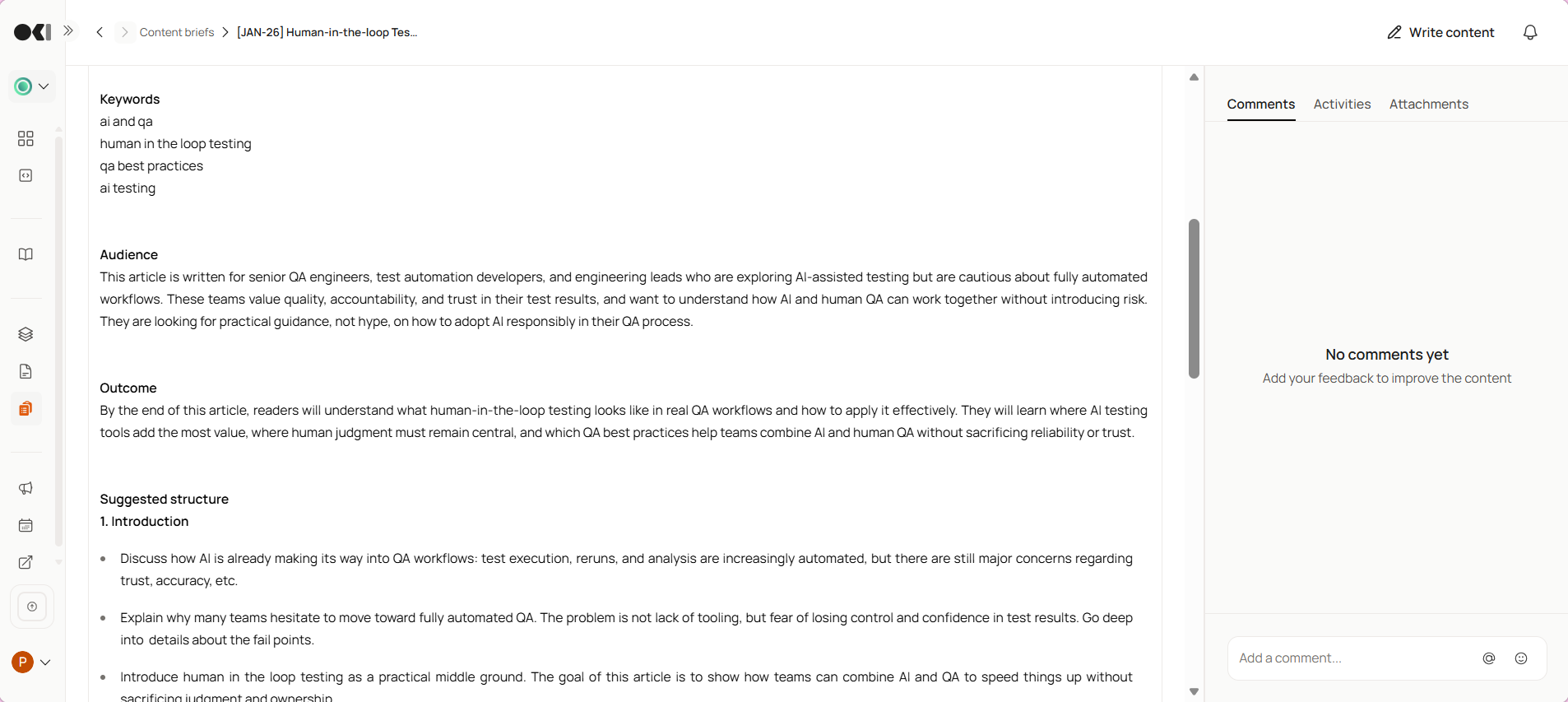
From that research, we build the brief using our internally developed content brief templates refined through years of collective content marketing experience across devtools and SaaS products. These templates encode the decisions we keep getting right: how to frame the objective, how to document the product angle so the content ties back to a business outcome, and how to structure the SEO and AEO requirements.



Inside Endform's 4x search growth
How Endform doubled site visitors and grew google search traffic close to 4x in four months
Read the case study
A finished Hackmamba brief includes the target keywords, audience overview, search intent, an outline with the argument each section needs to make, and the success criteria for the piece.
80% of the time, our clients approve the briefs on first review because we surface product angles they had not considered.
Why this stage matters: A brief forces us to ask, "What is the purpose of this content?" Targeting keywords is great, but what matters more is what product behavior the article drives and what success looks like after reading. If you cannot answer those questions in the brief, you cannot answer them in the article.
We have also documented our process for SEO for developer tools — check it out.
Stage 2: outlining and drafting (5-7 days)
Once the brief is approved, the next step is outlining. Before drafting begins, writers create a structure that maps the flow of the article, the key arguments, and the information needed to satisfy both the audience and the search intent. The how to create a technical content outline guide covers our five-step outlining process, from reviewing the brief and selecting a writing framework to organizing headings in a logical sequence.
After the outline is approved, the project moves to one of our technical writers. We intentionally work with writers who have hands-on experience building software because developer audiences quickly recognize content written without practical understanding of the technology.
The approved brief serves as the foundation for the article. Writers may use AI tools to support research, ideation, or early drafting, but editorial decisions remain firmly in human hands. Every article is reviewed, refined, and shaped by a technical writer who is responsible for the final output.
This approach allows us to combine the efficiency of modern tools with the judgment, experience, and technical depth required to create credible content. Our writers work closely with subject matter experts, product teams, documentation, and primary sources to ensure the content is accurate, useful, and grounded in real-world implementation experience.
The result is content that feels authentic to developers because it is informed by practitioners, not generated from prompts alone.
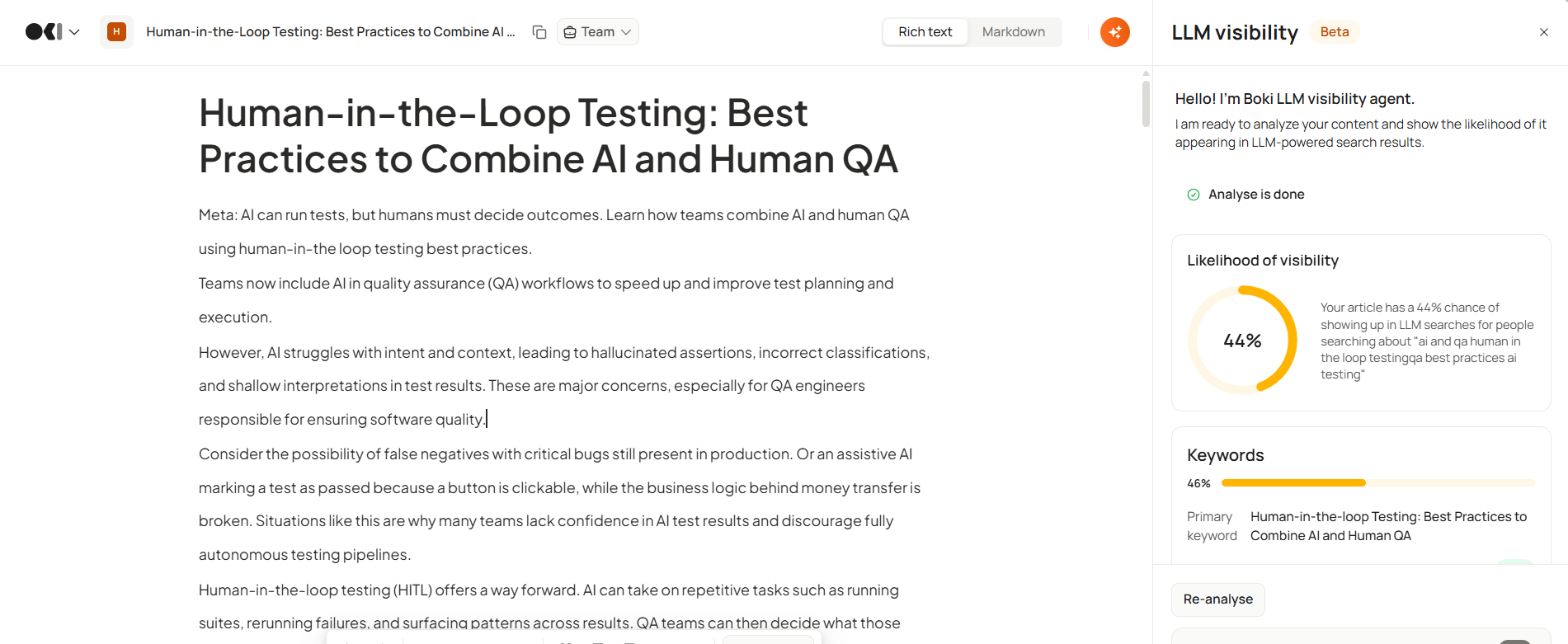
The draft goes through our internal design team for any supporting illustrations or workflow images the piece needs. We also run each piece through SurferSEO and Boki's LLM visibility agent to ensure we are covering the topic with the depth and breadth that search engines and AI search tools expect.
What we do not do: We do not use AI-generated drafts as final deliverables. AI helps our writers with research, analysis, and workflow efficiency, but the structure, arguments, technical accuracy, and final editorial decisions remain the responsibility of a human writer. The AI tools we use and where they fit into the writing process are covered in the AI tools technical writers use.
Stage 3: content marketing review (3 days)
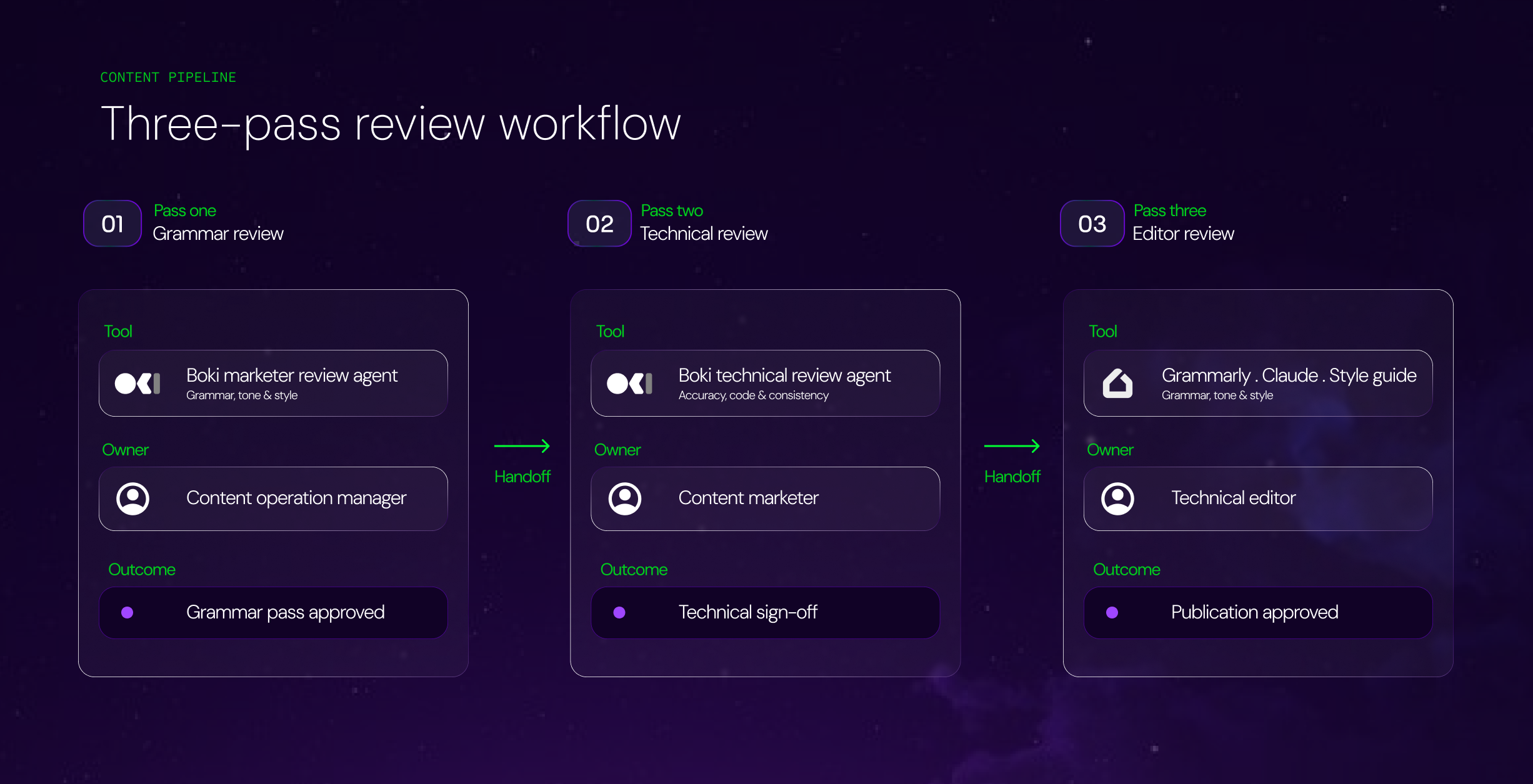
Our content marketing review has three distinct passes, and skipping any of them creates problems that are expensive to fix later.
Grammar review
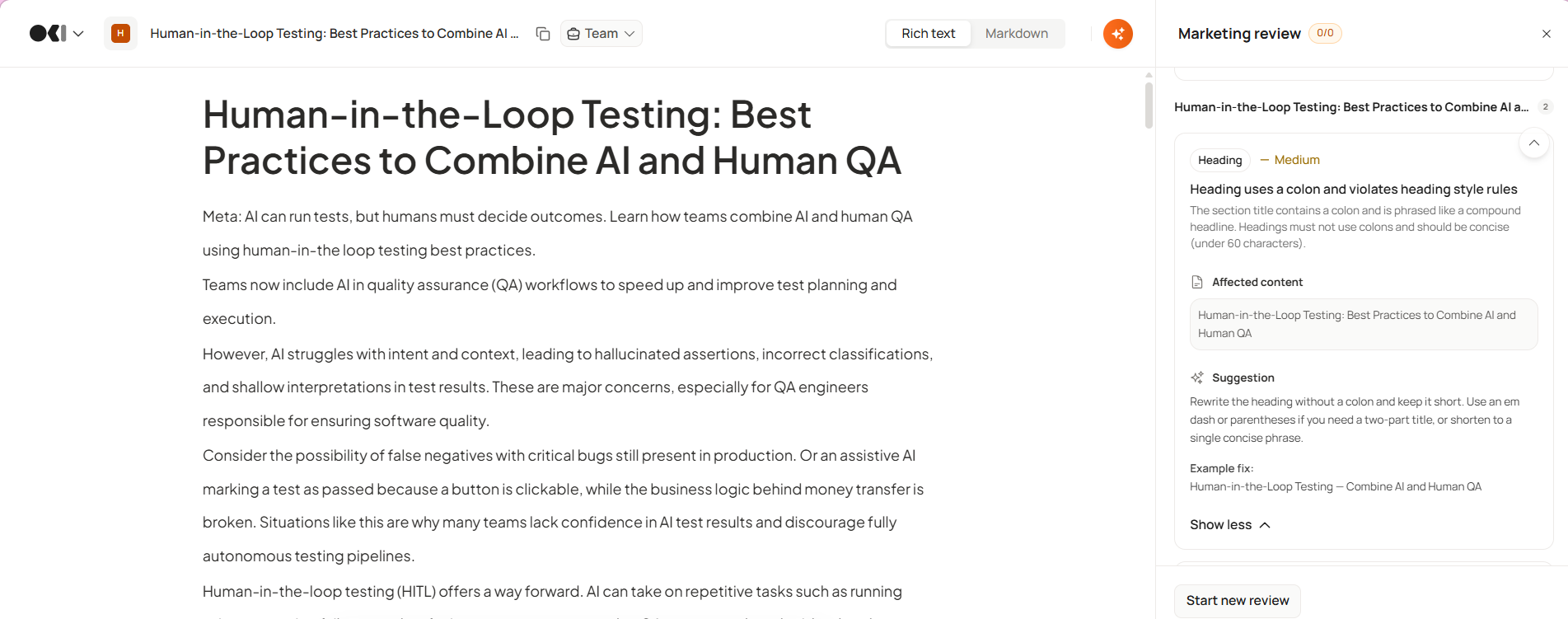
We use Boki's marketer review agent to spell-check and catch anything that may disrupt the reading experience, including sentence-level clarity issues and structural problems, with specific suggestions. Our content operations manager reviews every flag and decides what stays and what changes. Human judgment is always at the center of our technical writing workflow.
Technical review
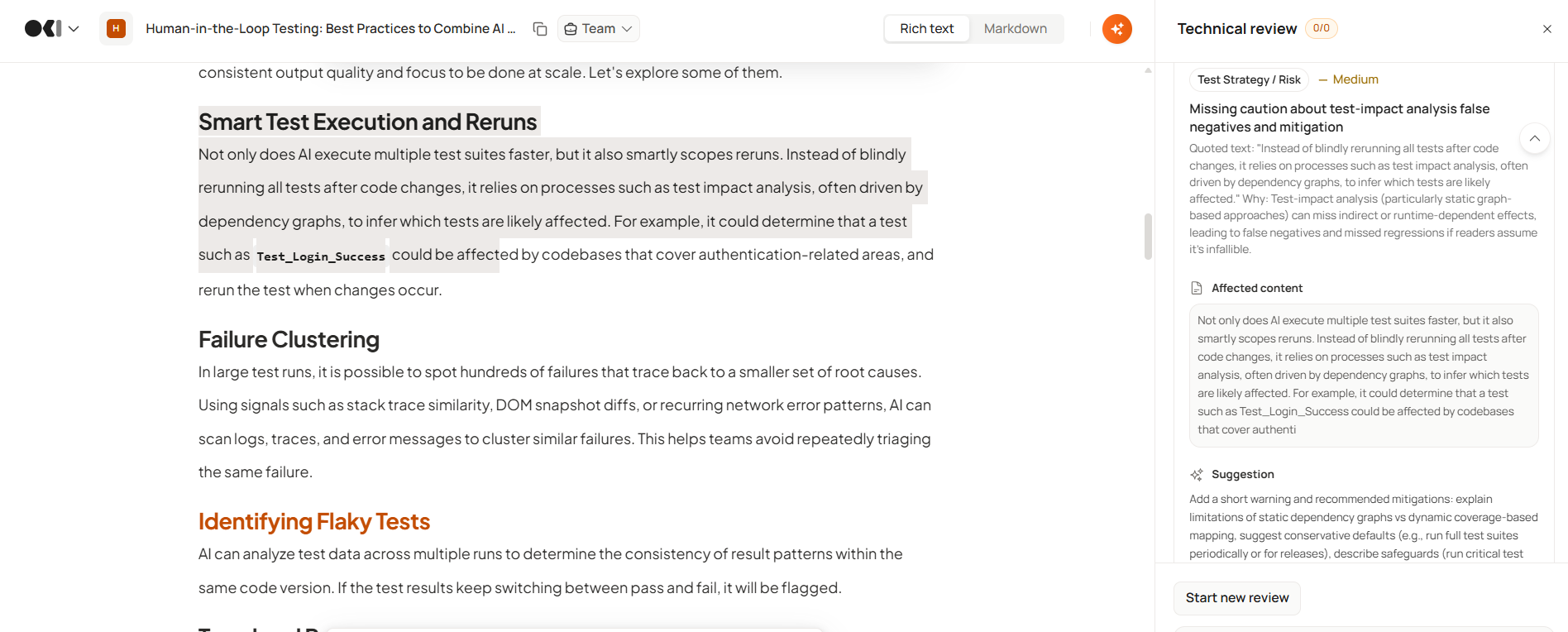
This is the review process most content teams skip entirely or rely on an overextended engineering team to catch problems before publication. Our technical review highlights errors in code logic, flags sections that lack sufficient depth, and identifies anything that undermines the piece's technical credibility.
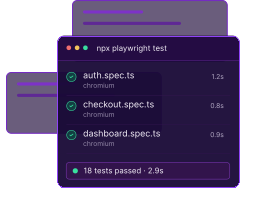
We use Boki's technical review agent for the first half of this review. It audits technical terms for accuracy, validates that sources back every claim, checks code behavior, and flags anywhere the piece loses coherence as a technical argument. Using Boki for technical reviews has cut our writers' back-and-forth with human content marketers by nearly 65%. Every round of revision that Boki catches before a human sees the draft is time saved on both sides.
Our content marketers focus on the parts of the process that require human judgment. They test code, verify technical accuracy, evaluate structure and flow, and ensure the content aligns with the client's goals and the expectations of the target audience.
When I review technical articles, I'm checking across four layers. First, technical accuracy: are the claims, terminology, and any code or commands actually correct and current? Second, clarity and flow: I look for repetition, filler, and anything that slows the reader down. Third, structure: does the piece have a clear argument and central takeaway? And fourth, SEO. — Rocio Berardo, Growth Specialist and Content Marketer at Hackmamba
Once content passes technical review, differentiation becomes the next priority. The how to create differentiated SEO content guide explains the positioning and angle framework we use to help technical content stand out in competitive search results.
Editor review and proofreading
The final pass under content marketing is our technical editor. At this point, the content has undergone grammar and technical review. The editor's job is to catch anything that slipped through, including grammatical errors, sentences that do not land, and transitions that break the flow. This is the last human checkpoint before the content goes to the client.
As a technical editor, I make sure that the language is clear and concise. I also double check everything against the Hackmamba (or the client's) style guide so that the spelling, grammar, and other conventions are consistent. Finally, I proofread for any typos or errors in the piece before it goes on to the final review stage. — Stella Clymer, Technical Editor at Hackmamba
These three content marketing reviews are how we consistently deliver work that gets feedback like this:
Hackmamba creates high-quality technical and SEO content matching our editorial plan, and multiplying of our internal content production. They never miss a deadline and are proactive in suggesting new ways of optimizing the process and exceed expectations. It's exactly what we needed. — Paolo Martinoli, DevRel at Contoso
"Start writing" is not a technical writing workflow. Every process, from idea generation to reviews, requires careful planning.
Stage 4: client review
When content leaves our review pipeline, it goes to the client through the designated Boki workspace. The client drops their comments directly on the piece and the assigned technical writer responds within 24 hours.
We ask clients to share feedback within 3 to 5 working days of receiving the article. That window keeps revision cycles from dragging into weeks. If we do not hear back, our content operations manager follows up to align on a realistic timeline.
When a technical writer addresses the feedback, our content operations manager reviews the changes. In cases where the edits touch technical claims, our content marketer steps in for a quick sign-off before we notify the client.
70% of the time, our clients approve articles on first submission because the brief did its job. But when feedback does come in, one revision cycle covers it, so neither side is managing a thread of back-and-forth comments across multiple versions. A content process that requires rounds of client revision is a sign that something upstream broke down. It is either that the brief missed the mark, the draft diverged from it, or the review process did not catch what it should have.
The full picture
The cycle between brief creation and editor review takes 10 to 14 days. Before we built this process and integrated Boki into it, the same cycle took closer to three weeks and produced more revision rounds.
| Stage | Owner | Tools | Time spent |
|---|---|---|---|
| Audience analysis and brief creation | Content manager | Boki's marketing AI agent; Claude Skills and Perplexity; internal content brief template | 8-12 hours |
| Drafting | Technical writer + design team | SurferSEO integration and Claude augment the creation process | 5-7 days |
| Grammar review | Content operations manager + Boki | Marketing agent flags sentence and clarity issues | 3-4 hours |
| Technical review | Boki + human content marketer | Boki's technical agent catches code errors; Claude | 12-24 hours |
| Editor review and proofreading | Technical editor | Grammarly, Claude, internal editing checklist | 12-24 hours |
| Client review | Client | - | Subjective |
We have used the same technical writing process to produce content for Cloudinary, Flutterwave, Currents, and Roadmap.sh. The output is different across clients, but the system remains the same.
How to audit your technical writing workflow
Use our process as a benchmark for your own workflow. Here are the three questions you should answer with your team today.
How long does your current process take? Map out how much time your team spends on briefing, writing, and reviews. Compare that to our 10-14-day cycle above. Your time might be going into revision loops that could be caught earlier with our three-pass content marketing review process.
How do you ensure depth and accuracy? If you are using AI for drafting, a human needs to improve it with examples and technical depth. An AI draft should never be the final output. If your current review process is a single pass by a content manager who lacks niche knowledge, you are publishing content that developers will not trust.
Do you have a human-in-the-loop? AI augments a strong process, but it does not replace the human judgment that makes content credible and memorable. Your content manager should still oversee technical content operations from start to finish.
Our technical writing process supports content beyond technical articles, including technical documentation and user manuals. Adjust the stages to fit your output, and the process still holds.
A repeatable process is the product
If you have read this far, you are probably trying to improve an existing content marketing process, evaluate how your team operates today, or decide whether it makes sense to bring in external support.
Start by identifying the bottleneck. Is research taking too long? Are briefs inconsistent? Are writers spending too much time on revisions? Is technical review a recurring problem? Small improvements at the weakest stage often have the biggest impact on the overall cycle time.
For teams comparing hiring options, how and where to hire a technical writer breaks down the costs, trade-offs, and responsibilities of full-time hires, freelancers, and agencies.
For teams that want an experienced partner to own the process end to end, Hackmamba helps SaaS and developer-first companies create technical content, documentation, SEO programs, and developer education assets that support adoption and growth. If you would like to see how we would approach your content operations, book a call with us.
FAQs
1, What is the technical writing process?
The technical writing process is the structured sequence of steps used to produce a finished technical document, from audience analysis and research through drafting, review, and publication. A strong technical writing process includes a brief or outline stage before drafting begins, multiple review passes covering grammar, technical accuracy, and editorial quality, and a defined handoff to the client or publishing team. At Hackmamba, our process runs across four stages and takes 10 to 14 days from brief to client handoff.
2, What are the stages of the technical writing process?
We follow four stages: brief creation (audience analysis, keyword research, outline), drafting (outlining, writing, design support, SEO optimization), content marketing review (three passes covering grammar, technical accuracy, and editorial quality), and client review. Each stage feeds the next. The brief defines the draft; the review protects the draft; the client review validates it.
3, What is a content brief in technical writing?
A content brief is the document that provides the structure and direction needed to produce an authentic article. At Hackmamba, it includes the target keyword, audience overview, search intent, section outline with the argument each section needs to make, product angle, and success criteria. 80% of our briefs are approved on first review because we surface product angles clients had not considered.
4, How do you review technical content for accuracy?
We use a two-pass technical review: first through Boki's technical review agent, which catches code errors and depth issues automatically, and then through a human content marketer who evaluates the content against engineering standards, technical correctness, and narrative coherence. Using Boki for the first pass has cut writer-to-reviewer back-and-forth by nearly 65%.
5, What tools do technical writing teams use?
At Hackmamba, we use Boki for content operations (brief creation, marketer review, technical review, and client handoff), Claude for brief layout and long-form content reviews, Perplexity for source research, Ahrefs for keyword research, and SurferSEO for on-page optimization during drafting. The principle: AI handles the automatable parts, human judgment handles everything that requires context and expertise.
6, How long should the technical writing process take?
A well-structured technical writing process for a single article should take 10 to 14 days end to end, including brief creation, drafting, review, and client approval. Longer cycles are usually a sign that the brief was not aligned before drafting started, or that review is happening in a single pass instead of multiple focused passes. Before Hackmamba formalized this process, the same cycle took closer to three weeks.
7, What is the difference between technical writing and content writing?
Technical writing produces documentation, guides, and instructional content for an audience that needs to accomplish a specific task, often with a technical product. The priority is accuracy, clarity, and completeness. Content writing produces articles, blog posts, and thought leadership aimed at awareness, engagement, or search visibility. The two overlap when the content requires technical depth, as with developer tutorials, API explainers, and SaaS product documentation. Hackmamba produces both, using the same four-stage process with the review emphasis adjusted based on the output type.
About author
Technical content writer and storyteller for AI-first companies. I use storytelling to write content that educates, builds trust, and drives adoption











.svg)