PPC for developer tools: the complete playbook
Learn how to budget for PPC, choose the right channels, benchmark cost per developer sign-up, set up attribution, and report revenue from developer marketing campaigns.

The one thing that changed how I think about developer marketing, not just PPC but any channel, is understanding where a developer sits before you decide how to reach them.
Developers move through five stages before they adopt a tool. They start unaware that a problem exists. Something then goes wrong in production, a pipeline breaks, performance degrades, and they become aware of a bottleneck. They start looking around and become aware that solutions exist. They find specific products and begin evaluating. Then they are ready to adopt.
The image below shows what that journey looks like.
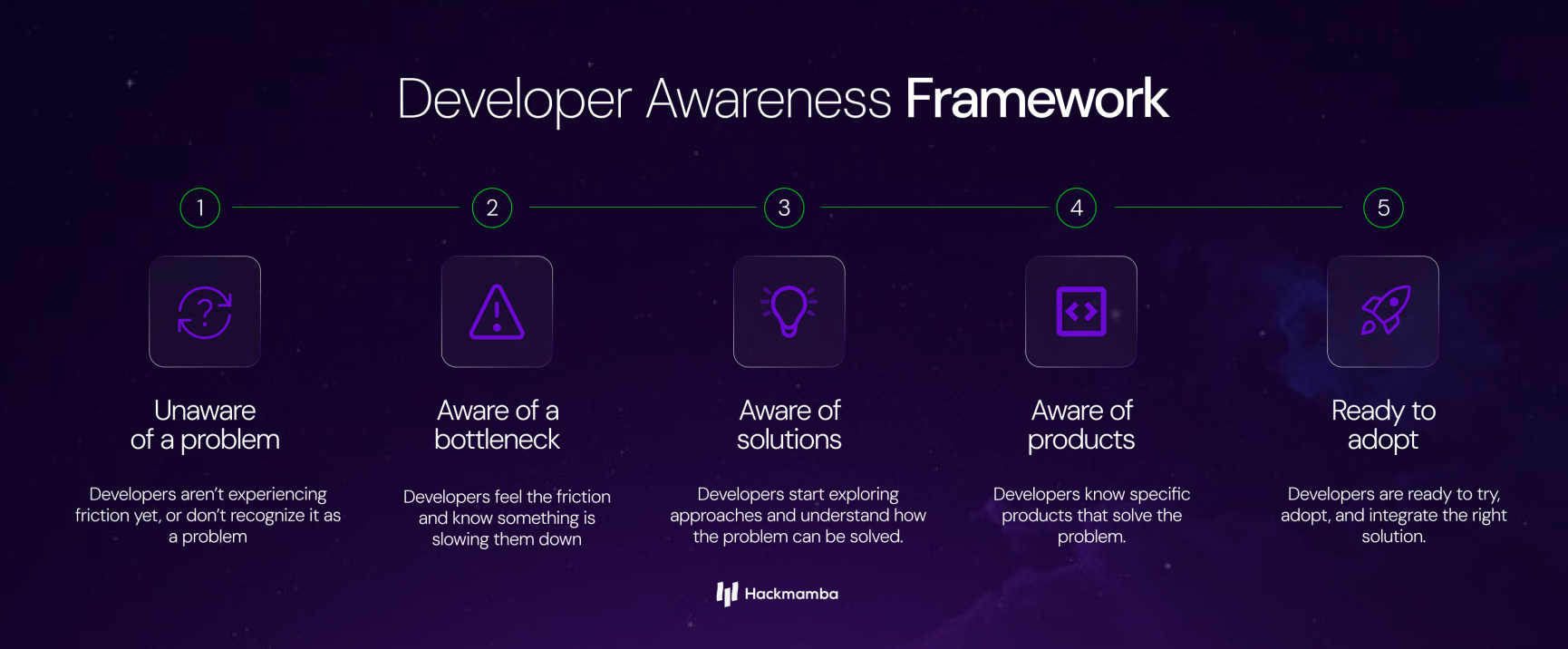
Every decision we make, which channel to run, what to say in the creative, how much to spend, what to measure, starts here. A developer at stage 1 (unaware of a problem) is not searching on Google yet but a developer at stage three (aware of solutions) is. The channel follows from where they are.
Here is what this guide covers:
- The developer awareness framework - the five stages every developer moves through before adopting a tool, and why every channel decision in this guide starts here
- Whether PPC makes sense for your product and how to size the budget - the ACV sustainability check, how we reverse engineer budget from a sign-up or pipeline target, and what fraction of that target paid media should drive
- Which channel to run and when - how the awareness framework maps to channel selection, what each channel actually does for devtools, and the right channel stack for four different devtool personas
- What acquisition costs look like by category and channel - CPC ranges across 12 devtools categories on Google Search for the US and EU, LinkedIn costs by persona derived from Campaign Manager forecasting data, and Reddit costs by subreddit category anchored to our own campaign data
- How to set up attribution before you spend a dollar - CRM integration, activation tracking as the conversion event for PLG devtools, and UTM naming across every channel
- How we track spend and report back to revenue - spend tracking cycles, the revenue attribution workflow that maps each channel back to paying customers and LTV, and the four numbers we review by channel
- ChatGPT Ads - what we know so far and why we are not running it yet
If you have not read it yet, I also put together a full guide on SEO for developer tools that covers the organic side of things. PPC and SEO compound well together.
Let’s get started.
The developer awareness framework
I want to take a few minutes to walk through this framework before we get into channels and budgets, because everything else in this guide builds on it. If you skip this section, the channel decisions we make later will not make sense.
This framework is based on our own proprietary framework called Developer Adoption Architecture.
Developers do not discover tools the way other buyers discover software. They hit a problem first. They look for answers in communities. They find a category. They evaluate products on their own terms. By the time they talk to anyone at your company, the decision is mostly made.




Inside the launch of VectorAI DB
How Actian positioned VectorAI DB for developers and drove adoption from day one
Read the case study
That journey has five stages.
Unaware of a problem. The developer does not know they have a pain worth solving yet. No intent-based paid channel reaches a developer at this stage because there is no search query to capture. Google Search does not work here. What works at this stage is discovery-based channels such as Reddit and YouTube, where the developer encounters the problem framing without actively looking for it. Word of mouth and developer relations work alongside this over time.
Aware of a bottleneck. Something broke or slowed down enough to be noticed. Deploys are taking too long. The database is timing out under load. Vector search results are returning irrelevant matches. The developer knows the pain but has not connected it to a solution category yet. They are not searching on Google because they do not know what to search for, so they are describing the problem to colleagues or posting in a Reddit thread.
Aware of solutions. The developer now knows a category of tools exists that addresses their problem. They start searching for terms like "best vector database for RAG," "Kubernetes monitoring tool," or "API gateway comparison," which is where Google Search captures them.
Aware of products. The developer knows your product exists. They have been to your site, read your documentation, and possibly started a free trial, but they have not committed yet because they are still evaluating. Remarketing, LinkedIn, and Meta reach them at this stage.
Ready to adopt. The developer has made up their mind. They are back on Google searching your brand name, checking competitor alternatives, and going through your pricing page. Google Search on brand and competitor terms and remarketing to warm audiences are the right channels here. If the purchase requires sign-off from an engineering leader, LinkedIn reaches that decision maker, but the developer themselves is already past needing to be convinced.
Each stage represents a different developer mindset, and the channel you run, the creative you write, and what you measure all change depending on which stage you are targeting.
Every channel decision in the rest of this guide references back to this framework.
How much budget do you need before you start
Before answering this, the first question is whether you should be running PPC at all.
Most developer tools run a product-led growth motion. A developer signs up for free, uses the product, and upgrades when they hit a limit or need a feature on a paid plan. PPC feeds that funnel by getting qualified developers to sign up. As deal sizes grow and companies start selling to engineering teams and organizations, sales gets involved and PPC shifts to driving qualified conversations into a sales process.
For both motions, the acquisition cost of a customer through paid media has to make business sense. A healthy developer tool business targets a 3:1 LTV to CAC ratio. If your maximum sustainable CAC is below what paid acquisition costs on any channel, PPC is not the right move yet. Fix the pricing or grow through organic and community first.
| Monthly revenue per customer | Estimated max CAC (3:1 LTV:CAC, ~24–36 month retention) |
|---|---|
| $20–$50 | $160–$600 |
| $100–$200 | $800–$2,400 |
| $500 | $4,000–$6,000 |
| $1,000–$2,000 | $8,000–$24,000 |
| $5,000+ | $40,000+ |
Once you know PPC makes sense, the budget comes from your sign-up or pipeline target
The budget is not a number you decide upfront. It is the output of a reverse engineering calculation. The input to that calculation is not revenue. Revenue is the lagging indicator. By the time it shows up, the campaign decisions that produced it are weeks or months old.
For a PLG motion, the input is your sign-up target. How many qualified developers do you want entering the free tier from paid media this month. For a sales-assisted motion, the input is your pipeline target. How much qualified pipeline do you want PPC to contribute to the sales process this quarter. Both are numbers you can measure and optimise toward in real time.
Not all of your sign-ups or pipeline will come from PPC. Organic search, community, socials contribute alongside it. Decide what fraction of your sign-up or pipeline target you expect PPC to drive before running the calculation. A reasonable starting point is 20 to 30 percent. If you have a strong organic and community engine already running, PPC may only need to contribute 15 to 20 percent.
To complete this calculation you need one number: your cost per sign-up on the channel you are running. If you have run campaigns before, use your historical data. If you are starting fresh, we cover what acquisition costs look like by devtools category and channel in the cost benchmarks section below. Come back to this formula once you have that number.
Here is what the calculation looks like for a PLG devtool once you have it.
Assume, your monthly sign-up target is 1,000 qualified developers. You expect PPC to drive 25 percent of that, which is 250 sign-ups. Your cost per sign-up on Google Search is $80. Your required monthly PPC budget is $20,000.
From those 250 sign-ups, if your free-to-paid conversion rate is 20 percent, PPC produces 50 paying customers. At $500 average revenue per customer, that is $25,000 in new monthly recurring revenue. from PPC. Now you have a number you can defend to a board or a CFO.
For a sales-assisted motion, replace the sign-up target with a pipeline target and factor the sales cost into the CAC calculation alongside the ad spend.
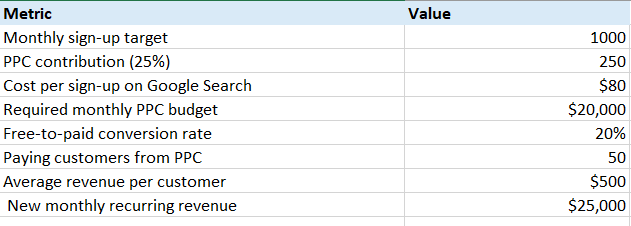
As you can see in the screenshot above, the number becomes concrete quickly. If the calculation shows you need $20,000 per month and you have $5,000 available, you either reduce the sign-up contribution you expect from PPC, extend the timeline, or accept a proportionally smaller result.
Once you have a budget, the next question is which channel to put it behind.
How do you choose the right PPC channel for devtools?
With a budget confirmed, the question is where to put it. The answer depends on two things: where your audience sits on the awareness framework and whether you are running a PLG or sales led motion.
The table below maps your situation to the right channel stack.
| Situation | Primary channels | Secondary channels |
|---|---|---|
| Early stage PLG, new category, low search volume | Google Remarketing once traffic builds | |
| Early stage PLG, established category, search volume exists | Google Search, Google Remarketing | Reddit for demand creation |
| Growth stage PLG, established category | Google Search, Google Remarketing, Reddit | LinkedIn retargeting, Meta lookalike audiences |
| Enterprise devtools with a sales motion | Google Search, Google Remarketing, LinkedIn cold acquisition | Meta ABM, YouTube |
Google search ads is purely a demand capture channel. A developer typing "best vector database for RAG" or "kubernetes monitoring tool" is solution aware or product aware and ready to evaluate. If your category has no search volume yet, Google search is not your first move; you need to create demand first. We have put together a do and don’t in search ads for developer marketers, check it out.
Google Remarketing is the highest-performing channel we have run for developer tools. For a vector database client with an ACV of $8,400, we saw CPCs below $0.50 and a cost per developer sign-up of under $70. A developer who visited your pricing page or started a trial is already product aware. Remarketing closes the loop on someone who was already close to deciding.
Reddit ads is a demand creation channel. It reaches developers before they start searching, including developers who do not yet know they have a problem and developers who know the pain but have not connected it to a solution category yet. A Promoted Post in the right subreddit can surface a problem a developer had not put a name to, or validate one they were already feeling. The creative has to read like it belongs in the feed. A post titled "How we reduced Kubernetes alert noise by 80%" works because it opens with the problem. We have also seen meme-style ads perform well on Reddit for developer tools. A meme that captures a recognisable developer pain point stops the scroll because it reads like something a fellow engineer posted. Reddit CPCs in developer subreddits run $3.50 to $6.00 in the US..
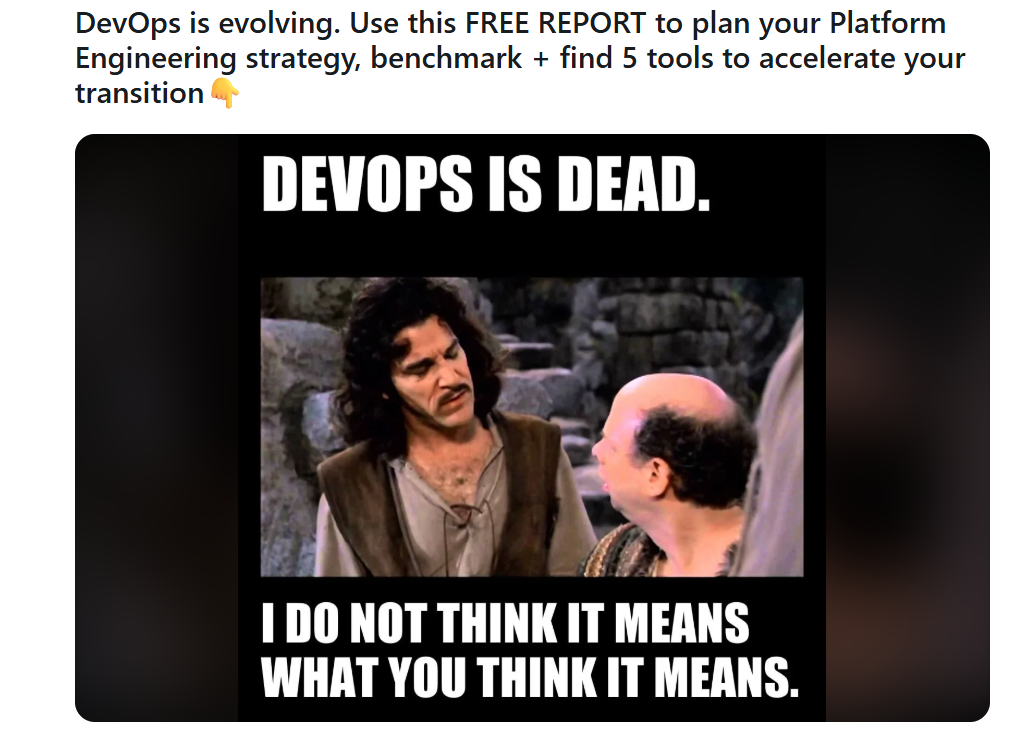
YouTube ads reaches developers while they are watching tutorials and comparison videos before they search. Across campaigns we have run for a vector database client and a developer security client, CPV averaged $0.18 to $0.40 in the US for targeted developer audiences. It works best for developer tools with strong tutorial-style content or a product that benefits from being seen in action.
LinkedIn ads for PLG is a retargeting and nurture channel. We use it to reach developers who visited the product but did not convert, and engineering leaders who need to approve the purchase. At $9 to $12 CPC in the US, cold individual developer acquisition on LinkedIn is too expensive for most PLG motions. For enterprise, LinkedIn cold acquisition makes sense through job title, seniority, company size, and industry targeting. A Head of Platform at a 500-person fintech company is reachable with that combination. Thought Leader Ads from a founder or senior engineer generate stronger engagement than branded Sponsored Posts for devtools audiences because developers respond to practitioners.
Meta ads works in three specific ways for developer tools. First, retargeting. A developer who visited your pricing page will see your brand again on Facebook or Instagram alongside Google Remarketing. Meta retargeting CPM is lower than LinkedIn, making it cost-effective for staying visible to a warm audience over a longer consideration period. Second, lookalike audiences built from your best activated developers for cold acquisition. This is a later-stage play that requires enough first-party data to build a meaningful seed audience. Third, account-based marketing through company list uploads for enterprise, keeping you visible to a buying committee across a long sales cycle.
Note: Paid acquisition is only one part of the developer growth equation. The strongest devtools companies combine paid channels with long-term acquisition engines such as content, documentation, SEO, developer communities, GitHub, Reddit, Stack Overflow, and DevRel programs. The developer marketing channels guide explores how these channels work together across different stages of the developer journey.
For a broader view of how acquisition channels fit into product-led and sales-led growth motions, the developer-led GTM strategy guide covers channel selection, intent signals, and go-to-market execution in detail.
What does it actually cost to acquire a developer through PPC
Before you commit budget to any channel, you need a realistic expectation of what acquisition costs look like in your specific category. The estimates below cover Google Search, LinkedIn, and Reddit.
Note: These numbers are based on our learnings and ad data from Google Ads, LinkedIn Ads, and Reddit Ads, cross-referenced against published third-party data. Actual costs in your campaigns will vary based on creative quality, keyword or subreddit selection, landing page conversion rate, and how competitive your category is at the time you run. Treat them as a starting point.
Google Ads
Methodology
Average CPC = (CPC min + CPC max) / 2 averaged across high-intent keywords in each category from Google Keyword Planner. Outliers above $40 US / $30 EU are removed. Cost per sign-up = average CPC divided by landing page CVR across three scenarios: 3% (conservative), 6% (realistic for a well-built devtool landing page with a free trial), and 8% (achievable with a strong offer and an optimised page). Cost per activated developer assumes 60% of sign-ups activate.
Google ads - US
| Category | Avg CPC range | Cost per sign-up (3% CVR) | Cost per sign-up (6% CVR) | Cost per sign-up (8% CVR) | Cost per activated developer (6% CVR) |
|---|---|---|---|---|---|
| Developer Databases | $3.50–$16.24 | ~$329 | ~$164 | ~$123 | ~$274 |
| AI / Vector Databases | $3.03–$18.19 | ~$354 | ~$177 | ~$133 | ~$295 |
| Authentication / Identity | $2.94–$18.32 | ~$354 | ~$177 | ~$133 | ~$295 |
| AI/ML Infrastructure | $2.62–$18.43 | ~$351 | ~$175 | ~$132 | ~$292 |
| Feature Flags / Experimentation | $5.64–$22.53 | ~$469 | ~$235 | ~$176 | ~$392 |
| CI/CD / DevOps | $6.42–$22.60 | ~$484 | ~$242 | ~$181 | ~$403 |
| Search Infrastructure | $3.67–$23.62 | ~$455 | ~$228 | ~$171 | ~$380 |
| Error Monitoring / Crash Reporting | $6.73–$25.67 | ~$540 | ~$270 | ~$202 | ~$450 |
| Observability / Monitoring | $3.93–$28.84 | ~$546 | ~$273 | ~$205 | ~$455 |
| Data Engineering / Pipelines | $5.28–$27.64 | ~$549 | ~$274 | ~$206 | ~$457 |
| Cloud Security / DevSecOps | $5.90–$30.23 | ~$602 | ~$301 | ~$226 | ~$502 |
| API Management | $6.11–$35.81 | ~$699 | ~$349 | ~$262 | ~$582 |
Google Search - EU
EU CPCs run 35 to 60% lower than US across all categories.
| Category | Avg CPC range | Cost per sign-up (3% CVR) | Cost per sign-up (6% CVR) | Cost per sign-up (8% CVR) | Cost per activated developer (6% CVR) |
|---|---|---|---|---|---|
| Error Monitoring / Crash Reporting | $2.07–$4.47 | ~$109 | ~$54 | ~$41 | ~$90 |
| AI/ML Infrastructure | $1.18–$5.52 | ~$112 | ~$56 | ~$42 | ~$93 |
| Search Infrastructure | $0.93–$5.66 | ~$110 | ~$55 | ~$41 | ~$92 |
| AI / Vector Databases | $1.55–$6.80 | ~$139 | ~$70 | ~$52 | ~$117 |
| Developer Databases | $1.44–$7.09 | ~$142 | ~$71 | ~$53 | ~$118 |
| CI/CD / DevOps | $2.33–$8.75 | ~$185 | ~$92 | ~$69 | ~$153 |
| Data Engineering / Pipelines | $3.01–$9.90 | ~$215 | ~$108 | ~$81 | ~$180 |
| Observability / Monitoring | $2.06–$10.47 | ~$209 | ~$104 | ~$78 | ~$173 |
| Authentication / Identity | $1.92–$13.69 | ~$260 | ~$130 | ~$98 | ~$217 |
| Cloud Security / DevSecOps | $2.33–$12.89 | ~$254 | ~$127 | ~$95 | ~$212 |
| Feature Flags / Experimentation | $3.42–$13.77 | ~$287 | ~$143 | ~$108 | ~$238 |
| API Management | $2.47–$21.53 | ~$400 | ~$200 | ~$150 | ~$333 |
LinkedIn Ads
Methodology
LinkedIn targeting is title-based. DevTools median CPC sits at $9–$12 at manager level in the US for standard Sponsored Content. IC level runs 15–25% below. Director and above carries a 30–50% premium. EU runs 20–30% lower than US.
CPCs reflect a blended rate across Sponsored Content and Thought Leader Ads. Thought Leader Ads run 77% cheaper per click and consistently outperform on engagement for developer audiences. Running both formats brings the effective CPC down and makes senior persona targeting viable at lower ACV thresholds.
For IC-level personas, cost per activated developer uses a 30% activation rate. For manager and above, cost per qualified opportunity is calculated through the full conversion chain: sign-up to demo show (50%), demo to qualified opportunity (50%), giving an effective sign-up to qualified opportunity rate of 1.5%.
LinkedIn Ads - US
| Target persona | Blended CPC | Cost per sign-up | Cost per activated dev / qualified opp |
|---|---|---|---|
| Software Engineer / Backend Engineer | $4.30–$6.15 | ~$72–$103 | ~$239–$342 (activated dev, 30%) |
| DevOps / Platform Engineer | $4.92–$6.77 | ~$82–$113 | ~$273–$376 (activated dev, 30%) |
| AI Engineer / ML Engineer | $4.92–$6.77 | ~$82–$113 | ~$273–$376 (activated dev, 30%) |
| Data Scientist | $4.30–$6.15 | ~$72–$103 | ~$239–$342 (activated dev, 30%) |
| Head of Data | $6.15–$8.61 | ~$103–$144 | ~$342–$478 (activated dev, 30%) |
| Engineering Manager | $5.54–$7.38 | ~$92–$123 | ~$369–$492 (qualified opp) |
| Head of Engineering | $6.77–$9.22 | ~$113–$154 | ~$451–$615 (qualified opp) |
| VP of Engineering | $7.38–$9.84 | ~$123–$164 | ~$492–$656 (qualified opp) |
| Head of AI | $6.77–$9.22 | ~$113–$154 | ~$451–$615 (qualified opp) |
| VP of AI / Chief AI Officer | $8.00–$11.07 | ~$133–$184 | ~$533–$738 (qualified opp) |
| CTO | $8.61–$12.30 | ~$574–$820 | ~$2,296–$3,280 (qualified opp) |
| CISO / Chief Security Officer | $8.61–$12.30 | ~$144–$205 | ~$574–$820 (qualified opp) |
LinkedIn Ads - EU
| Target persona | Blended CPC | Cost per sign-up | Cost per activated dev / qualified opp |
|---|---|---|---|
| Software Engineer / Backend Engineer | $3.01–$4.30 | ~$50–$72 | ~$167–$239 (activated dev, 30%) |
| DevOps / Platform Engineer | $3.44–$4.74 | ~$57–$79 | ~$191–$263 (activated dev, 30%) |
| AI Engineer / ML Engineer | $3.44–$4.74 | ~$57–$79 | ~$191–$263 (activated dev, 30%) |
| Data Scientist | $3.01–$4.30 | ~$50–$72 | ~$167–$239 (activated dev, 30%) |
| Head of Data | $4.30–$6.03 | ~$72–$101 | ~$239–$335 (activated dev, 30%) |
| Engineering Manager | $3.88–$5.17 | ~$65–$86 | ~$259–$345 (qualified opp) |
| Head of Engineering | $4.74–$6.45 | ~$79–$108 | ~$316–$430 (qualified opp) |
| VP of Engineering | $5.17–$6.89 | ~$86–$115 | ~$345–$459 (qualified opp) |
| Head of AI | $4.74–$6.45 | ~$79–$108 | ~$316–$430 (qualified opp) |
| VP of AI / Chief AI Officer | $5.60–$7.75 | ~$93–$129 | ~$373–$517 (qualified opp) |
| CTO | $6.03–$8.61 | ~$402–$574 | ~$1,608–$2,296 (qualified opp) |
| CISO / Chief Security Officer | $6.03–$8.61 | ~$101–$144 | ~$402–$574 (qualified opp) |
Reddit Ads
Methodology
Based on our learnings running devtools campaigns, category-level CPCs are adjusted based on subreddit audience size and competition level. Larger general subreddits like r/programming carry lower CPCs. Niche technical subreddits like r/netsec and r/dataengineering carry higher CPCs. Cost per sign-up range reflects two CVR scenarios: 1.5% (conservative) and 2.68% (realistic with community-native creative). Cost per activated developer uses a 60% activation rate. EU CPCs run 30% lower than US.
Reddit Ads - US
| Category | Subreddits | CPC range | Cost per sign-up | Cost per activated developer |
|---|---|---|---|---|
| AI / Vector Databases | r/MachineLearning, r/LocalLLaMA, r/LLMDevs | $3.50–$5.50 | ~$131–$367 | ~$218–$612 |
| AI/ML Infrastructure | r/mlops, r/MachineLearning, r/learnmachinelearning | $4.00–$6.00 | ~$149–$400 | ~$248–$667 |
| API Management | r/webdev, r/node, r/softwareengineering | $2.50–$4.00 | ~$93–$267 | ~$155–$445 |
| Authentication / Identity | r/webdev, r/netsec, r/softwareengineering | $2.50–$4.00 | ~$93–$267 | ~$155–$445 |
| CI/CD / DevOps | r/devops, r/docker, r/kubernetes, r/github | $3.50–$5.00 | ~$131–$333 | ~$218–$555 |
| Cloud Security / DevSecOps | r/netsec, r/cybersecurity, r/devops | $5.00–$7.00 | ~$187–$467 | ~$312–$778 |
| Data Engineering / Pipelines | r/dataengineering, r/apachespark, r/bigdata, r/dbt | $4.50–$7.00 | ~$168–$467 | ~$280–$778 |
| Developer Databases | r/postgresql, r/database, r/dataengineering | $3.50–$5.50 | ~$131–$367 | ~$218–$612 |
| Error Monitoring / Crash Reporting | r/devops, r/webdev, r/softwareengineering | $3.00–$5.00 | ~$112–$333 | ~$187–$555 |
| Feature Flags / Experimentation | r/softwareengineering, r/programming, r/webdev | $2.50–$4.00 | ~$93–$267 | ~$155–$445 |
| Observability / Monitoring | r/devops, r/sysadmin, r/kubernetes, r/docker | $3.50–$5.50 | ~$131–$367 | ~$218–$612 |
| Search Infrastructure | r/elasticsearch, r/webdev, r/programming | $3.00–$5.00 | ~$112–$333 | ~$187–$555 |
Reddit Ads - EU
| Category | CPC range | Cost per sign-up | Cost per activated developer |
|---|---|---|---|
| AI / Vector Databases | $2.45–$3.85 | ~$91–$257 | ~$152–$428 |
| AI/ML Infrastructure | $2.80–$4.20 | ~$104–$280 | ~$173–$467 |
| API Management | $1.75–$2.80 | ~$65–$187 | ~$108–$312 |
| Authentication / Identity | $1.75–$2.80 | ~$65–$187 | ~$108–$312 |
| CI/CD / DevOps | $2.45–$3.50 | ~$91–$233 | ~$152–$388 |
| Cloud Security / DevSecOps | $3.50–$4.90 | ~$131–$327 | ~$218–$545 |
| Data Engineering / Pipelines | $3.15–$4.90 | ~$118–$327 | ~$197–$545 |
| Developer Databases | $2.45–$3.85 | ~$91–$257 | ~$152–$428 |
| Error Monitoring / Crash Reporting | $2.10–$3.50 | ~$78–$233 | ~$130–$388 |
| Feature Flags / Experimentation | $1.75–$2.80 | ~$65–$187 | ~$108–$312 |
| Observability / Monitoring | $2.45–$3.85 | ~$91–$257 | ~$152–$428 |
| Search Infrastructure | $2.10–$3.50 | ~$78–$233 | ~$130–$388 |
Cross all channel costs against your ACV sustainability table from the budget section before committing spend.
Set up attribution before you spend a dollar
The most common problem we find when auditing devtool PPC accounts is campaigns optimized for form fills, which means the platform is learning from the wrong signal. The result is cheap leads that never activate and never convert to revenue.
Before any campaign goes live, three things go in first.
CRM integration. Connect HubSpot or Salesforce to the ad platform. Every SQL, closed deal, and activated developer imports back as an offline conversion event. This is what teaches each platform what a real conversion looks like. Without it, the algorithm optimises toward whoever fills out a form, not whoever becomes a paying customer.
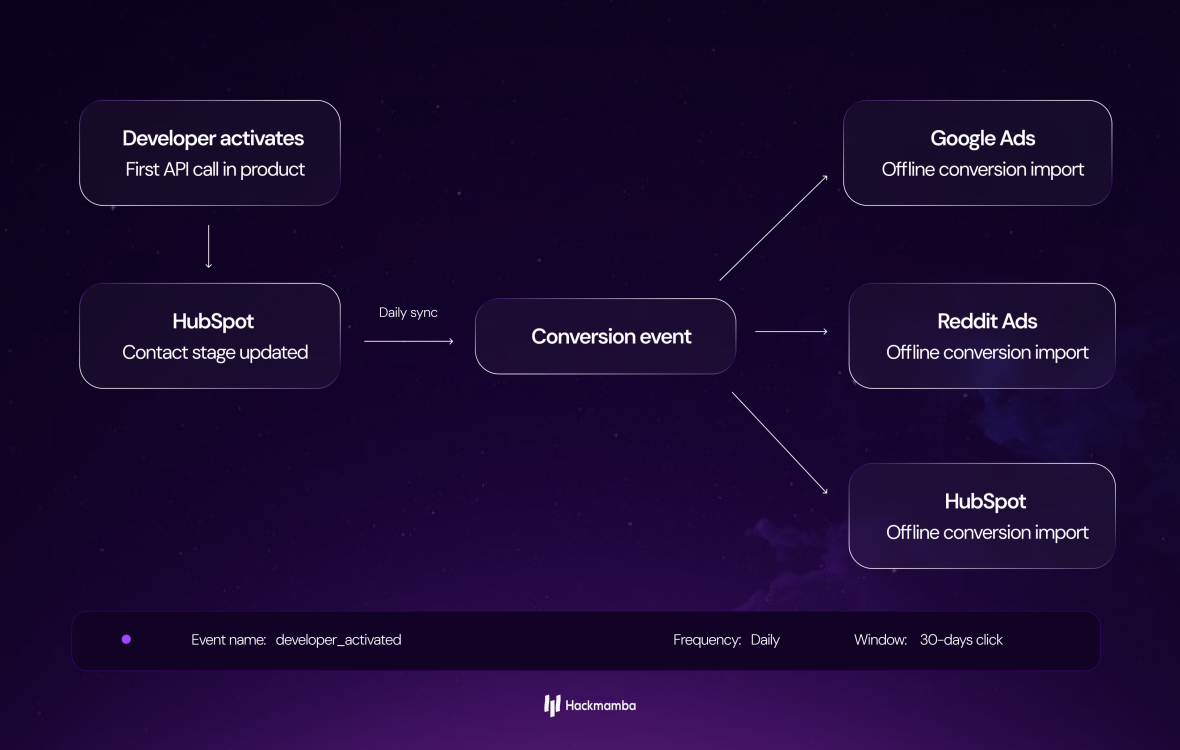
Activation tracking. For PLG devtools, the conversion event is not a sign-up. It is an activated developer who completed their first meaningful action in the product, such as making their first API call, running their first successful query, or completing their first deployment. Set this up as a server-side event and import it into the ad platform as a downstream conversion. This is the signal that actually correlates with revenue.
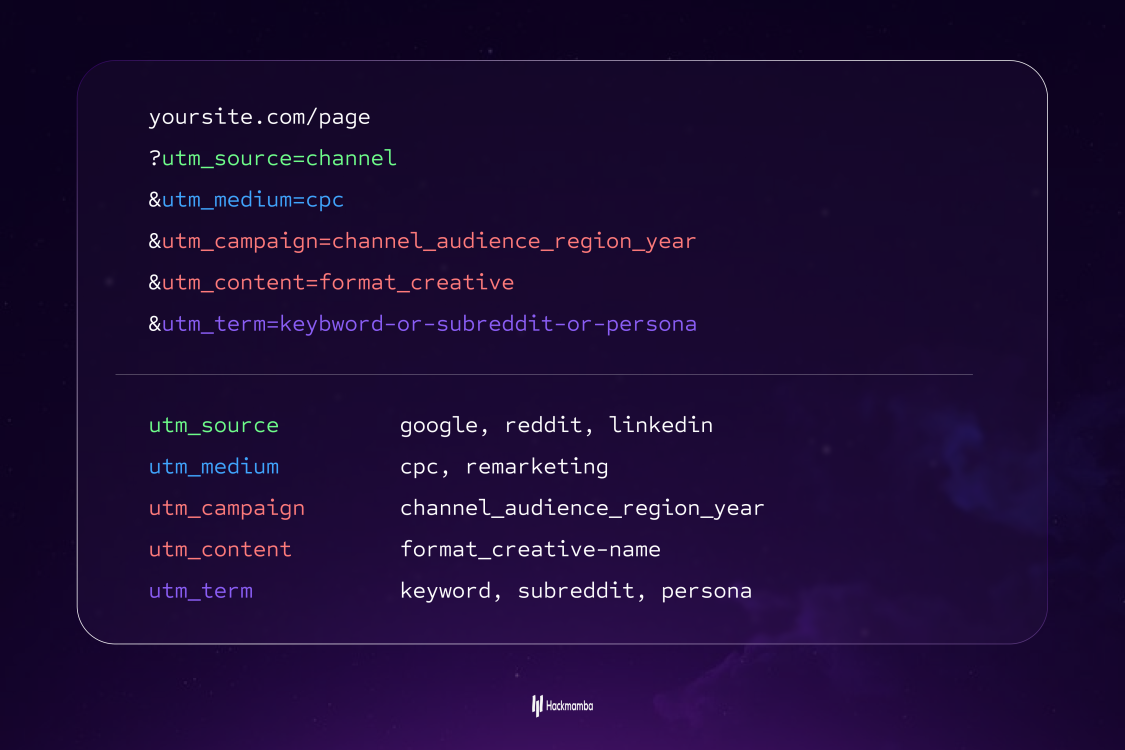
UTM naming. Every channel, every campaign, and every ad needs a consistent UTM structure from day one. If your UTM naming breaks midway through a campaign, your attribution data becomes unreliable and you cannot make confident channel decisions.
Spend tracking and revenue reporting
How we track spend
We build a spend forecast at the start of every cycle and track actuals against it weekly. The budget split between channels follows performance data and not instincts. If Reddit produces qualified sign-ups in cycle one, its budget share increases in cycle two. If a channel underspends, we flag it with a reason such as the algorithm still being in the learning phase, creative still being in testing, or the audience pool being too small.
The tracking sheet shows planned budget, actual spend, remaining budget, and percentage allocation by channel for each cycle. Status is reviewed weekly and budget shifts happen at the start of each new cycle.
Revenue reporting
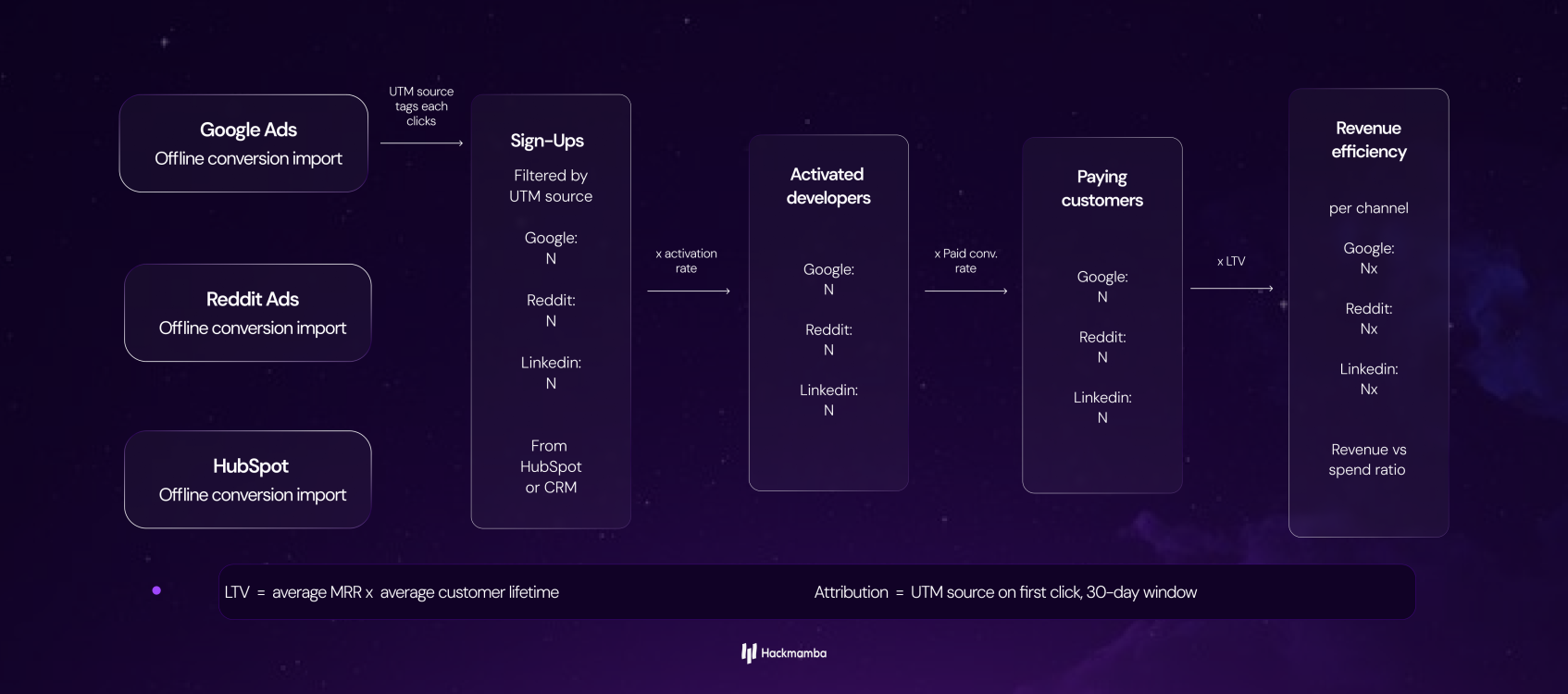
Most PPC reporting stops at cost per sign-up or cost per lead. The number that matters is revenue attributed to each campaign, which means tracing the full chain from ad click to paying customer to lifetime value.
The workflow below shows how each channel's spend maps back to revenue. Every metric is filtered by UTM source so Google, Reddit, and LinkedIn are reported separately. Blended numbers hide which channels are actually working.
The four numbers we review in every reporting cycle:
- Cost per activated developer by channel
- Activated developer to paid conversion rate by channel
- LTV of customers sourced by each channel
- Revenue attributed to each channel against spend
A $65 cost per sign-up from Reddit looks efficient until the LTV data comes in. If those customers churn after 6 months while Google Search customers stay for 24, the channel that looked expensive is actually cheaper per retained customer. This is why we never make channel decisions on cost per sign-up alone, and why reporting by channel separately is not optional.
What are we seeing with ChatGPT ads
We have not run this for any client yet. Access is still limited and measurement infrastructure is early. But we are tracking it closely because the intent signal is worth paying attention to.
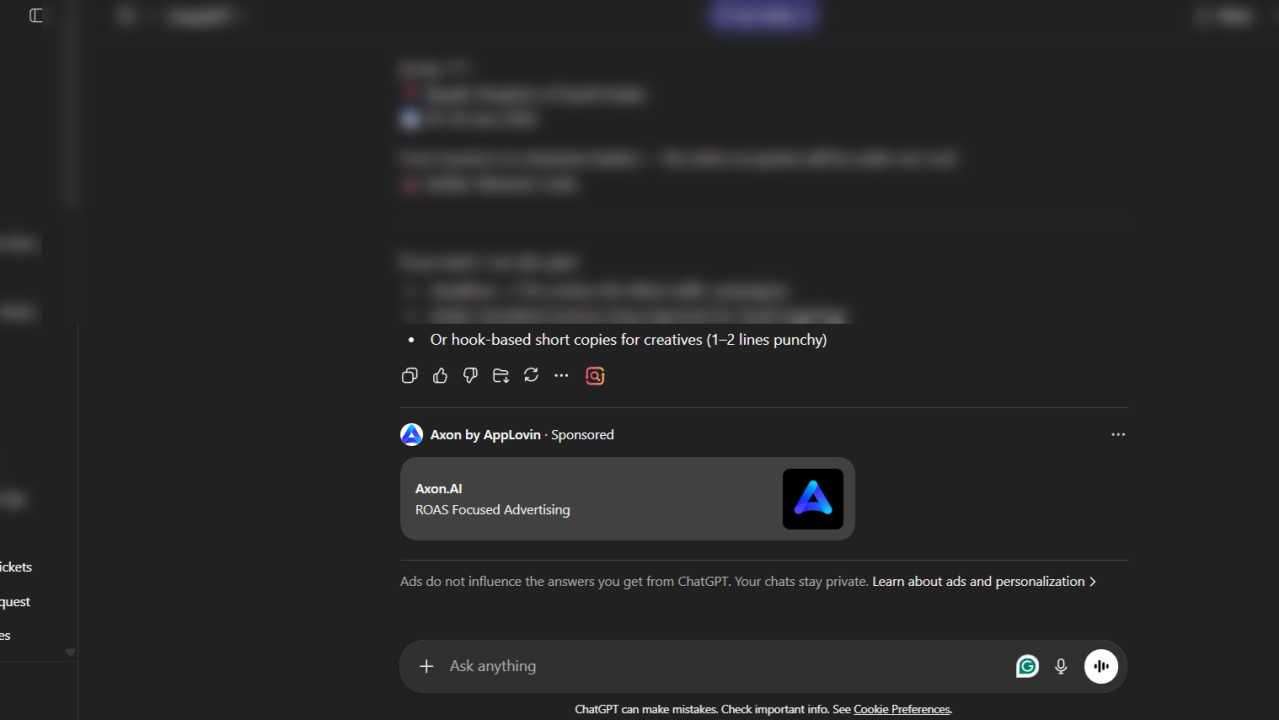
OpenAI launched ads inside ChatGPT on February 9, 2026 for Free and Go tier users in the US. The format is a clearly labeled sponsored box that sits below the AI response, separate from the answer and never influencing it. As you can see in the image below, the ad appears with a Sponsored label and the advertiser's name, visually distinct from the conversation. Users on Plus, Pro, Business, and Enterprise plans see no ads.
 The platform launched on a CPM model at $60 per thousand impressions. That dropped to $25 within ten weeks as inventory expanded and OpenAI shifted to CPC pricing in April 2026, with bids settling at $3 to $5 for general categories. For SaaS and developer tools, CPCs are reported at $8 to $18, putting it in the same range as competitive Google Search terms.
This is purely a demand capture channel. A developer asking ChatGPT to compare observability platforms or recommend a vector database is already solution aware and actively researching, not browsing. The sponsored result appearing at the bottom of that conversation is structurally similar to a Google Search ad appearing against a high-intent query, except the developer has had a full conversational context before seeing the ad, which arguably signals stronger intent.
The challenge right now is measurement. OpenAI is still building its advertising science infrastructure and conversion tracking is immature. Evaluating ChatGPT clicks against Google Search clicks without reliable attribution data is not something we are willing to do with a client's budget yet.
The minimum spend has come down significantly since launch and a self-serve ads manager is now open globally. We will test it for relevant devtools categories when measurement matures.
Wrapping up
Marketing is 90% logic, and that applies to every channel, not just PPC.
You have probably heard that ads do not work for developers. We disagree. Developers adopt tools that solve real problems. The challenge is not the channel. The challenge is whether the message matches what the developer is trying to accomplish.
Many developer-focused campaigns fail because they are built around product features instead of developer needs. The targeting is too broad, the creative sounds like a company announcement, and the landing page talks about the product before addressing the problem. Developers quickly move on because nothing about the experience feels relevant to them.
The logic is simple. If you understand the problem a developer is trying to solve, where they go for information, how they describe that problem, and what they need to see before trusting a solution, your marketing becomes significantly more effective. The channel becomes secondary.
That is why developer-focused campaigns can succeed across Google, Reddit, LinkedIn, YouTube, and increasingly, AI-powered search experiences. Developers are not rejecting ads. They are filtering out messages that do not help them make progress.
That is ultimately what this guide is about. Not just the mechanics of PPC, but the thinking behind it. If you would rather have a team run the mechanics for you, that is what our paid media agency does.
If you are building a developer tool and want to understand where paid acquisition fits into your growth strategy, Hackmamba is a developer marketing agency that helps devtools companies build developer-focused acquisition programs across paid, organic, community, documentation, and DevRel channels. Book a call with us and we can discuss where you are today and where you want to go.
For the broader developer marketing program that PPC supports, our guide to B2D marketing covers strategy, channels, GTM, and measurement. If you are looking to grow through channels beyond paid acquisition, the SEO for developer tools guide explores how organic search drives long-term developer discovery and adoption.
About author
From SEO and growth campaigns to documentation, landing pages, and developer-focused content, the list goes on! My passion lies in helping products connect with developers and driving measurable results through thoughtful marketing. Outside of work, you’ll find me chasing new adventures, gazing at the moon, and enjoying the timeless charm of old Hollywood movies.










.svg)