How to build a developer-led GTM strategy in 2026
Learn how to build a GTM strategy for devtools that aligns with developer-led adoption. Understand hybrid GTM, developer intent signals, and modern B2D sales motions.

Developer marketers are expected to influence an audience that actively resists being “sold to.” The real challenge isn’t demand generation, it’s redesigning B2D GTM motions to align with how developers actually evaluate and adopt products.
Developers are among the most evolved buying personas in B2B. While much of the B2B world has only recently shifted toward product-led buying, developers have long relied on self-directed research, hands-on product experience, and a deep understanding of how tools work. They prefer to explore, test, and even build with a product well before any purchase decision enters the picture.
But if someone does not want to be sold to, does not mean there is nothing for the sales and marketing team to do about it. In fact, the Modern GTM process by Unusual Ventures and a number of thought leaders in the space have been prescribing a redesign of the GTM process for modern software buying behaviour.
Hence, it would be useful to discuss how the Modern GTM Process looks for a Developer Led Sales Organization. So before you proceed we highly recommend you to read Understanding Modern GTM and The Modern GTM User / Buyer Journey by Unusual VC; although to put it very briefly:
- Modern GTM is needed since buyers today don’t want to be sold to; at least till they have experienced the product themselves
- It prescribes creating steps and action items specifically for 2 personas - the User (someone who will try your product but will not have the budgets and authority to purchase it) and the Buyer (someone who will listen to and be heavily influenced by the User, might only partially try the product themselves, but will have the budgets and authority to purchase the product.
- Also, organizations need to have Hybrid GTM processes, a mix of Bottom’s up and Top Down; where the User will need content, education and a strong self serve motion driven by marketing and product teams (Bottom’s Up); while the Top Down sales team driven processes get activated once the prospect has experienced product on their own.
What does the modern GTM process look like for developer led sales?
The Modern GTM process for B2D companies differs from the traditional approach in many ways including:
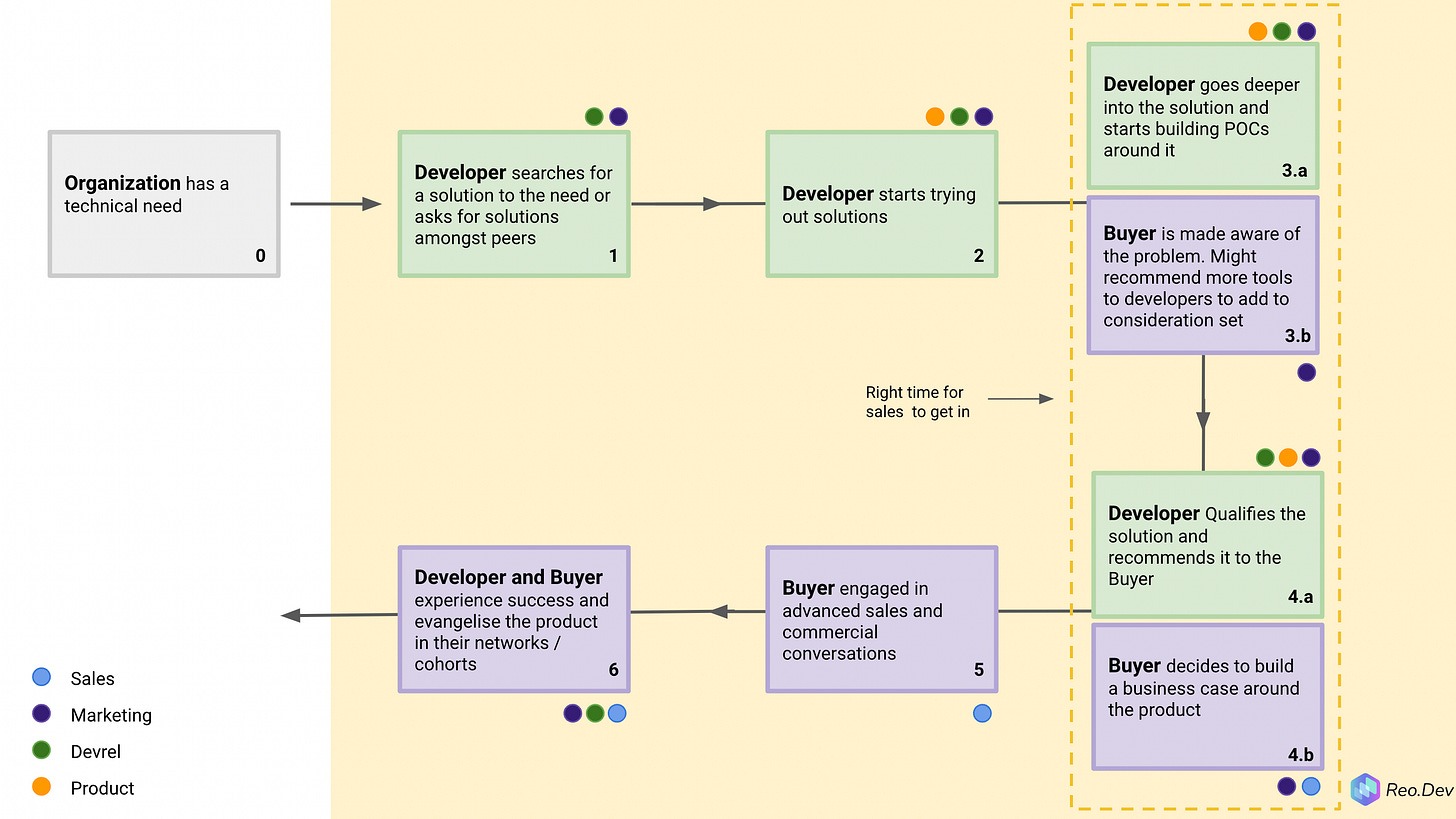
The B2D buying journey involves two distinct but tightly connected personas: the Developer and the Buyer.
- Developers don’t want to be sold to. They prefer discovering and validating solutions on their own terms. What they do value is fast, high-quality support, especially direct help from engineers when they ask for it. While developers often have limited or no purchasing authority, they exert significant influence over the final buying decision.
- Buyers, typically CTOs, CXOs, VPs of Engineering, or VPs of Product, control budgets and are more open to sales or discovery conversations. However, they rarely buy without their team’s validation. In practice, most sales outreach to buyers eventually gets delegated back to developers for trials, evaluations, and POCs.
This makes the motion neither purely bottom-up nor top-down. It’s inherently hybrid.
- Developers need a bottom-up activation motion that is educational, product-led, and community-driven.
- Buyers, especially in larger deals, need top-down support through a commercial motion, often involving sales at the right stage.
This GTM model is also deeply collaborative. Success depends on tight coordination across teams rather than siloed execution. For example:
- DevRel teams often hold critical feedback from trials, POCs, and community interactions.
- Product teams need that input to continuously improve the developer experience and embed in-product triggers that guide developers toward support or paid usage.
- Growth teams must identify which signups and accounts show real intent and surface those signals to sales.
- Sales teams then focus effort on accounts already qualified by developer activity and intent.
This is fundamentally different from traditional GTM models, where teams operated in isolation. In B2D GTM, alignment across product, DevRel, growth, and sales isn’t optional. It’s the system.
Understanding the stages of modern GTM for developer-led sales
Stage 0: A technical need emerges inside the organization
Every developer tool or infrastructure product exists to solve a technical need within an organization. These needs usually surface when teams are dealing with complex problems, building sophisticated systems that require the right building blocks, or when engineering leaders want their teams to focus on high-leverage work while offloading routine or repetitive tasks.
Stage 1: Developers search for solutions
Once developers understand the problem they need to solve, they begin researching potential solutions. They search online, ask peers for recommendations, browse developer communities, read technical content, and explore how other teams have approached similar challenges.
This is often the first point where they encounter your product. That introduction may come through a search result, a community discussion, a technical article, an open-source project, or a recommendation from another developer. At this stage, developers are not looking for vendors. They are looking for credible information that helps them understand their options.
The quality of your technical content plays a major role in whether your product earns attention. Developers evaluate content based on its clarity, technical depth, and practical usefulness. Documentation, tutorials, implementation guides, and educational content help establish trust long before a developer signs up for a trial or speaks with sales. Teams that invest in technical content as a core go-to-market function tend to appear more frequently during this research process.
Organic search is typically the most important acquisition channel at this stage. The SEO for developer tools guide explains how to build topical authority, create developer-focused content, and develop a keyword strategy that drives qualified discovery.
This is one reason many devtools companies work with a developer marketing agency like Hackmamba. By combining technical content, documentation, SEO, and developer-focused distribution, these teams help products become discoverable when developers are actively researching solutions.
Stage 2: Developers start trying out solutions
At this stage, developers move beyond research and begin evaluating products through direct experience. They sign up for free trials, explore documentation, test APIs, fork GitHub repositories, and build proof-of-concepts to determine whether a tool fits their workflow. Your product is now competing against other options they are actively testing.
The goal is to help developers reach meaningful value as quickly as possible. Fast onboarding, clear documentation, working code examples, and a straightforward path to a successful first implementation all influence whether a developer continues evaluating your product or moves on to another solution.
This is where developer experience becomes a critical part of go-to-market success. If onboarding is slow, documentation is unclear, or implementation becomes frustrating, developers are unlikely to progress further in the evaluation process. Developer marketing without DevX explores how developer experience directly impacts product adoption and pipeline growth.
Stage 3: Developers build, buyers start paying attention
At this stage, your product is gaining meaningful adoption within the developer team. Multiple developers are actively using it, reading documentation, testing integrations, signing up for accounts, and engaging with support, community, or DevRel channels to answer implementation questions.
This is also when buying stakeholders begin to enter the evaluation process. They may join discovery calls, review potential solutions, or participate in product demonstrations. However, developers remain the primary evaluators, continuing to test capabilities, compare alternatives, and validate technical fit. This creates an opportunity for sales teams to engage using developer intent signals, providing context and support without disrupting the evaluation process.
The community programs, content initiatives, and adoption tactics that help move developers through this stage are covered in developer marketing strategies, including examples from Stripe, Twilio, and Supabase.
Stage 4: Developers validate the product, buyers justify the decision
Developers don’t just try tools before buying them. They build real workflows with them. At this stage, your product gets a clear signal of approval from developers, often through sustained use of a free, open-source, or freemium version. Usage increases, and developers spend more time across your product, docs, and ecosystem.
Buyer interest is usually highest here. Teams can either let developers move forward naturally through a product-led motion or support buyers in putting together a business case. This makes it a strong moment for sales to help with pricing, value, and ROI discussions, without slowing down developer momentum.
Stage 5: Buyers enter deeper sales and commercial conversations
This stage looks a lot like a traditional enterprise sales process. Because of that, many developer-focused companies assume this is where revenue is really made. In reality, this stage only works because of everything that happened earlier.
When you step back and look at the full journey, it becomes clear how developer experience, product-led adoption, intent signals, and cross-team coordination all come together to enable sales at this point.
Stage 6: Developers and buyers see value and share it
This is when purchase and implementation are complete, and the customer starts seeing real outcomes from the product. Both developers and buyers begin talking about their success internally and externally, turning into advocates within their teams and across their networks.
How to build a GTM strategy for developer led sales
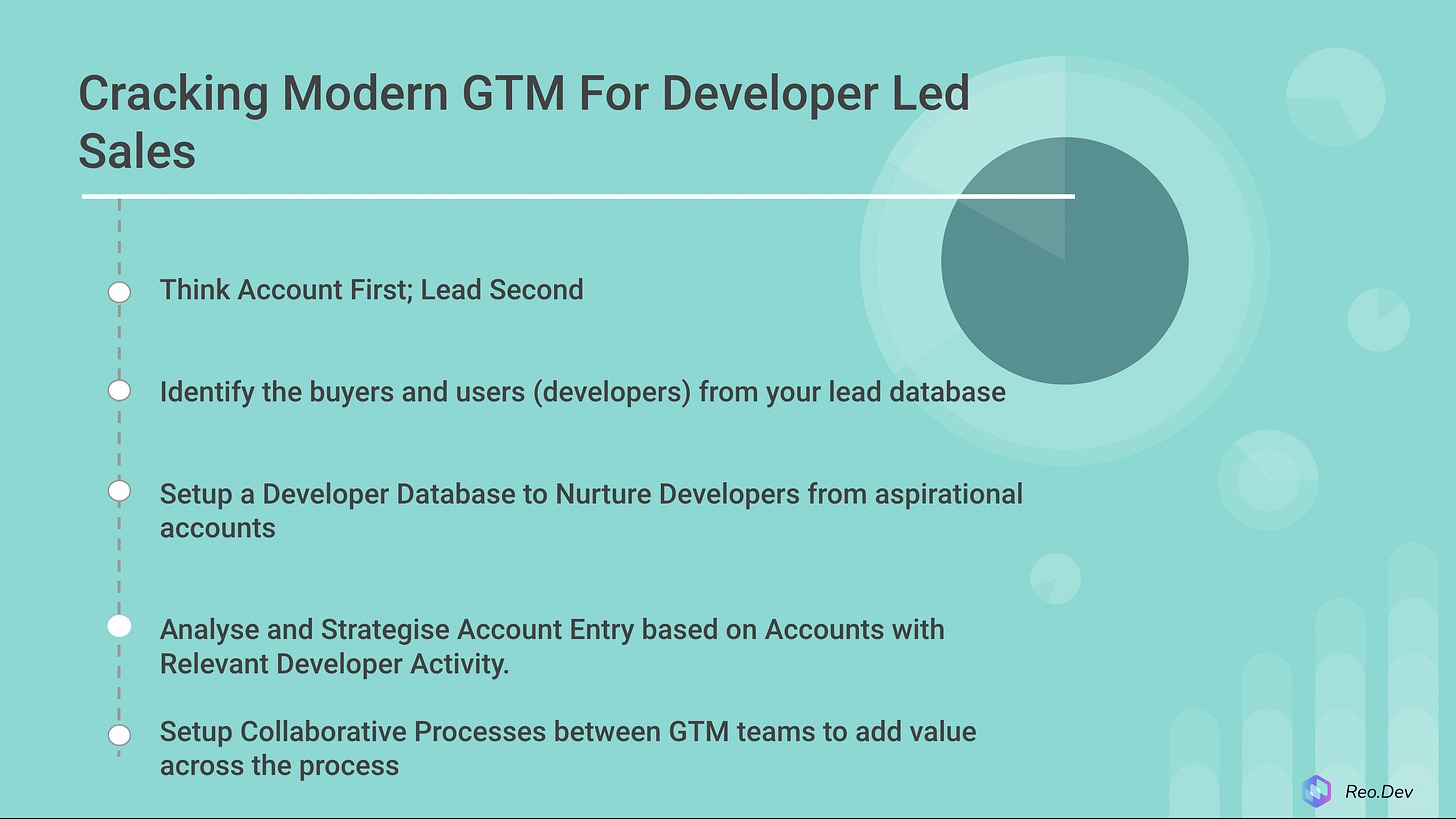
Think account first, lead second
Traditional marketing tends to react to individual signals: set up nurture flows after a lead is captured, trigger discovery calls after a signup. But in developer-led motions, these signals often indicate the opposite. They reflect developers who want the freedom to explore on their own and only engage when they actively need help.
The more effective approach is to look beyond isolated leads and triangulate developer intent across activities. By connecting these signals, teams can identify which accounts show real momentum and where meaningful opportunities exist.
This is where account-based GTM becomes powerful. With context from developer behavior, GTM teams can approach the right persona within an account, at the right time, with the right level of involvement, without disrupting the developer’s evaluation process.
The metrics that surface account-level intent - activation signals, depth of use, advocacy - are covered in the developer marketing metrics guide.
Understand who is a buyer and who is a user in your lead database
The two core personas in a developer-led motion, the Buyer and the User (Developer), have very different goals and expectations from your product. Because of this, the same messaging and outreach approach rarely works for both.
The first step is to clearly distinguish buyers from users across your marketing and sales systems. This helps teams tailor communication instead of relying on one-size-fits-all nurture flows. Some practical signals to look at include:
- Designations: Job titles and seniority can indicate budget ownership versus hands-on usage.
- Delegation patterns: If discovery conversations consistently lead to developers signing up or starting trials, it’s a strong signal of buyer-led delegation.
- Product and documentation engagement: Leads spending significant time in technical docs, repositories, or hands-on guides are usually developers.
- Depth and intensity of usage: Frequency of usage, feature depth, and experimentation often separate evaluators from decision-makers.
Once these personas are clearly identified, teams can design distinct messaging paths. Developers can be nurtured through education, documentation, and support, while buyers receive context around value, risk, and outcomes, without crossing signals or breaking trust.
Set up a developer database to nurture aspirational accounts
Once you maintain a dedicated developer database, you can segment and nurture developers very differently from buyers. Traditional GTM tactics like retargeting, email follow-ups, or discovery call requests may work for buyers. For developers, however, nurtures should focus on education, faster problem-solving, and timely access to support.
This shift changes everything: the messaging developers receive, the content they are guided through, and even who engages with them when they ask for help. Instead of pushing conversations, the goal is to remove friction and help developers reach value as quickly as possible.
A separate developer database also helps DevRel and support engineers prioritize developers from high-value or aspirational accounts and offer better SLAs. Importantly, developer activity signals in your CRM should not trigger sales outreach to developers. Instead, these signals should help teams prioritize the right accounts and engage buyers more thoughtfully, knowing that developers inside those accounts are already active with the product.
Analyze and strategize account entry based on developer activity
By this point, your product, content, and community have done their job in attracting developer interest. A dedicated developer database ensures developers are educated and supported, rather than overwhelmed with marketing. You are no longer just tracking individual leads, but identifying accounts where developer activity signals real buying momentum.
This visibility helps you understand which accounts genuinely have the potential to convert. It also creates a natural, low-friction path to enter those accounts. We’ve written in more detail about how developer-led motions can enable warm entry points to buyers, once the right signals are in place.
As reflected in Stages 3 and 4 of the journey, this is where responsibility can shift to sales and account marketing teams. With the right context and level of maturity, they can focus their effort on accounts that are truly ready. Some signals that indicate it’s the right time to engage include:
- Developers from the account exploring advanced features or going deeper into the product
- Multiple developers within the same account actively evaluating or using the product
- Repeated developer activity from the same account over shorter time periods
- Developers spending time in documentation or asking questions in community channels
In practice, these signals tend to live in different places, product usage, documentation, GitHub activity, and community interactions. The real challenge is stitching them together at an account level to understand when interest has moved beyond exploration and into serious evaluation.
This is where developer-first GTM platforms like Reo.Dev come into the picture. They focus on translating developer activity into clear account-level and developer-level intent, helping teams engage at the right moment instead of reacting to isolated leads.
Together, these signals suggest that the account has moved beyond casual exploration and is ready for more deliberate engagement.
Collaborate and close
One of the biggest shifts in modern go-to-market strategy is the level of coordination it requires. Developer-led growth does not succeed through a single team. Product, DevRel, marketing, and sales each play a distinct role in moving developers from discovery to adoption and, eventually, to a buying decision.
A strong product experience gives developers a reason to try the tool. DevRel, whether an in-house team or devrel services from a partner, helps them get value quickly through education, documentation, and support. Developer Marketing creates awareness and demand among both developers and buyers. Sales then works with qualified opportunities to turn adoption into revenue.
To make this work, GTM cannot operate as a collection of disconnected functions. It needs shared goals, clear ownership, and visibility into the same metrics so every team is working toward the same outcome.
Remarketing plays an important role during the evaluation and purchase stages. These campaigns focus on developers and buying committee members who have already interacted with your product, content, or website. The PPC for developer tools guide explores how remarketing, LinkedIn advertising, and intent-based campaigns can be used across different stages of the developer journey.
Closing thoughts
For GTM leaders, understanding how developer-led buying behavior influences modern go-to-market execution is becoming increasingly important. Product adoption, developer engagement, and buyer readiness are now closely connected, making it essential to understand how accounts move through each stage of the journey.
One challenge is identifying where an account actually sits within that journey. Developers rarely announce that they are evaluating a tool. Instead, they leave signals through product usage, documentation engagement, community activity, and other behaviors. Our developer intent signals guide explains the indicators that suggest an account is moving from research into active evaluation.
If you're looking to build the broader program around these buying motions, the B2D marketing guide covers the full framework, including content, community, developer experience, acquisition channels, and measurement.
Need help putting the strategy into action? As a developer marketing agency, Hackmamba helps devtools companies execute developer-led GTM programs through technical content, documentation, SEO, community, developer education, and demand generation. We help teams turn developer interest into product adoption, pipeline, and revenue growth.
FAQ
It is a go-to-market strategy built around how developers discover, test, and adopt a product before a buyer gets involved. It plans for two personas: the developer who uses the tool and the buyer who pays for it.
The post maps seven: a technical need emerges, developers search for solutions, developers try them, adoption grows and buyers notice, developers validate and buyers justify, commercial conversations begin, and both groups share the value.
Plan account first and lead second, keep buyers and users as separate records in your lead database, and create assets for each stage of the developer evaluation journey, from research to advocacy.
Several developers from one account signing up, reading documentation, testing integrations, forking repositories, and asking questions in support or community channels.
After developers have already validated the product through hands-on use. Sales conversations go better once a team inside the account is using the tool and a buyer has noticed.
About author
From SEO and growth campaigns to documentation, landing pages, and developer-focused content, the list goes on! My passion lies in helping products connect with developers and driving measurable results through thoughtful marketing. Outside of work, you’ll find me chasing new adventures, gazing at the moon, and enjoying the timeless charm of old Hollywood movies.










.svg)