5 best technical writing agencies for SaaS & devtools (2026)
Compare the 5 best technical writing agencies for SaaS and DevTools. See who handles SEO, documentation, and developer content end to end.

I was listening to a sales recording last week where a bootstrapped SaaS founder said they had outsourced technical writing services for $20,000 to one of the agencies in the US. The engagement covered SEO content and a small set of documentation pages. All deliverables were completed on time. Six months after publication, there was no change in the quality of inbound leads, no improvement in trial activation, and no reduction in support tickets.
For a business that is bootstrapped, that spend did not translate into momentum, and the team had to pull back on further investment. The outcome was a loss of trust in agencies. This is just one instance.



Inside the launch of VectorAI DB
How Actian positioned VectorAI DB for developers and drove adoption from day one
Read the case study
Every agency today claims to be a technical writing agency. The label has become cheap. The consequences of choosing the wrong one are not. Teams lose money, momentum, and confidence in agencies as a category. Many move the work to an in house team and never look back.
Before you spend even a dollar on an agency, you need a clear standard for what that agency should own and how success should be measured. Before looking at any names, it helps to understand the technical writing services you should expect an agency to provide and the expect outcomes for those services.
What are the technical writing services you should expect an agency to provide? (Along with outcomes)
Technical content exists to help developers find your product, understand it, try it, and continue using it without friction. An agency should own services that directly influence how developers move through that journey. Here are the technical writing services along with outcomes:
1. Technical SEO content
A agency should own search-driven content that answers developer questions tied to implementation problems. Content should reflect how developers search and how the product is actually used.
Expected outcomes
- Increase in organic sign-ups or trial starts attributed to content
- Growth in rankings for high-intent technical keywords
2. Product and integration pages
The agency should own the technical clarity of product, feature, and integration pages that developers review before committing time to a tool. These pages should explain setup requirements, constraints, and usage clearly.
Expected outcomes
- Higher click-through rate from pages to trial or dashboard
- Increased product page involvement in assisted conversions
3. Documentation and help content
The agency should own technical documentation that allows developers to complete core actions without assistance. Documentation should be structured around workflows and maintained as the product evolves.
Expected outcomes
- Decrease in support tickets related to setup and usage
- Shorter time to first successful action after sign-up
4. Onboarding guides and tutorials
The agency should own guides and tutorials that take developers from initial setup to a working implementation. Content should follow the real workflows and be easy to complete.
Expected outcomes
- Higher activation rate within the first seven days
- Improved completion rates for onboarding tutorials
5. Scripted technical video content
The agency should own scripts for walkthroughs and onboarding videos that align with documentation and product behavior. Video should support self-guided learning.
Expected outcomes
- High completion rates for onboarding videos
- Increased movement from video views to product actions
6. Internal technical content
The agency should own internal documentation that helps support and DevRel teams answer developer questions consistently. Content should reduce dependency on ad hoc explanations.
Expected outcomes
- Faster response times to developer queries
- Fewer escalations to engineering teams
7. Ongoing content maintenance
The agency should own keeping technical content accurate after releases and changes. Outdated guidance should be identified and corrected proactively.
Expected outcomes
- Fewer user errors caused by outdated documentation
- Lower volume of support issues tied to content gaps
Top 5 Technical writing agencies for SaaS and developer products (2026)
1. Hackmamba
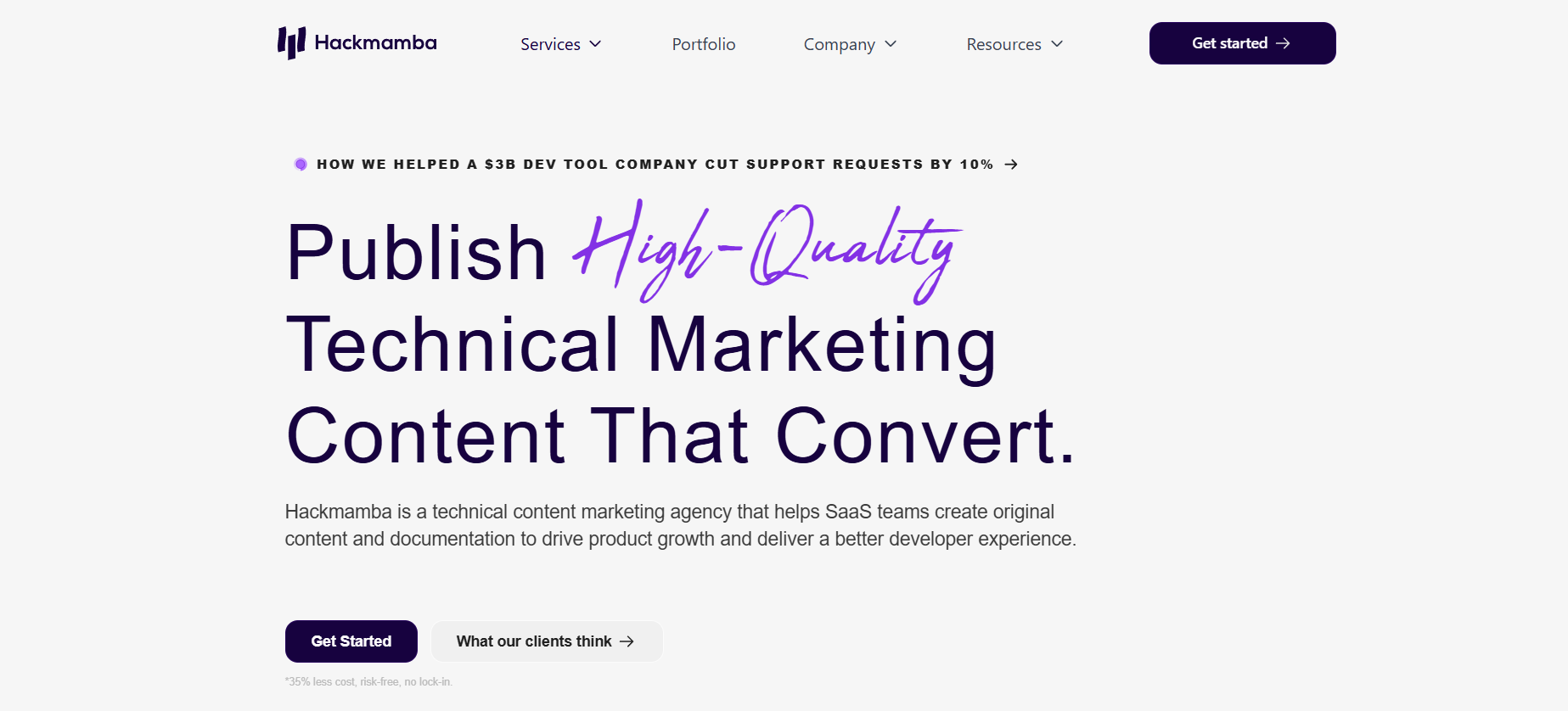
Founded: 2021
Best for: End-to-end technical writing across SEO content, product pages, documentation, onboarding, and developer enablement for developer tools
Overview: Hackmamba was started by William after working as a developer and writing technical tutorials, documentation, and guides for SaaS and developer tools. While doing this work, he spent significant time inside products, understanding how features were implemented and how developers interacted with them. He often speaks about how technical content breaks when it is written without full product context.
Hackmamba was built to address this gap. Many agencies label their work as technical without fully understanding the product. The focus at Hackmamba has always been on writing content that reflects how products are used, how developers move through setup and evaluation, and what information they need at each step
Today, Hackmamba is a team of 50 professional technical writers working with engineering and product teams across time zones. The standards have not changed. Every technical writer is expected to understand the product deeply and produce content that supports adoption, clarity, and long-term trust.
Services include:
- SEO-driven technical content
- Product and feature landing pages
- Documentation and onboarding guides
- Tutorials and walkthroughs
- Technical videos
How we produce content: We are deliberate about how content is created. We are proud to call ourselves authentic content creators. We do not ship AI-generated or lightly edited content. Every content piece is written by humans with technical context and reviewed for accuracy, clarity, and usefulness before it is delivered.
Our Head of Content, Henry Bassey uses a framework to guide every piece we produce. The framework ensures that writing stays grounded in developer needs and product context. It starts by asking:
- Who the content is written for?
- What problem it is solving?
- Why that problem matters? and
- Where and how the content should be delivered?
Each question forces clarity and prevents content that exists without purpose.
Today, every technical writer in our team follows this framework and it has helped us produce great quality content that developers care about.
Client portfolio
- Replit
- Mintlify
- Openrouter
- CodeRabbit
- HCL Tech
Best work:
- Cloudinary:Increased organic traffic by 88% in 5 months, growing from 281K to 529K monthly visits through developer-focused SEO, content strategy, and technical content production.
- Roadmap: Grew organic traffic from 197K to 470K monthly visits by building topical authority around backend development, developer roadmaps, and educational content..
Client testimonials:
We consider Hackmamba a true partner. - Rotimi, Okungbaye, Enterprise Marketing at Flutterwave
Pricing: We typically charge between $600 and $800 for a technical article up to 2,500 words. Our end-to-end technical content marketing engagements starts at $6,000/month.
Website: Visit Hackmamba
Our process, from brief creation and drafting through three-pass review to client handoff, is covered in detail in our technical writing process.
2. Infrasity
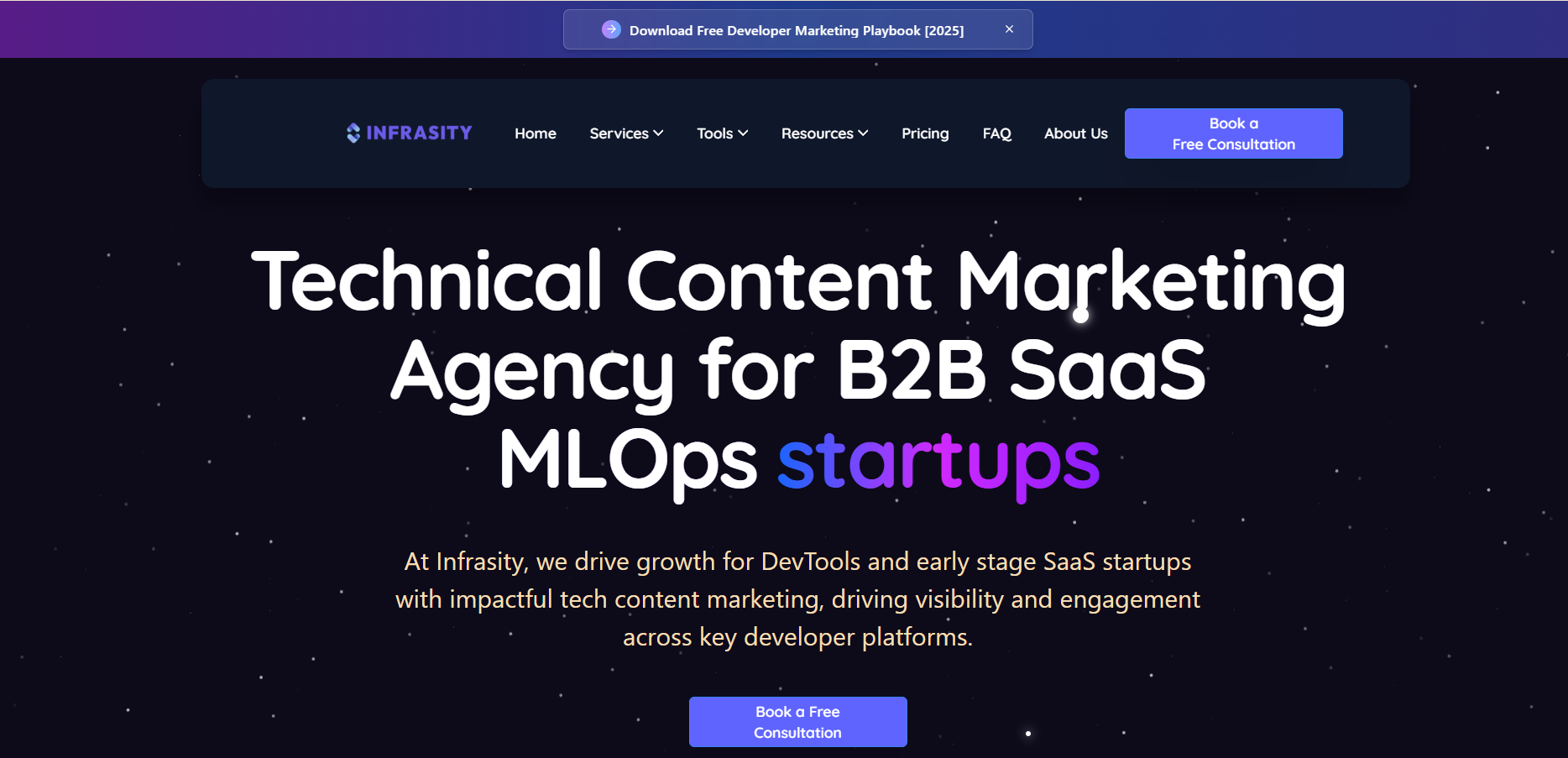
Founded: 2024
Best for: DevTools and SaaS teams that want end-to-end SEO strategy and execution
Overview: Infrasity is a content agency that focuses on developer-focused SEO and educational content. Their work is centered around long-form technical articles designed to rank for competitive keywords and attract developers through search. They are known for working closely with in-house teams to produce content that aligns with technical accuracy and SEO requirements.
Best work: Infrasity produced developer-focused technical content for Scalekit that drove an 8x increase in organic traffic over nine months. The work included deep-dive blogs explaining SCIM, SAML, and identity management concepts that improved search visibility and positioned Scalekit ahead of competitors.
Client portfolio:
- Firefly
- Scalekit
- Terrateam
Pricing: Infrasity have not publicly mentioned their pricing, please book a call with them to know more about pricing.
Website: Visit Infrasity
3. Draft.dev
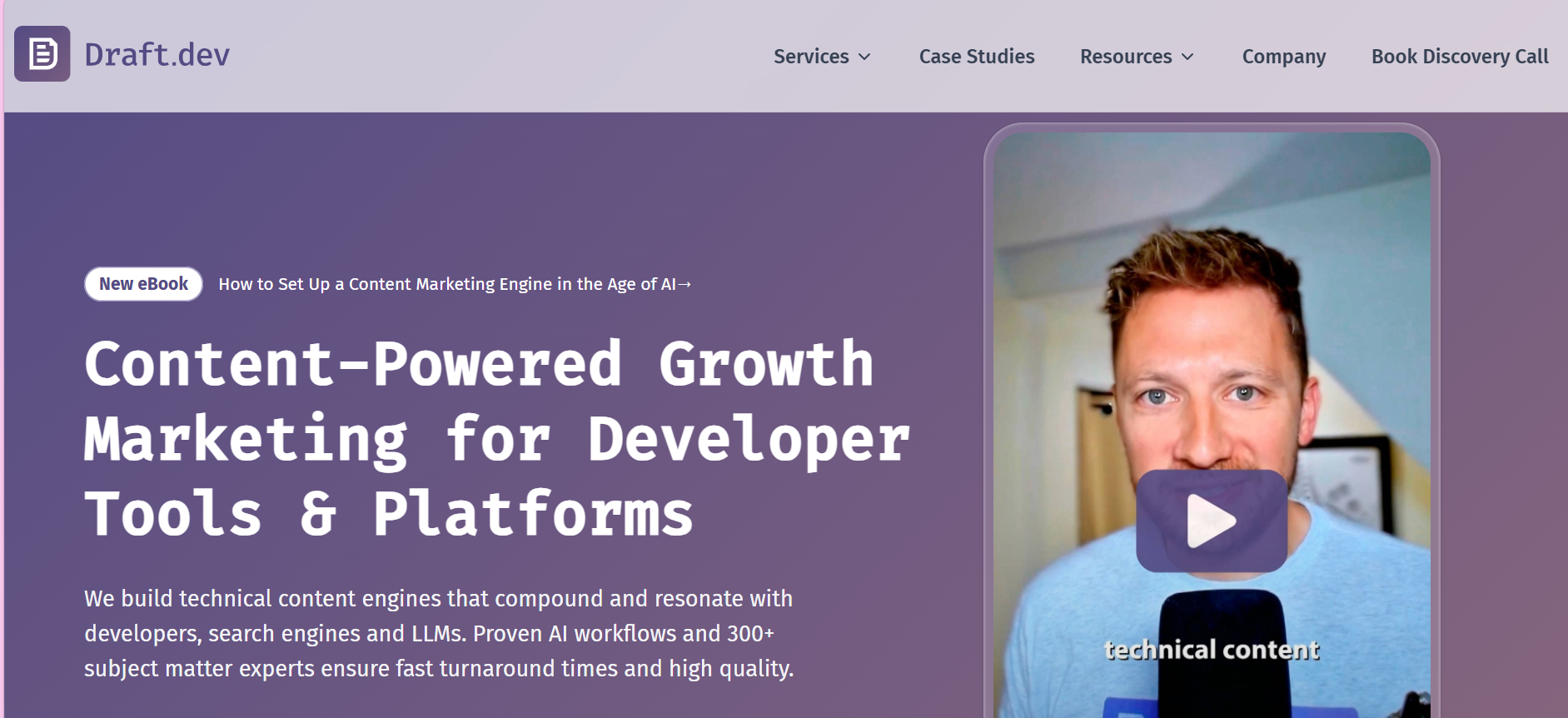
Founded: 2020
Best for: DevTools and AI teams that need expert-written technical content at scale in the age of AI overviews.
Overview: Draft.dev is a technical content agency founded by former CTO Karl Hughes, focused exclusively on creating content for developer tools and AI platforms. They work with a network of vetted subject matter experts and engineer-writers to produce blog posts, tutorials, comparison pages, lead magnets, and video content. Every piece is drafted using proven AI workflows, then reviewed by real, practicing developers and edited by professional technical editors.
Best work: Draft.dev helped Sinch Mailgun revive its developer-first content strategy when internal engineering bandwidth was tight, delivering SME-written tutorials, testing content, and editorial QA that achieved 20 to 45 percent CTR while saving the internal team weeks of production time.
Client portfolio:
- Docker
- JetBrains
- Sinch Mailgun
- Bright Data
- descope
Pricing: Plans start at $9,000 per month with an initial three-month minimum commitment. Retainers and custom offers are available on request.
Website: Visit Draft.dev
4. DevDocs
Founded: 2020
Best for: SaaS teams looking to improve technical documentation, onboarding clarity, and documentation structure
Overview: DevDocs is a technical writing and documentation agency focused on SaaS products, APIs, and software platforms. The team includes technical writers, developers, designers, and project managers who work together to plan, write, and maintain documentation that reflects how products are actually used. Their work typically covers API documentation, developer guides, product documentation, and structured knowledge bases.
Best work: DevDocs rebuilt Qualcomm’s AI Engine Direct SDK documentation with a modular structure and clear information architecture, reducing required reading by 80 percent and setup failure points by 60 percent. Their work improved how developers find and use critical SDK content, decreasing time to locate information by 70 percent.
Client portfolio:
- Qualcomm
- LittlePay
- Aptos
Pricing: DevDocs have not publicly mentioned their pricing, please book a call with them to know more about pricing.
Website: Visit Devdocs
5. 3DI Information Solutions
Founded: 2002
Best for: SaaS teams that need software documentation systems.
Overview: 3DI Information Solutions is a technical communication and content agency that focuses on documentation strategy, API and developer documentation, and structured content for SaaS and software companies. The team includes technical writers, information architects, and documentation specialists who build and optimize documentation frameworks, style guides, and reusable content models that scale with product complexity.
Best work: 3DI led a full documentation overhaul for a SaaS platform with a complex API surface, restructuring existing docs into a task-based information architecture. The engagement included API reference cleanup, user workflow guides, and the introduction of documentation standards that reduced onboarding confusion and improved self-serve usage across product team
Client portfolio:
- Apptio
- Unzer
- Promethean
Pricing: 3DI have not publicly mentioned their pricing, please book a call with them to know more about pricing.
Website: Visit 3DI
Conclusion
Choose a technical writing and documentation agency that is willing to understand your product, users, and the outcomes the content is expected to drive. The agencies listed here serve different needs, including SEO-led acquisition, documentation systems, developer education, and long-form technical content.
Before committing budget, define what you expect an agency to own and how success will be measured. When scope, responsibilities, and metrics are not explicit, it becomes difficult to evaluate impact and determine whether the engagement is delivering value.
Once you have chosen an agency, the next challenge is deciding what to hand off and what to keep in-house. The how and when to outsource technical writing guide provides a scoring framework and a breakdown of what to outsource at different stages, helping teams establish clear scope and expectations from the beginning.
For teams that have concerns about quality, consistency, communication, or loss of control when working with an external partner, the top 5 fears small teams have about technical writing agencies addresses those concerns directly and outlines the processes strong agencies use to manage them.
Hackmamba is a technical writing and documentation agency built for SaaS and developer-first companies that need end-to-end technical content across the full developer journey, from discovery and evaluation through adoption and advocacy, with clear ownership and measurable outcomes.
If you are building a SaaS product or developer tool and need technical content that supports growth, adoption, and long-term trust, talk to us.
FAQ
A technical writing agency helps SaaS and DevTools teams produce content that explains how a product works, how to use it, and why it matters. This includes technical SEO content, product and integration pages, documentation, onboarding guides, tutorials, and technical video scripts. The goal is to support discovery, evaluation, adoption, and support at scale.
Teams usually hire a technical writing agency when internal bandwidth is limited, documentation quality is affecting onboarding or support, or content is not contributing to pipeline or activation. It is also common when a product is scaling and content needs to stay accurate across releases.
You should expect measurable outcomes such as improved organic sign-ups, higher activation rates, reduced documentation-related support tickets, faster onboarding, and clearer product evaluation paths. Outcomes should be defined before work begins.
For most SaaS and DevTools products, technical writing is ongoing. Products evolve, APIs change, and documentation needs regular updates. Agencies that support maintenance and long-term ownership tend to deliver better results.
Hackmamba works with both early-stage and scaling SaaS teams, especially those building developer-facing products. The free trial and lack of vendor lock-in allow teams to evaluate fit before committing long term.
About author
From SEO and growth campaigns to documentation, landing pages, and developer-focused content, the list goes on! My passion lies in helping products connect with developers and driving measurable results through thoughtful marketing. Outside of work, you’ll find me chasing new adventures, gazing at the moon, and enjoying the timeless charm of old Hollywood movies.










.svg)