How Actian brought VectorAI DB to developers (w/Jennifer Jackson)
Jennifer Jackson shares how Actian brought VectorAI DB to developers and how Hackmamba helped with developer marketing, content, documentation, and adoption.

On April 28th, Actian launched VectorAI DB at AI Dev x SF, a portable vector database built for AI workloads running at the edge, on-premises, and in air-gapped environments where cloud-native databases aren't an option.
Hackmamba joined the project 4 months earlier, before the product was ready to launch.
The initial brief was: help Actian reach developers for a brand-new vector database entering one of the most competitive categories in AI infrastructure. The work quickly expanded beyond marketing. We worked with the team on developer onboarding, documentation, product messaging, positioning, activation, community, hackathons, and launch planning. Every decision was measured against a single question: would it help a developer get from first visit to first successful query faster?
By launch day, VectorAI DB had reached more than 300,000 developers across multiple channels. After launch, our work shifted to improving onboarding, refining pricing and messaging, growing developer adoption, and helping Actian hire its first Head of Developer Marketing to continue the next stage of growth.
We're excited to announce VectorAI DB, the first vector database purpose-built for high-performance, reliable AI at the edge.
— Emma K McGrattan (@emmakmcgrattan) April 28, 2026
RAG isn't dead. It just can't run in the environments that need it most.
In manufacturing, 46% of AI pilots never leave the OT network. Healthcare,… pic.twitter.com/l2pErARhGi
I sat down with Jennifer Jackson, Chief Marketing Officer at Actian, to discuss how VectorAI DB came to market. We talked about the strategy behind the launch, how the team adapted as the AI market evolved, the lessons learned along the way, and what she'd do differently if leading the launch again today.
1. Every product starts with a customer question
I asked JJ what led Actian to build VectorAI DB.

With the rapid advances in AI, vector databases started to become a critical infrastructure need for our customers who were often building in on-premises and edge environments. These are areas where we already had deep expertise. VectorAI DB was a strategic product decision to extend our proven on-premises platform capabilities into the AI category.

I think product teams underestimate repeated customer questions. When the same problem keeps surfacing across conversations, it's usually worth investigating. That's exactly what happened with VectorAI DB. The demand came first. The technology was already there. The product connected the two.
2. On-prem was the open lane
I asked JJ how the team positioned VectorAI DB in one of the most competitive categories in AI infrastructure.
Conversations with customers and a competitive analysis pointed to a clear opportunity. As AI adoption accelerated, organizations faced increasing regulatory requirements and growing concerns about moving sensitive data to the cloud. Many needed vector database capabilities they could deploy on-premises, at the edge, in disconnected environments, or embed directly into their applications. Actian already had deep experience building for those environments, making VectorAI DB a natural extension of the company's platform. The positioning was clear: AI infrastructure for organizations that need AI close to their data.
I've learned that good positioning starts with what your product is genuinely built to do. Actian already had years of experience building software for on-premises, edge, and air-gapped environments. VectorAI DB brought that expertise to the AI market at a time when more organizations wanted AI close to their data. That gave the team a clear story customers could immediately understand.
3. DevRel or developer marketing
I asked Jennifer what it takes to bring an enterprise product to developers.
In recent years, Actian has focused on selling to the C-Suite and Application Owner. We knew that marketing to developers would have to be something we did with intention and would deploy different tactics. We looked at building out the developer relations function, but we knew that DevRel often focused more on serving existing developer needs and being completely separate from the marketing funnel. Instead, we decided to move forward with the developer marketing function, because we needed the developer expertise of DevRel combined with the content creation and funnel-building know-how of marketing. That's why we hired Hackmamba.
Jennifer's answer reinforced something I've seen across developer-first companies. Reaching developers requires a dedicated developer marketing function that consistently creates demand, captures intent, and turns interest into product adoption. For VectorAI DB, these were the channels we invested in, many of which continue to be core developer acquisition channels today:
Technical content and distribution
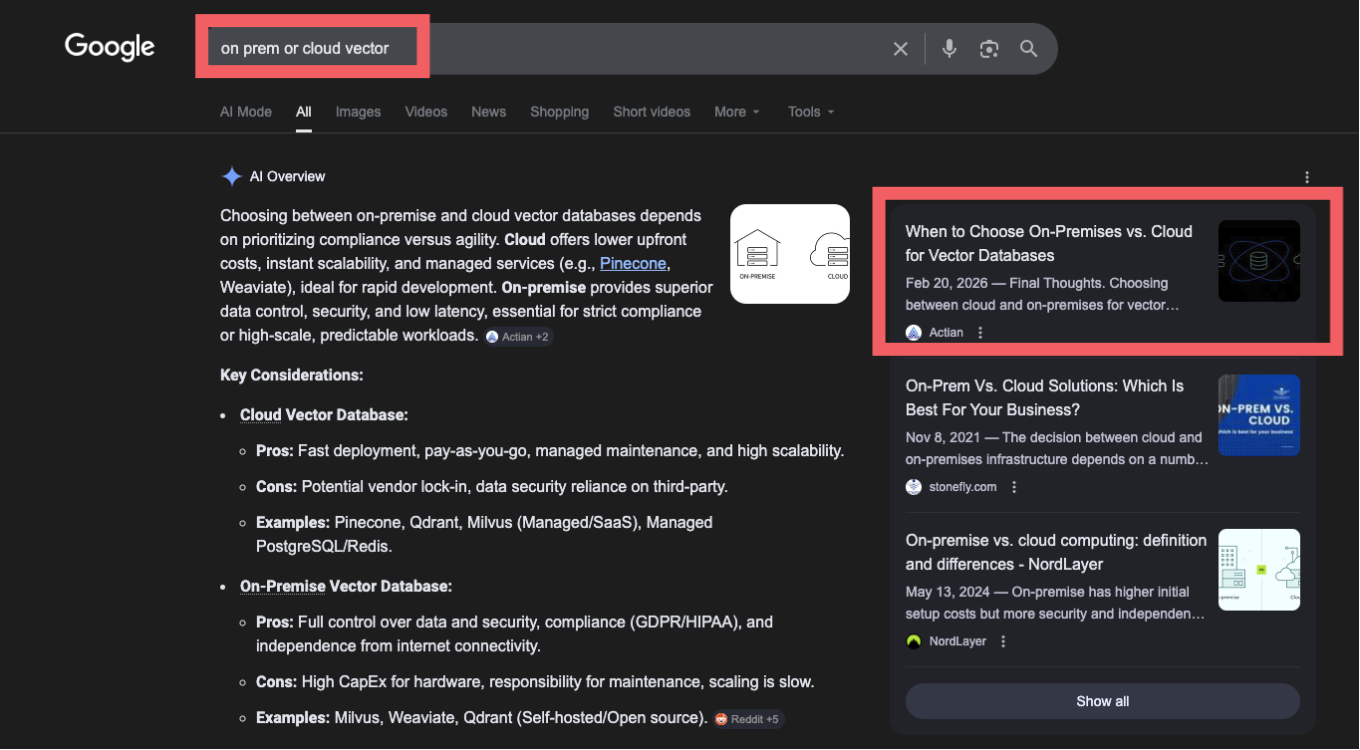
Led by our Head of Content, Henry Bassey, technical content became our second-largest developer acquisition channel. We focused on middle- and bottom-of-funnel topics that answered the questions developers ask when they're actively evaluating a tool. We published implementation guides, tutorials, comparison articles, benchmarks, and thought leadership pieces, that ranked on AI search (see image below)
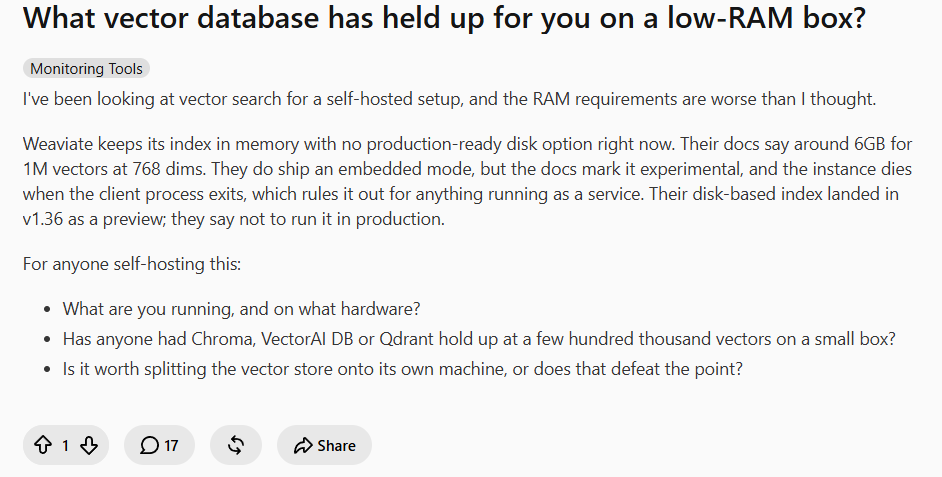
 Distribution was led by our Developer Advocate, Asjad Khan, who built a repeatable distribution strategy across Reddit, developer communities, newsletters, and other technical channels. Every piece of content was shared where developers were already discussing AI infrastructure, vector databases, and retrieval systems. That combination of high-quality content and consistent distribution continued driving qualified traffic, signups, and AI search visibility.
Search and paid acquisition
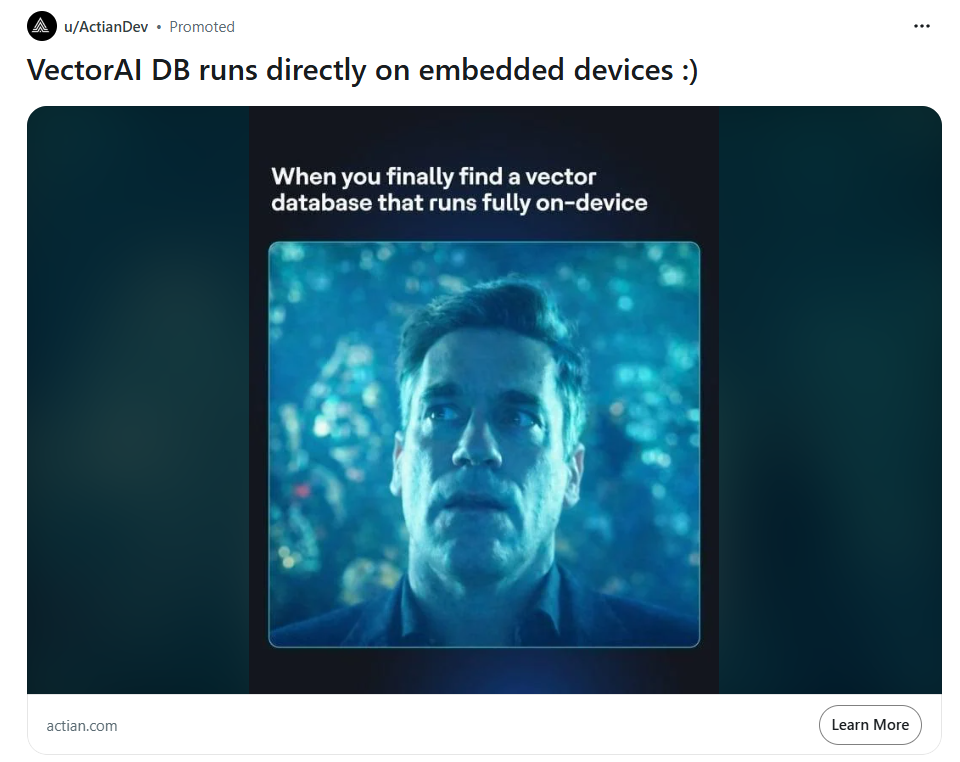
Led by me, search and paid acquisition became our largest developer acquisition channel. We built Google Ads campaigns around high-intent searches for vector databases, RAG, embeddings, and AI infrastructure, capturing developers already evaluating solutions. We also ran Reddit Ads across AI, machine learning, and vector database communities to reach engineers earlier in the evaluation process. Every visitor from Google Ads, organic search, documentation, Reddit Ads, and technical content was added to LinkedIn retargeting audiences, where we promoted technical articles, product updates, and documentation until they converted.
Creator and newsletter partnerships
We partnered with developer creators and sponsored technical newsletters to reach developers who discover new tools through creators and curated publications.
Video content
Videos gave developers another way to evaluate the product. We published walkthroughs, tutorials, and implementation videos that showed how VectorAI DB worked in practice.
Universities and hackathons
Led by Geri, university workshops and hackathons became an early developer acquisition and feedback channel. Developers built real projects with VectorAI DB, giving the team immediate insight into onboarding friction, documentation gaps, and SDK usability. That feedback was incorporated into the product and documentation throughout the launch.
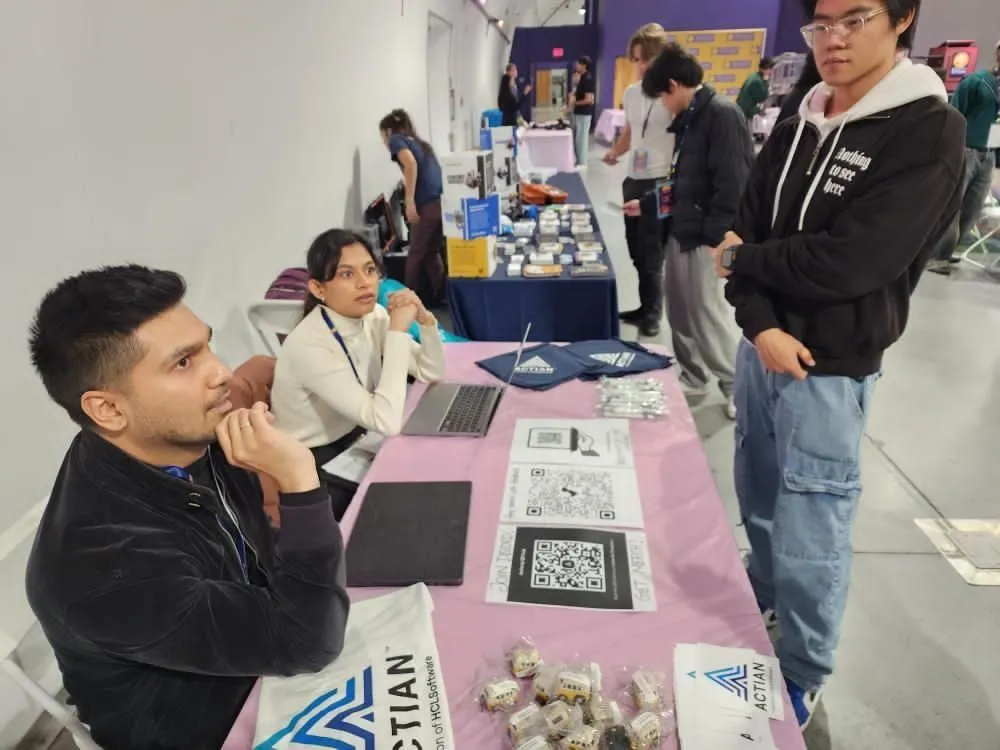
Looking back, this is what a developer marketing function looked like for VectorAI DB. Every channel solved a different problem. Together, they helped developers discover the product, evaluate it, build with it, and give the team feedback that improved every release.
4. Why bring in outside help?
I asked Jennifer why Actian chose to partner with a developer marketing agency instead of building everything in-house.
As CMO, I fundamentally believe that a marketing organization works best when you leverage in-house/full time employees, contractors, and agencies/partners. Depending upon the objectives and how fast you need to go, you make different resourcing decisions. In this case, it was easy to see that we could move faster and be most effective with a partner. The team looked into developer marketing agencies and when we came across Hackmamba it was clear that they were the best fit. Their expertise in the developer audience was immediately evident and they were able to add value from day one. William and team have a unique set of skills that combine the deeply technical with the creative and data-driven sides of marketing.
JJ’s answer reflects a practical approach to building marketing teams. Hiring isn't the only way to add capability. For specialized functions like developer marketing, the faster decision is often to bring in a team that has already solved similar problems. That gives the business immediate access to the experience, processes, and execution needed to move a product forward.
5. The foundations behind developer growth
I asked JJ where Hackmamba had the biggest impact on the VectorAI DB launch, and what made the biggest difference.
Hackmamba's biggest impact came in four areas. Building trust with our leadership team to help us push for the needs of modern developers. Creating developer content that resonated because it was deeply researched and never felt AI generated. Building relationships with universities so students could try out VectorAI DB and give us early feedback on the product before launch. Helping advise on creating the foundations for our PLG motion, whether it was licensing, developer touchpoints, or the developer events that supported our launch.
Looking back, those four areas touched almost every part of the developer journey. We worked with the product, engineering, and marketing teams to improve how developers discovered VectorAI DB, how quickly they could get started, and how the team gathered feedback to make each release better. That work continued well after launch as the product, documentation, and developer ecosystem expanded.
6. The shelf life of AI positioning
I asked JJ whether there were assumptions about the market, messaging, or developer behavior that changed after launch.
We launched with annual pricing. Developers needed monthly flexibility to test before committing to infrastructure. We adjusted. The AI market also moves fast so we monitor developer conversations closely to ensure our roadmap and messaging stay aligned with market needs.
Products often outlast their original positioning. The companies that remain relevant are the ones that continuously adapt how they communicate their value as developer priorities evolve.
The pricing change made sense. Developers want the flexibility to evaluate infrastructure before making a long-term commitment. A monthly option lowers that barrier and makes it easier to test the product in real workloads.
The second lesson is how quickly AI categories evolve. VectorAI DB launched when developers were focused on vector search and RAG. Within months, the conversation shifted toward agent frameworks, MCP, evaluation, and observability. The product remained relevant, but the conversations around it changed.
The shift isn't unique to Actian. It's happening across the developer ecosystem. LangChain is a good example. What started as a framework for chaining LLM calls evolved into LangGraph and LangSmith as developers moved from experimentation to production agent systems. Harrison Chase describes it as three generations of agent frameworks in just three years.
For marketing leaders, the lesson is clear. Monitoring developer conversations shouldn't end after launch. It should become a continuous input into positioning, messaging, content, and go-to-market decisions as the market evolves.
7. Build the product like a startup
As we wrapped up, I asked JJ what advice he'd give a Marketing leader preparing to launch a new AI developer tool.
Think outside the box, do things differently, shake things up! When we launched VectorAI DB, we made a deliberate choice to treat it like a startup inside a larger company. That meant building a dedicated team focused solely on the product, protecting it from legacy sales processes and internal approval cycles that would slow us down. In a product-led growth motion, customer experience is shaped by the systems and tools behind it. We gave the team autonomy to experiment and iterate quickly. The alternative of forcing VectorAI DB into traditional B2B processes would have killed the launch. That's why we partnered with Hackmamba. We needed a team that could move at startup velocity while we created organizational space for them to do it.
VectorAI DB wasn't managed like another enterprise product. It had a dedicated team with the authority to make decisions, experiment, and iterate. That made it possible to adjust pricing, refine messaging, improve onboarding, and respond to developer feedback as the AI market evolved. For new products inside large organizations, creating that autonomy can be just as important as building the product itself.
8. Looking back on our partnership
To close our conversation, I asked JJ how she would describe Hackmamba's role in helping Actian bring VectorAI DB to developers.
Hackmamba helped us successfully launch VectorAI DB. They brought three critical things we needed to bolster: deep developer marketing expertise that informed our strategy and positioning, the ability to produce high-quality technical content and videos at scale, and the relationships to activate developers through hackathons and university partnerships. Hackmamba didn't just execute a plan. They helped us build the right plan. They became an extension of our team and accelerated our entry into the developer market.
We have a simple belief at Hackmamba: our growth follows our clients' growth. That's the approach we brought to VectorAI DB, and it's the same approach we bring to every developer product we work on.
Looking Ahead
Thank you, JJ, for taking the time to answer these questions and for being candid throughout the interview.
Our work with VectorAI DB now has three priorities.
- First, scale the developer acquisition channels we've built over the past few months and get more developers signing up for the product.
- Second, help the team improve the onboarding experience so developers can move from sign-up to building production-ready applications with VectorAI DB faster.
- Third, help the team convert developer adoption into revenue by strengthening the path from first use to paid customers.
We'll also be joining the team at HexaFalls and the Autonomous Agents Hackathon in San Francisco, where developers will get hands-on experience building with the product.
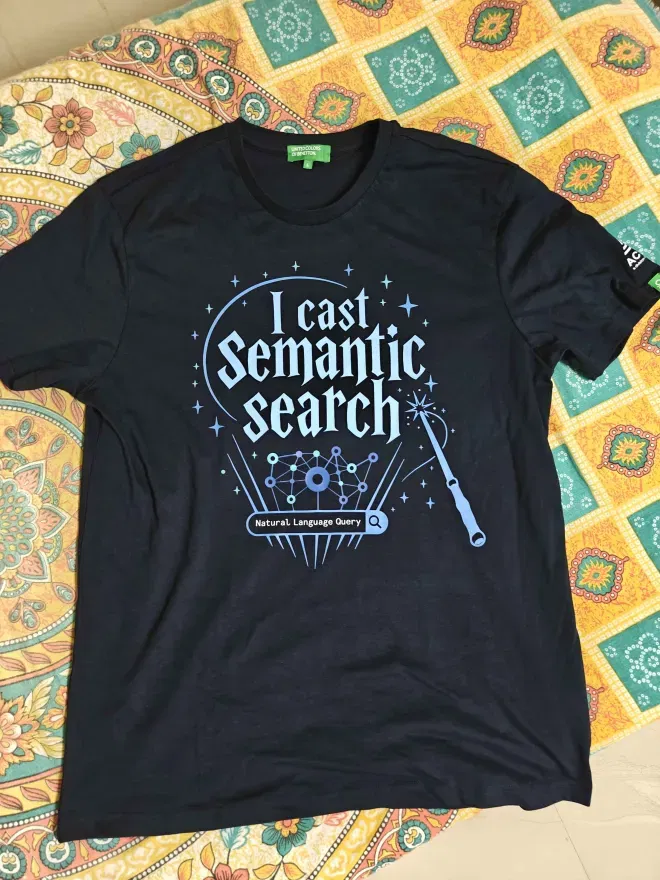
We also helped Actian hire a Head of Developer Marketing. We'll continue working with the team as they expand the programs we built and grow the developer marketing function internally.
Every developer product has a different journey, but the challenge is often the same: helping more developers discover the product, get to their first success quickly, and become long-term users. If that's something you're working through, we'd be happy to share what we've learned from working with companies like Actian.
About author
From SEO and growth campaigns to documentation, landing pages, and developer-focused content, the list goes on! My passion lies in helping products connect with developers and driving measurable results through thoughtful marketing. Outside of work, you’ll find me chasing new adventures, gazing at the moon, and enjoying the timeless charm of old Hollywood movies.









.svg)