17 tech YouTubers to follow or partner with in 2026
Discover the best tech YouTubers for developers: 17 creators in coding, AI, DevOps, and cybersecurity, with subscriber counts and median video views.

Trying to learn Kubernetes? Nana Janashia has detailed tutorials on Docker, Kubernetes, and CI/CD.
Preparing for coding interviews? Raj Vikramaditya, better known as Striver, has built an entire learning library around data structures and algorithms. And if you're getting into LLM evaluations, Hamel Husain is someone I'd recommend following.
There are plenty of tech YouTubers covering everything from programming to AI. Finding creators who consistently teach something useful takes a little more work.
I put together this list for two groups: developers looking for people they can learn from, and DevTools companies looking for creators whose content reaches the software engineers they want to acquire.
I shortlisted 17 tech YouTubers covering coding, AI, DevOps, cybersecurity, data engineering, and Web3. I also used the Bright Data API to collect publicly available YouTube data on November 4, 2026, including subscriber counts and video views, so you can see how each creator's content is performing.
Whether you're looking for your next YouTube subscription or researching creators for an influencer marketing campaign, you'll find their channels, areas of expertise, and audience metrics below.
How I picked these tech YouTubers
I started with 20 YouTube channels covering software development, AI, cloud infrastructure, security, and related technical subjects.
I used the Bright Data API to scrape publicly available YouTube channel and video data, including subscriber counts, video views, and upload dates.
From there, I selected 17 individual creators whose content is relevant to developers.
For each channel, I looked at:
- Subscribers: How many people subscribe to the channel.
- Recent video views: Views recorded across up to 10 available uploads.
- Median views: The middle value of those sampled video views.
- Content: What the creator teaches and who the videos are for.
I used median views because one unusually popular video can push the average up. It's a helpful starting point for understanding how individual uploads perform.
The sample includes Shorts and long-form videos. Some channels also have older uploads, which I've flagged below.
Here's what I found.
In a nutshell: Tech YouTubers by subscribers, topics and median video views
By subscribers and topics
| Tech YouTuber | Main topic | Subscribers |
|---|---|---|
| Nana Janashia | DevOps, Kubernetes | 1.5M |
| Raj Vikramaditya (Striver) | Coding, DSA | 1.13M |
| Kunal Kushwaha | DevOps, open source | 926K |
| Abhishek Veeramalla | AWS, DevOps | 677K |
| Gerald Auger | Cybersecurity | 278K |
| Daniel Bourke | Machine learning | 253K |
| Andreas Kretz | Data engineering | 245K |
| Ben Sadeghipour | Ethical hacking | 212K |
| Patrick Collins | Web3, Solidity | 173K |
| Mischa van den Burg | Kubernetes | 129K |
| Benjamin Rogojan | Data engineering | 123K |
| Adrian Cantrill | AWS architecture | 74.9K |
| Rishab Kumar | Cloud, DevRel | 34.8K |
| Elvis Saravia | LLMs, AI research | 25.5K |
| Jason Haddix | Offensive security | 24.5K |
| Hamel Husain | LLM evaluations | 20.5K |
| Brian Jenney | Software engineering, AI | 10.6K |
By median video views
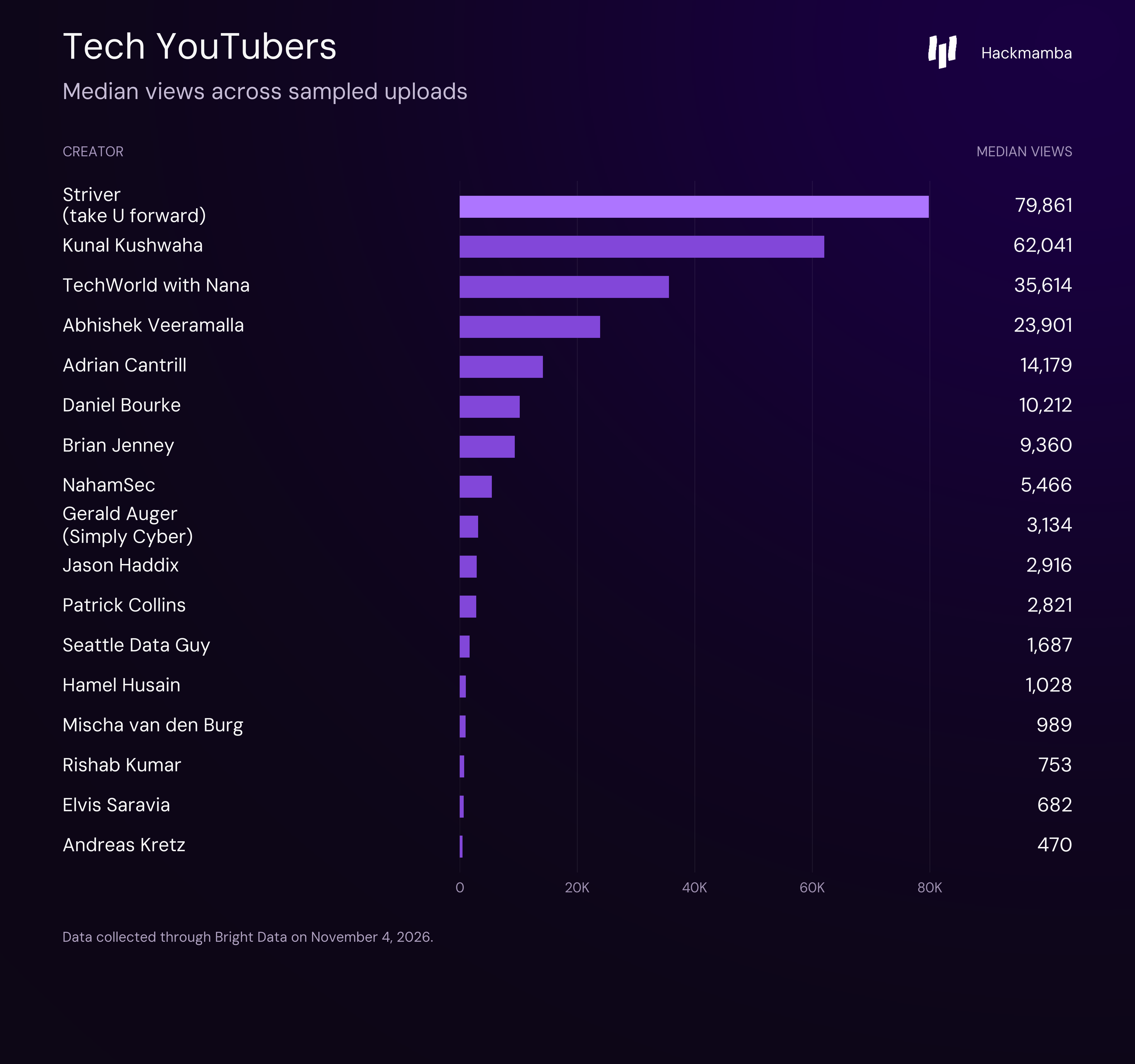
One interesting finding was Brian Jenney. He had 10,600 subscribers, but his sampled videos had a median of 9,360 views.
Andreas Kretz, with 245,000 subscribers, had a median of 470 views across his sampled videos.
The samples cover different topics and upload dates, so this isn't a direct comparison of sponsorship performance. It's a good reason to look at individual videos before making decisions based on subscriber counts.
Now, let's get into the creators.
Best coding and programming YouTubers
If you're learning to code, preparing for interviews, or exploring AI-assisted development, these two channels are good starting points.
1. Raj Vikramaditya (Striver)
YouTube: take U forward Subscribers: 1.13 million Median video views: 79,861
If you've ever prepared for a software engineering interview, you've probably come across Striver.
His channel, take U forward, focuses on data structures, algorithms, competitive programming, and coding interview preparation.
One of his best-known resources is the A2Z DSA Course, which takes learners through programming fundamentals, arrays, recursion, linked lists, trees, graphs, and dynamic programming.
He breaks problems down, works through the logic, and explains how to approach similar questions.
I'd recommend Striver to students preparing for technical interviews and developers who want to revisit their DSA fundamentals. His channel had 547 videos and more than 219 million lifetime views when we collected the data.
Good for: Data structures, algorithms, coding interviews, and competitive programming.
2. Brian Jenney
YouTube: Brian Jenney Subscribers: 10,600 Median video views: 9,360
Brian Jenney creates content around software engineering, AI-assisted development, and working with AI tools. His videos explore how developers can incorporate AI into their workflows and what it takes to move into AI-focused engineering roles.
What caught my attention was his view data. Despite having 10,600 subscribers, his sampled videos averaged 9,648 views, with a median of 9,360.
For a smaller channel, that's an interesting result. If you're experimenting with AI coding tools or trying to understand how software engineering roles are changing, his channel is worth exploring.
Good for: Applied AI, AI coding tools, and software engineering careers.
Best AI and machine learning YouTubers
AI YouTube has grown into a pretty broad category. You'll find everything from daily model announcements to tutorials that walk through training models, building LLM applications, and evaluating outputs.
These three creators focus on the technical side.
3. Daniel Bourke
YouTube: Daniel Bourke Subscribers: 253,000 Median video views: 10,212
Daniel Bourke teaches machine learning through practical projects. His tutorials cover PyTorch, deep learning, computer vision, and building machine learning applications with Python.
He often works through code, explains what's happening, and shares learning resources that viewers can follow.
His Learn PyTorch material is a good example.I'd recommend his channel if you already know some Python and want to get comfortable building and training machine learning models.
Good for: Python, PyTorch, deep learning, and machine learning projects.
4. Hamel Husain
YouTube: Hamel Husain Subscribers: 20,500 Median video views: 1,028
Building an LLM demo is one thing. Figuring out why it fails on real user inputs is another problem entirely.
That's the kind of work Hamel Husain talks about. His content covers LLM evaluations, LLM-as-a-judge, testing AI applications, and improving their reliability.
He also writes extensively about these subjects on hamel.dev. If you're building an AI application and trying to understand how to evaluate its output, Hamel's work is a good place to start.
Good for: LLM evaluations, AI application testing, and production AI.
5. Elvis Saravia
YouTube: Elvis Saravia Subscribers: 25,500 Median video views: 682
Elvis Saravia covers large language models, prompt engineering, and AI research. He's also associated with DAIR.AI, which maintains educational resources such as the Prompt Engineering Guide.
His work is helpful if you're trying to understand research concepts and how they apply to building AI applications.
I'd put him on the list for developers who want to learn more about prompting techniques, LLM capabilities, and emerging research.
Good for: LLMs, prompt engineering, and applied AI research.
Best DevOps, cloud, and platform engineering YouTubers
If you're learning Docker, Kubernetes, AWS, Terraform, or CI/CD, this category has some particularly good educators.
6. Nana Janashia
YouTube: TechWorld with Nana Subscribers: 1.5 million Median video views: 35,614
Nana Janashia runs TechWorld with Nana, one of the larger YouTube channels dedicated to DevOps education.
Her tutorials cover Docker, Kubernetes, Terraform, CI/CD, and cloud infrastructure. Her longer videos often begin with the fundamentals before moving into implementation.
For example, her Docker content explains images, containers, networking, and how the pieces fit together when running an application.
That makes her channel particularly helpful for developers moving into DevOps or platform engineering.
Good for: Docker, Kubernetes, Terraform, CI/CD, and DevOps fundamentals.
7. Kunal Kushwaha
YouTube: Kunal Kushwaha Subscribers: 926,000 Median video views: 62,041
Kunal Kushwaha creates tutorials on DevOps, cloud-native development, Kubernetes, Docker, and open source. He also spends time helping developers understand how to contribute to open-source projects.
One resource worth checking is his DevOps Bootcamp, which includes learning materials, assignments, and project resources.
His content is particularly relevant to developers getting started with DevOps and open-source contributions..
Good for: DevOps, Kubernetes, open source, and cloud-native development.
8. Abhishek Veeramalla
YouTube: Abhishek Veeramalla Subscribers: 677,000 Median video views: 23,901
Abhishek Veeramalla creates practical tutorials around AWS, DevOps, Kubernetes, Terraform, and CI/CD. A lot of his content follows a Zero to Hero format, making it easier to work through a subject in sequence.
His AWS DevOps Zero to Hero repository also gives learners access to project material and exercises.
If you're learning how to deploy applications, manage cloud infrastructure, or automate development workflows, his channel has plenty to explore.
Good for: AWS, Terraform, Kubernetes, and DevOps projects.
9. Mischa van den Burg
YouTube: Mischa van den Burg Subscribers: 129,000 Median video views: 989
Mischa van den Burg covers Kubernetes, cloud-native infrastructure, and homelab projects.
His videos explore tools such as Talos, CloudNativePG, and other technologies used to manage Kubernetes environments.
If you enjoy setting up infrastructure yourself and understanding how different components behave, you'll probably find something relevant here.
His sampled uploads had a median of 989 views. However, the sample included videos published as recently as November 4, so some had very little time to accumulate views.
Good for: Kubernetes, homelabs, and cloud-native infrastructure.
10. Adrian Cantrill
YouTube: Adrian Cantrill Subscribers: 74,900 Median video views: 14,179
Adrian Cantrill teaches AWS architecture and cloud engineering.
His educational material goes into networking, identity, storage, security, and designing systems using AWS services.
He's also known for his detailed AWS certification courses. I'd recommend his work if you're preparing for AWS certifications or want to understand how AWS services work together when designing applications.
One thing to flag: the ten videos in our sample were published between March and July 2023.
Good for: AWS architecture, cloud fundamentals, and certification preparation.
11. Rishab Kumar
YouTube: Rishab Kumar Subscribers: 34,800 Median video views: 753
Rishab Kumar creates content around cloud engineering, developer advocacy, and technical education.
His work covers cloud-native technologies and topics relevant to developers working with modern infrastructure.
He's also someone I'd look into if I were researching how developer advocates explain technical products through educational content.
Good for: Cloud engineering, developer advocacy, and technical education.
Best cybersecurity and ethical hacking YouTubers
Security covers several different disciplines. A developer interested in securing an application will probably look for different material than someone preparing for a SOC analyst role.
These three creators cover defensive security, web hacking, and offensive security.
12. Gerald Auger
YouTube: Simply Cyber Subscribers: 278,000 Median video views: 3,134
Gerald Auger runs Simply Cyber, a channel covering cybersecurity education, security careers, and defensive security practices.
His content includes discussions about security operations, industry developments, and what people working in cybersecurity do.
If you're interested in SOC operations or considering a career in cybersecurity, his channel is a good starting point.
Good for: Cybersecurity fundamentals, SOC operations, and security careers.
13. Ben Sadeghipour (NahamSec)
YouTube: NahamSec Subscribers: 212,000 Median video views: 5,466
Ben Sadeghipour, better known as NahamSec, creates content about ethical hacking, bug bounties, and web application security.
His tutorials explore reconnaissance, vulnerability research, and how security researchers approach web applications. If you're a developer interested in understanding how attackers identify weaknesses in applications, his videos are worth watching.
His content is also relevant to teams building application-security and developer-security tools.
Good for: Ethical hacking, bug bounties, and web application security.
14. Jason Haddix
YouTube: Jason Haddix Subscribers: 24,500 Median video views: 2,916
Jason Haddix is known for The Bug Hunter's Methodology, which covers approaches to reconnaissance and vulnerability discovery.
His educational material goes into how security researchers investigate targets, identify attack surfaces, and organize their testing.
You can also find related training through The Bug Hunter's Methodology. His YouTube content is particularly relevant if you're learning penetration testing or bug bounty research.
Good for: Penetration testing, reconnaissance, and offensive security.
Best data engineering YouTubers
Data engineering is another area where YouTube can be helpful, particularly when you're learning how databases, pipelines, orchestration, and analytics infrastructure work together.
15. Andreas Kretz
YouTube: Andreas Kretz Subscribers: 245,000 Median video views: 470
Andreas Kretz teaches data engineering fundamentals, including data pipelines, architecture, and engineering projects.
He's also behind Learn Data Engineering, which provides educational resources for people entering the field.
If you're trying to understand ETL pipelines, data infrastructure, or what data engineers work on, his content is a relevant starting point.
Interestingly, the ten sampled uploads had a median of 470 views. Anyone evaluating the channel for a collaboration should inspect the formats and publication dates before drawing conclusions from that number.
Good for: Data pipelines, ETL, and data engineering fundamentals.
16. Benjamin Rogojan (Seattle Data Guy)
YouTube: Seattle Data Guy Subscribers: 123,000 Median video views: 1,687
Benjamin Rogojan creates content about data engineering, analytics architecture, and building data pipelines.
He covers topics such as ETL, ELT, data infrastructure, and careers in data engineering. His Seattle Data Guy newsletter also explores data engineering and related technical subjects.
I'd recommend his channel to developers working with data systems or considering a move into data engineering. His sampled videos had a median of 1,687 views. The sample ended in June 2026, so check his latest uploads if you're evaluating current activity.
Good for: Data engineering, ETL/ELT, and analytics infrastructure.
Best Web3 and blockchain development YouTubers
17. Patrick Collins
YouTube: Patrick Collins Subscribers: 173,000 Median video views: 2,821
If you're learning Solidity or smart-contract development, Patrick Collins is someone you'll probably come across. His tutorials cover Solidity, Foundry, blockchain development, and smart-contract security.
He's also associated with Cyfrin Updraft, which provides structured courses for developers learning blockchain development.
His longer tutorials walk through writing, testing, and working with smart contracts. I'd recommend his content to developers building on Ethereum-compatible blockchains or getting started with smart-contract security.
Good for: Solidity, Foundry, and smart-contract development.
How to find the right tech YouTuber for your developer product
Let's say you're marketing a Kubernetes observability tool. You could approach a creator with a million subscribers who occasionally talks about cloud infrastructure.
But before doing that, I'd want to know something more specific: How many of their viewers are actively deploying, managing, or debugging Kubernetes clusters? That's the audience your product needs to reach. The same applies to other developer products.
If you're marketing an LLM evaluation platform, Hamel Husain's content is worth examining.
For an application-security product, I'd start by reviewing NahamSec and Jason Haddix. And for a DevOps tool, creators such as Nana Janashia, Kunal Kushwaha, and Abhishek Veeramalla are relevant starting points.
Here's how I'd evaluate them before spending money.
1. Look at the videos, not just subscriber counts
Subscriber numbers are useful for understanding a channel's size. They tell you very little about how an individual sponsored video might perform.
Take Brian Jenney. He had 10,600 subscribers, but his ten sampled uploads had a median of 9,360 views. That doesn't mean a sponsored video will get 9,000 views. It tells us his sampled uploads performed at that level.
I'd pull the creator's latest five to ten relevant videos, check their views and publication dates, and look for consistency. For technical products, I'd also compare long-form tutorials separately from Shorts.
2. Read the comments
Comments can tell you what people are trying to do with the information in a video. For example, on a Kubernetes tutorial, I'd look for questions about deployments, networking, debugging, and production environments.
Those are useful signals that viewers are trying to apply what they've learned. If most comments are from beginners asking how to install Docker, that's useful context too.
The right audience depends on what your product does.
3. See how the creator explains technical products
This matters quite a bit. In our survey of 101 developers about technical video content, 33% of respondents said excessive marketing or product promotion was their biggest frustration.
Another 24% pointed to missing or incomplete code. So, before approaching a creator, watch how they handle tutorials.
- Do they show the actual implementation?
- Can viewers follow along?
- Do they explain errors when something doesn't work?
For developer products, these details matter because the audience often wants to try the tool themselves.
4. Give the creator something they can actually build
If you're sponsoring a tutorial about your API, provide working documentation, API credits, and a sample project.
Let the creator work through the integration. Ideally, the finished video should help a developer complete a task with your product. You can review technical claims for accuracy without scripting every sentence.
5. Track what happens after someone watches
Views are useful, but I'd want to know what happened afterward.
- Did someone visit the documentation?
- Sign up?
- Make their first API call?
- Deploy something?
These actions tell you whether the campaign introduced developers who actually tried the product. Use trackable links and campaign landing pages where appropriate, and agree on what success looks like before the video goes live.
One final thing: the creators in this article haven't necessarily agreed to sponsorships. You'll need to contact them to confirm availability, pricing, and deliverables.
If you're building a creator program, our guide to developer marketing channels covers how creator partnerships fit into a broader distribution strategy.
Reach more developers with Hackmamba
Finding the right tech YouTubers is only the first step. You also need to understand who watches their content, whether those viewers are likely to use your product, and how to turn that interest into signups and active users.
At Hackmamba, we help DevTools and developer-focused companies acquire software engineers through tech influencer marketing.
We identify creators whose audiences match your ideal developers, manage outreach and partnerships, and work with them to produce technical tutorials, product walkthroughs, and integrations that show your product in use.
We also handle distribution and track what happens after someone watches, from website visits and developer signups to first API calls and product activation.
If you're looking to reach more software engineers through trusted technical creators, let's talk about your influencer marketing campaign.
FAQ
It depends on what you're learning. For Docker and Kubernetes, start with Nana Janashia. For DSA and coding interviews, check Striver. Daniel Bourke covers machine learning, Hamel Husain focuses on LLM evaluations, and NahamSec teaches web application security.
Striver's take U forward channel is a good place to learn data structures and algorithms. Brian Jenney covers software development and applied AI. If you're interested in the infrastructure side of software development, Nana Janashia, Kunal Kushwaha, and Abhishek Veeramalla have tutorials on Docker, Kubernetes, and AWS.
Brian Jenney, Hamel Husain, and Jason Haddix are three creators to explore. They cover different areas: software engineering and applied AI, LLM evaluations, and offensive security. All three had fewer than 25,000 subscribers in our November 2026 dataset.
Start by searching for creators who regularly teach the technologies your product supports. Check their recent tutorials, views, comments, and publishing frequency. Then contact the creators who appear relevant to ask about sponsorship availability and audience information.
For practical AI and machine learning content, I’d start with Daniel Bourke, Elvis Saravia, and Hamel Husain. They cover everything from building and training models to working with LLMs and putting AI applications into production.
About author
From SEO and growth campaigns to documentation, landing pages, and developer-focused content, the list goes on! My passion lies in helping products connect with developers and driving measurable results through thoughtful marketing. Outside of work, you’ll find me chasing new adventures, gazing at the moon, and enjoying the timeless charm of old Hollywood movies.