15 best MCP gateways for enterprise AI agents (2027)
Compare 15 MCP gateways for enterprise AI agents: managed platforms, API gateways with MCP support, self-hosted open-source options, and a practical test plan.

An MCP gateway is a proxy that sits between AI agents (MCP clients) and the MCP servers they call. It gives platform teams one place to authenticate users and agents, control which tools they can access, inject credentials, and log tool calls.
For example, consider an AI coding agent that needs read access to GitHub and internal documentation, along with permission to create Jira tickets. An MCP gateway can help enforce those permissions, manage credentials, and record the agent's actions.
But implementing these controls raises practical questions. Which permissions should the gateway enforce? Which should remain with downstream services? And what happens when authentication or authorization fails?
These questions matter as adoption of MCP grows. Anthropic introduced the Model Context Protocol in November 2024 and donated it to the Linux Foundation's Agentic AI Foundation in December 2025. MCP now has vendor-neutral governance, and gateway providers are building on the shared standard.
This guide compares 15 MCP gateways, including managed platforms, API gateways with MCP support, and self-hosted open-source options. It also provides a practical test plan to help you evaluate your shortlist.
How I picked these MCP gateways
I included products that meet three criteria: they sit between MCP clients and MCP servers or turn existing APIs into MCP tools, they document authentication, tool-level access control, and logging for MCP traffic, and they are generally available or open source as of November 2026.
Details come from each vendor's public product pages, docs, and GitHub repositories, reviewed in November 2026. I did not run hands-on benchmarks, so confirm features, limits, and pricing with each vendor before you buy. The list is grouped by type, not ranked.
What to evaluate before selecting an MCP gateway
The MCP authorization specification (2026-07-28 revision) defines how HTTP-based MCP transports handle OAuth. Gateways add operational controls on top of it.
1. Authentication and identity propagation
Determine how the gateway authenticates clients and identifies who initiated each request. Check for enterprise SSO, OAuth authorization, machine-to-machine authentication, scoped downstream credentials, and independent credential revocation.
Test how identities propagate to connected services. Gateway authentication does not automatically establish downstream authorization.
2. Tool discovery and authorization
MCP clients discover available tools through tool-listing requests. Gateways can aggregate servers and filter tools according to user or agent permissions.
Verify whether permissions apply during discovery and execution. Test what happens when an upstream server introduces new tools.
Gateways that generate tools from OpenAPI specs inherit the quality of those specs, so vague endpoint descriptions become vague tool descriptions. Hackmamba's guide to AI-ready API documentation covers how to fix that at the source.
3. Runtime security
Tool arguments and responses can contain untrusted instructions. The OWASP MCP Top 10 addresses risks involving credential exposure, tool poisoning, and insufficient authorization.
Evaluate request inspection, response filtering, resource restrictions, and data loss prevention integrations. Determine whether policies block execution or generate alerts.
4. Observability and auditability
Audit records should identify the principal, tool, execution time, outcome, and applicable policy decision.
Measure gateway processing overhead, downstream execution time, end-to-end latency, throughput, and errors separately. Low internal gateway overhead does not establish low end-to-end latency.
5. Deployment and failure behavior
Examine control-plane and data-plane separation, private connectivity, configuration management, and recovery procedures.
Test upstream timeouts, expired credentials, unavailable policy services, and control-plane failures. Document whether the gateway fails open or closed for security-critical operations.
Many of these failure modes, such as expired tokens, rate limits, and slow upstreams, are classic API integration problems. See common API integration challenges and how to overcome them for patterns that carry over.
15 best MCP gateways compared at a glance
The table provides an overview of all 15 MCP gateways, followed by detailed comparisons across three categories: managed platforms (1–6), API and cloud gateways with MCP support (7–10), and self-hosted open-source gateways (11–15).
| Gateway | Type | Deployment | Standout feature | Best for |
|---|---|---|---|---|
| TrueFoundry MCP Gateway | AI gateway platform | Managed, VPC, on-prem, air-gapped | LLM routing and MCP governance in one platform | Teams that want model and tool traffic governed together |
| Mintive MCP gateway | Managed MCP governance | Managed cloud (US/EU); self-hosted on request | Role-based Virtual MCP bundles | Rolling MCP out to non-engineering teams |
| Runlayer | AI control plane | Managed | Human approval for risky tool calls | Security-led rollouts with approval workflows |
| Speakeasy | AI control plane | Cloud or self-hosted | IdP-provisioned access plus MDM rollout | Orgs managing agents on company devices |
| Composio MCP gateway | Tool and auth platform | Cloud; VPC or self-hosted on Enterprise | 1,700+ managed app toolkits with OAuth | Agents that act in many SaaS apps per user |
| Prisma AIRS AI Gateway (formerly Portkey) | AI gateway with security | SaaS or hybrid (your Kubernetes) | Per-tool provisioning and rate limits | Palo Alto Networks or Portkey customers |
| Kong AI Gateway | API gateway extended to MCP | Kong Konnect or self-managed | REST endpoints mapped to MCP tools | Teams already running Kong |
| Cloudflare MCP server portals | Zero Trust portal | Managed (Cloudflare) | Curated tools behind Cloudflare Access | Cloudflare One customers |
| Amazon Bedrock AgentCore Gateway | Managed cloud gateway | Managed, serverless (AWS) | APIs and Lambda functions as MCP tools | Agents built on AWS |
| Traefik Hub MCP Gateway | API gateway extended to MCP | Self-hosted, air-gapped capable | Task-based access control on tool arguments | Kubernetes teams needing fine-grained policy |
| Obot | Open source (MIT) | Self-hosted or Obot Cloud | Catalog, SSO, and shadow MCP scanning | Teams that want OSS with a full admin UI |
| Bifrost (Maxim AI) | Open source (Apache 2.0) | Self-hosted; enterprise edition | LLM, MCP, and agent gateway in one Go binary | Self-hosted model routing plus MCP |
| IBM ContextForge | Open source (Apache 2.0) | Self-hosted (PyPI, Docker, Kubernetes) | Federation of MCP, A2A, REST, and gRPC | Federating many services across environments |
| Docker MCP Gateway | Open source (MIT) | Local or self-hosted (Docker) | Each MCP server in an isolated container | Developers and small teams |
| Microsoft MCP Gateway | Open source (MIT) | Self-hosted (Kubernetes, Azure template) | Server lifecycle management on Kubernetes | Platform teams hosting many MCP servers |
1. TrueFoundry MCP Gateway
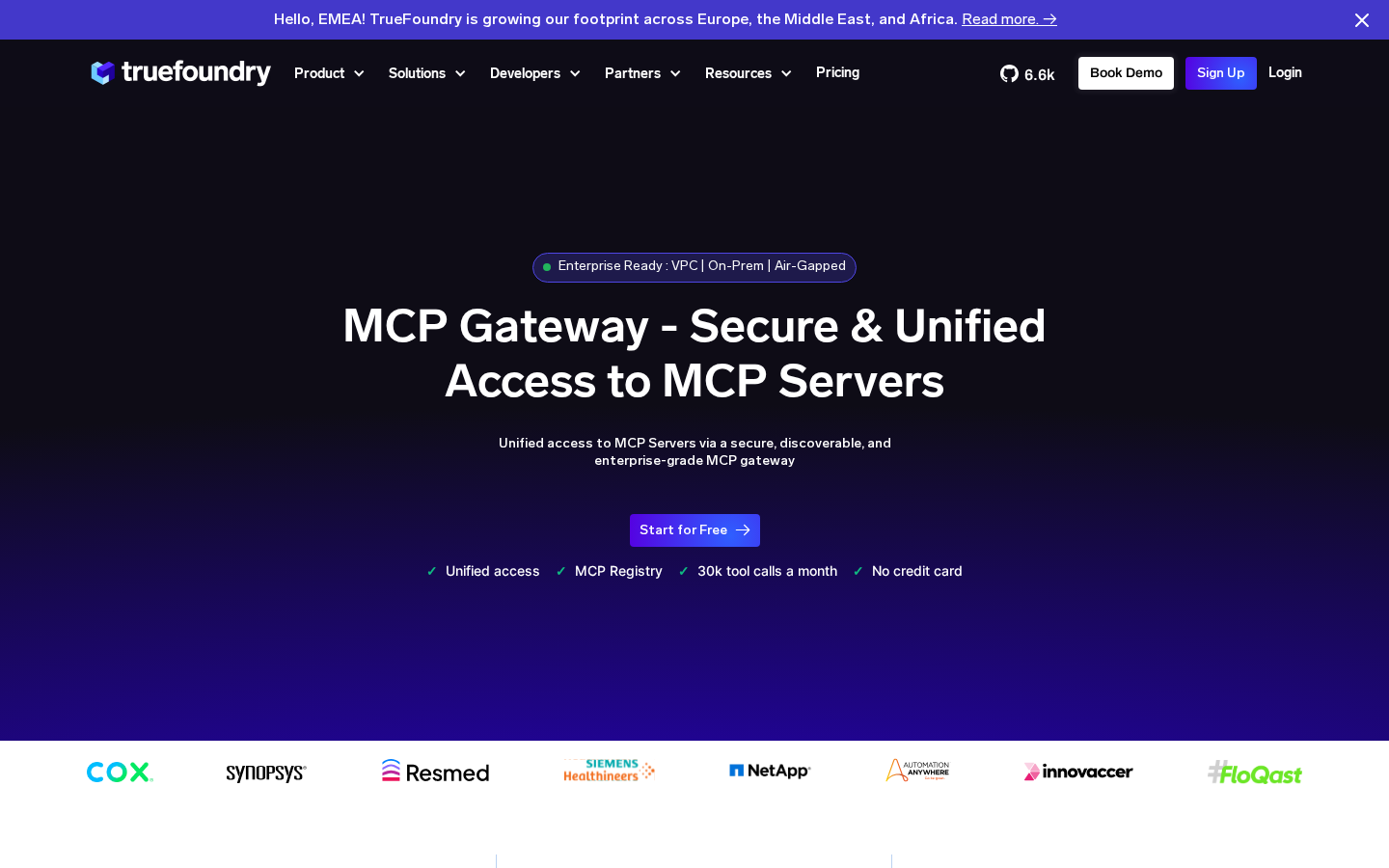
TrueFoundry MCP Gateway is the MCP layer of TrueFoundry's AI gateway platform, built for teams that want model traffic and MCP tool access governed in one place.
It keeps internal and third-party MCP servers in a central registry with approval flows per role, federates login through Okta, Azure AD, or another IdP, applies RBAC per MCP server, and supports OAuth 2.0 with dynamic discovery. Every MCP call, agent step, and LLM request is traced with latency, error, and usage data that you can filter by user, tool, or team.
Deployment: managed, or inside your own VPC, on-prem, air-gapped, or across clouds. TrueFoundry lists SOC 2, HIPAA, and GDPR compliance. The MCP gateway page offers a no-credit-card start that includes 30,000 tool calls a month. Best for: teams that want LLM routing and MCP governance in one platform, running in their own cloud. What to test: Examine Kubernetes integration, secrets management, network policies, and resource isolation. Measure MCP tool-call latency independently of LLM gateway processing overhead.
2. Mintive MCP gateway (formerly MintMCP)
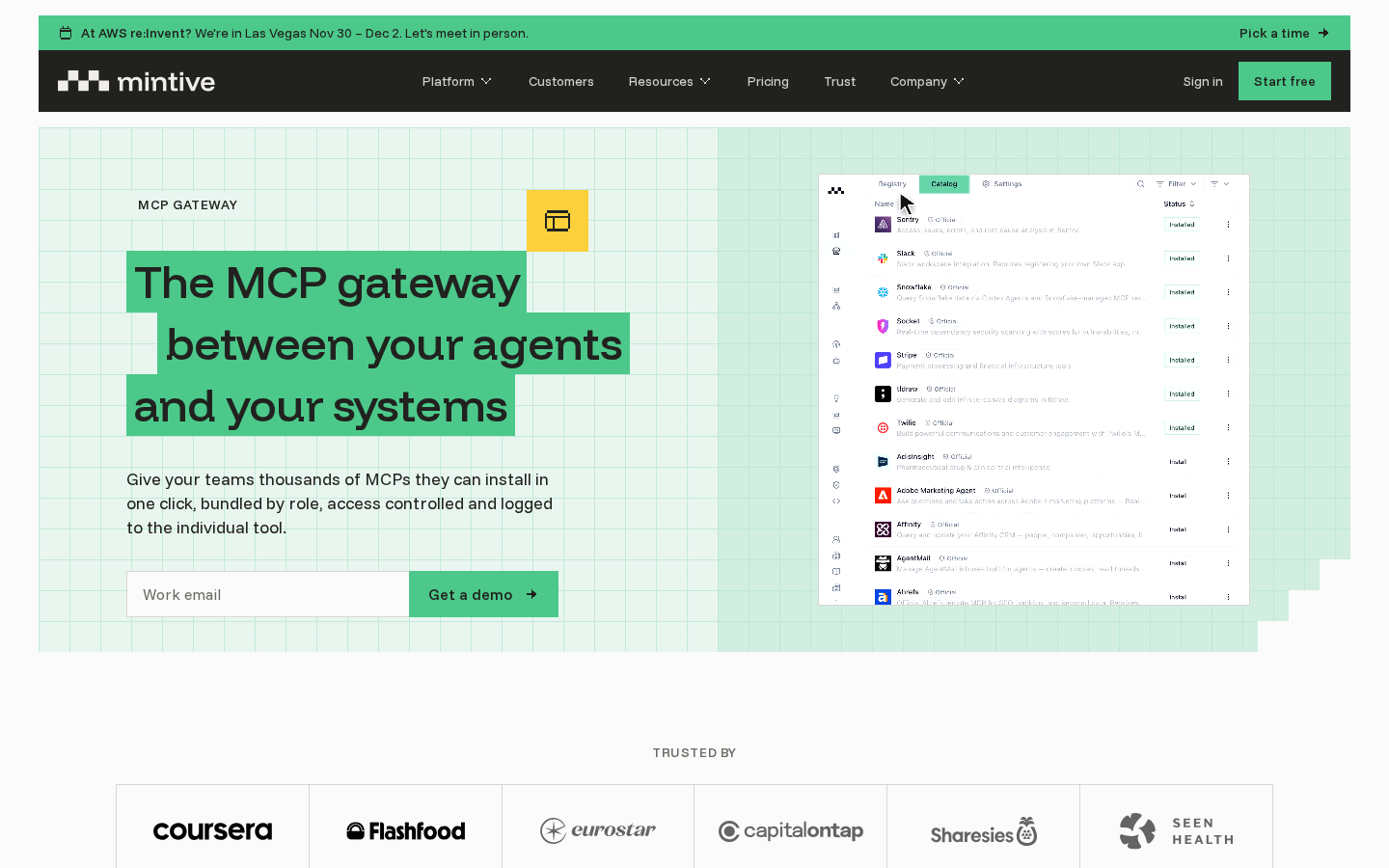
Mintive, renamed from MintMCP in October 2026, is a managed MCP gateway that bundles approved MCP servers into role-based endpoints it calls Virtual MCPs.
Admins curate a catalog of approved servers with pre-configured credentials and can turn off destructive tools. SSO through SAML or OAuth, with SCIM group sync, drives Virtual MCP access policies, and autonomous agents get their own identities and credentials instead of borrowing human logins. Mint Guard screens tool calls for prompt injection and sensitive data, starting in monitoring mode before enforcing, while Rules and gateway middleware handle custom masking. Agent Monitor ties each call to a person, agent, server, and model and exports the record to a SIEM or over OTLP. The same platform includes an LLM gateway with per-team budgets.
Deployment: managed cloud with US or EU data residency; VPC and self-hosted deployment on request. Pricing is a custom quote based on active AI agent users. Best for: companies rolling MCP out to non-engineering teams in ChatGPT, Claude, and Microsoft 365 Copilot that want role-based tool bundles. What to test: Revoke an agent identity, change directory permissions, and verify whether audit records attribute actions to the correct principal.
3. Runlayer
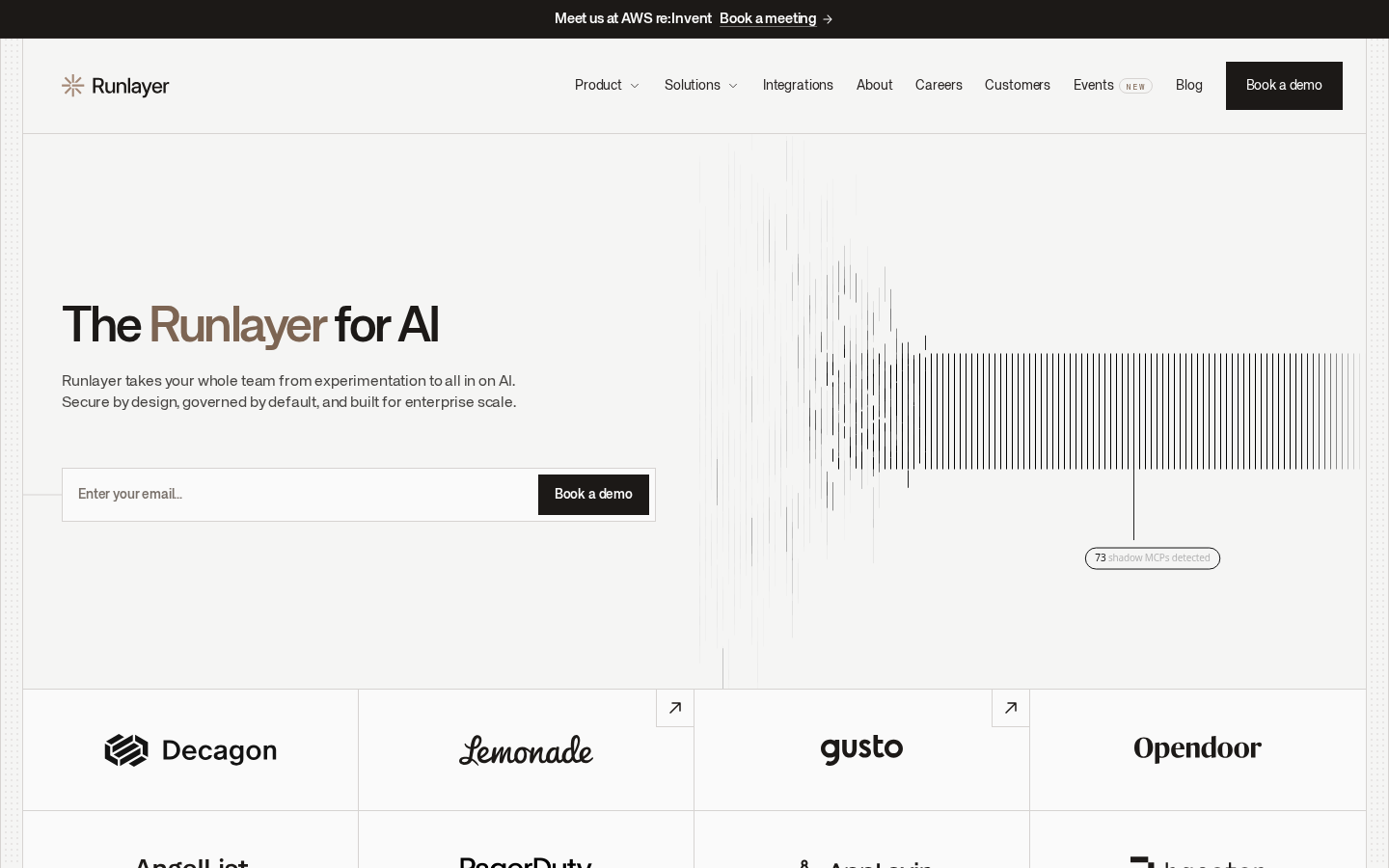
Runlayer is a managed AI control plane whose gateway sits between agents and company data for both MCP and LLM calls, with permissions, authentication, and allowed tools defined up front.
It discovers shadow agents, MCP servers, and skills across endpoints and clients, keeps an internal catalog of approved connectors and agents, and can require human approval before a risky tool call runs. Built-in scanners look for PII, data exfiltration, and agent intent drift, starting in alert-only mode before you switch to blocking. Runlayer describes the MCP gateway as one layer of a wider enablement platform.
Deployment: managed platform. The public site does not describe self-hosting, so ask during evaluation. Best for: security teams that want approval workflows and shadow AI discovery alongside the gateway. What to test: Attempt a sensitive operation requiring additional approval. Verify whether execution is blocked or held, how approval decisions are recorded, and whether authorization persists beyond the intended operation. Also test credential revocation during active sessions.
4. Speakeasy
Speakeasy sells an AI control plane built around an MCP gateway that gives each team one governed URL to its MCP servers, provisioned by role from the identity provider.
Teams and roles sync from Okta or Entra ID, agents run on short-lived, task-scoped credentials, and permissions go down to the individual tool, with a matching deny rule always winning. Rollout to employee machines can run through Jamf, Intune, or another MDM, and connections to MCP servers outside the approved catalog are detected and quarantined. Tool calls are logged to any OpenTelemetry destination. Speakeasy lists SOC 2 Type II and ISO 27001.
Deployment: cloud or self-hosted, with a free starting tier. Best for: organizations that want MCP access to follow IdP roles and MDM-managed devices. What to test: Deploy an approved MCP configuration across developer machines. Examine configuration propagation, local modification detection, and interactions between endpoint restrictions and server-side authorization.
5. Composio MCP gateway
Composio is a managed tool and authentication platform whose MCP gateway puts its 1,700+ managed app toolkits and your own MCP servers behind one endpoint.
It stores and refreshes OAuth credentials server-side, so agents and models never handle provider tokens, and it supports several accounts per app. Policies apply at org, team, user, and action level, with access requests and central revocation. Enterprise plans add SAML or OIDC SSO and SCIM provisioning. Audit records keep tool-call metadata (user, team, tool, action, outcome) without storing payloads. Composio lists SOC 2 Type II.
Deployment: Composio Cloud by default; private VPC, self-hosted with Helm, and customer-managed keys are Enterprise arrangements. The free Hobby plan includes 100,000 tool calls a month, and some third-party tools bill per call. Best for: teams building agents that act in many SaaS apps on behalf of individual users. What to test: Connect multiple accounts to the same application. Verify account selection, token refresh, credential revocation, and external API rate-limit handling. Identity mapping and consent management deserve particular attention for customer-facing applications.
6. Prisma AIRS AI Gateway (Palo Alto Networks, formerly Portkey)
Prisma AIRS AI Gateway is Portkey's AI gateway under its new name. Palo Alto Networks closed its acquisition of Portkey in May 2026, and the gateway now handles LLM, MCP, and agent-to-agent traffic as part of Prisma AIRS.
For MCP, clients authenticate once with an API key or IdP token (Okta and Auth0 are supported). The gateway checks access to each server and tool, injects upstream OAuth tokens or API keys, and logs every call with user, parameters, and response. Admins can enable or disable individual tools per user, rate-limit by request count or tokens per key, server, or tool, and add content guardrails and approval workflows per server.
Deployment: SaaS, or hybrid with the data plane in your own Kubernetes cluster, both managed from Strata Cloud Manager. Palo Alto's docs list the Americas region and a Prisma AIRS license as requirements. Best for: teams already using Portkey or Palo Alto Networks security that want MCP and LLM traffic in one gateway. What to test: Verify the MCP workflows supported by the selected deployment. Examine policy enforcement on requests and responses, identity attribution, security event exports, and coverage limitations across supported clients.
7. Kong AI Gateway
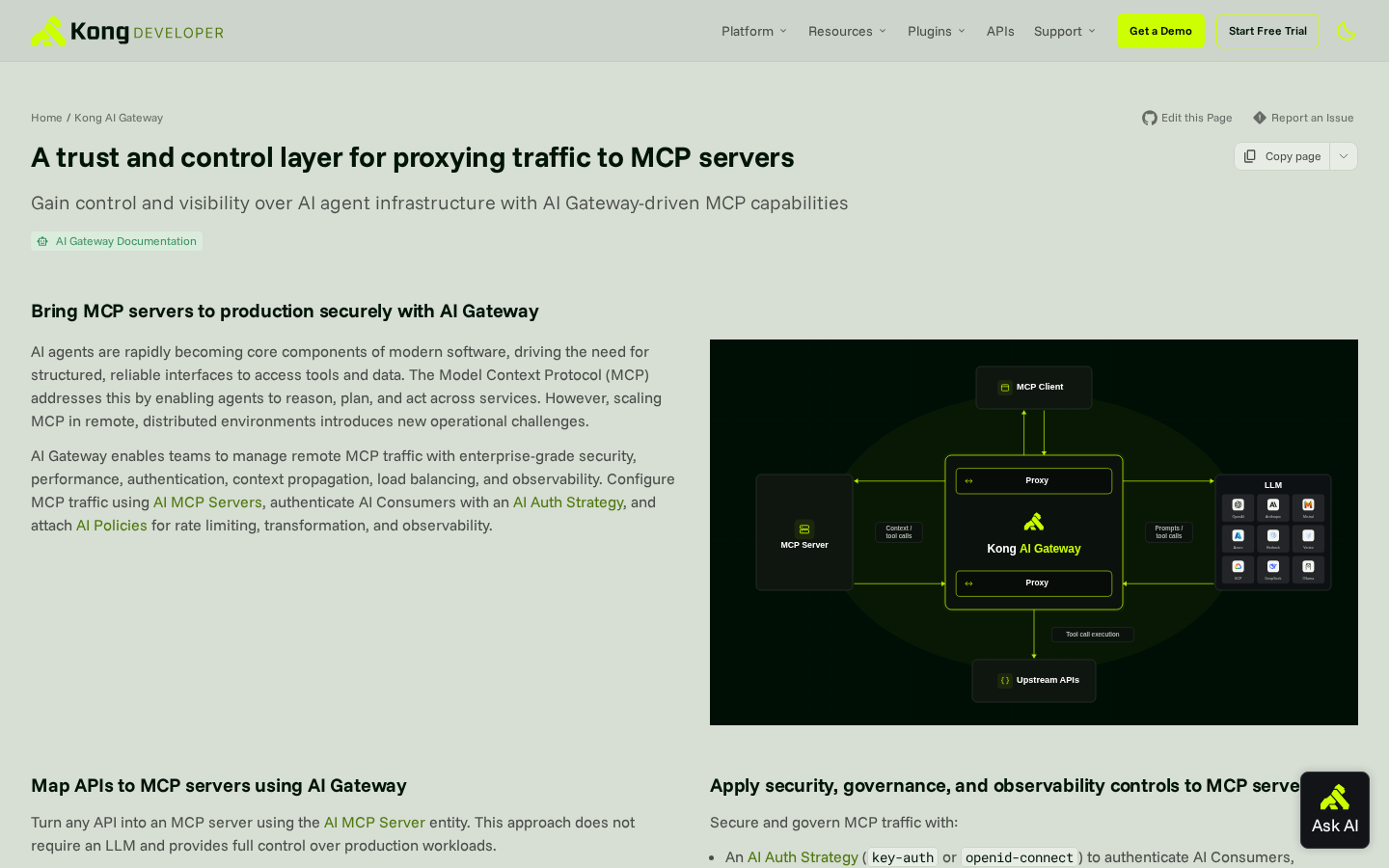
Kong AI Gateway extends Kong's API gateway to MCP traffic, so teams that already run Kong can proxy, secure, and observe MCP servers with the same plugins and policies.
The AI MCP Server entity maps REST API endpoints to MCP tools without custom code and can aggregate several MCP servers into one endpoint. Consumers authenticate with key-auth or OpenID Connect, optionally with protected resource metadata for MCP-spec OAuth 2.0. ACLs control tool usage, the Rate Limiting policy governs volume, and logs capture session IDs, JSON-RPC methods, payloads, latencies, and errors, with OpenTelemetry export. An MCP Registry in Konnect Catalog is in tech preview.
Deployment: Kong Konnect or self-managed Kong Gateway. Best for: platform teams already standardized on Kong for API traffic. What to test: Verify identity propagation when exposing REST APIs as MCP tools. Examine how policy changes affect discovery and execution, and whether configuration integrates with existing deployment pipelines.
8. Cloudflare MCP server portals
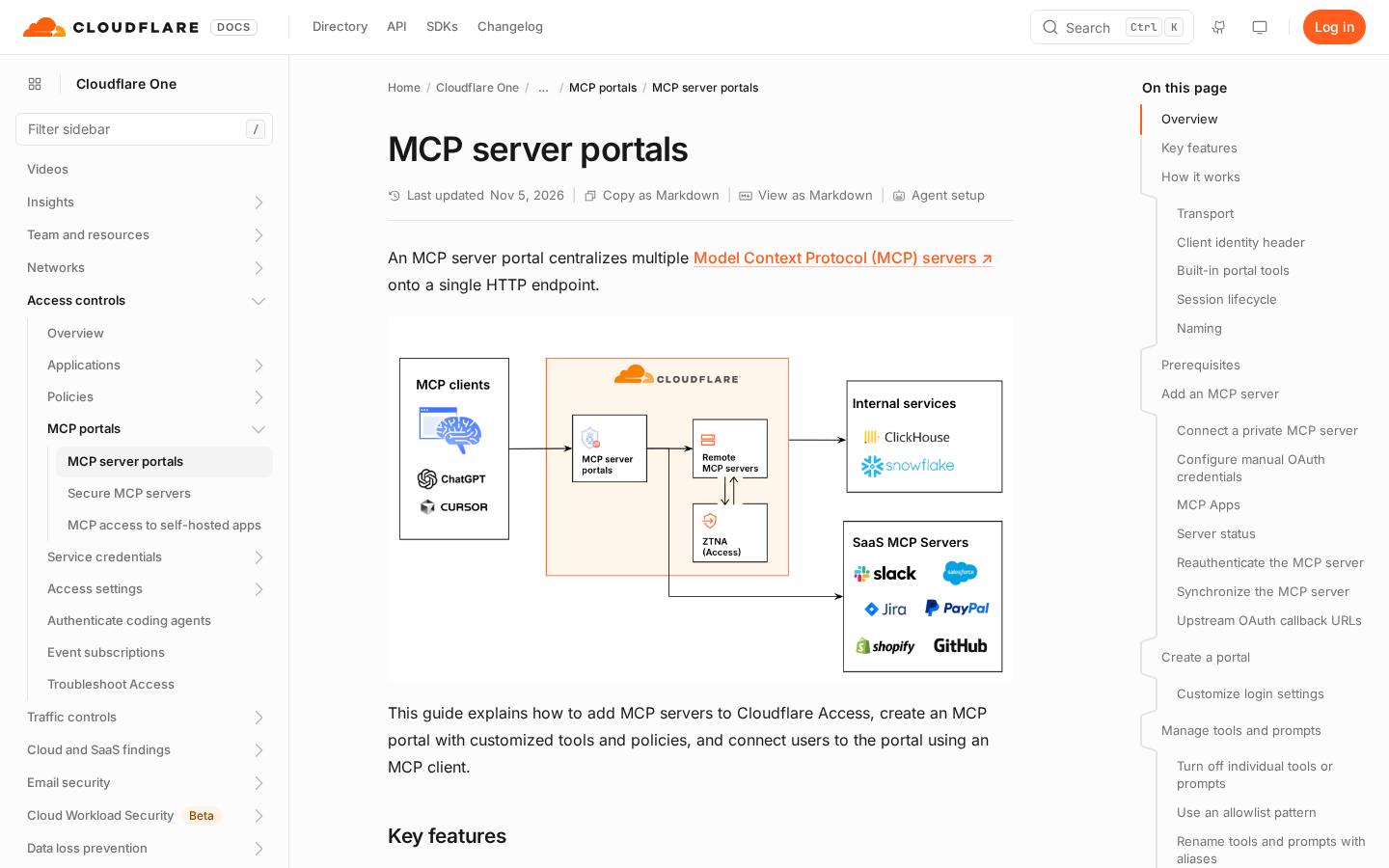
Cloudflare MCP server portals put several MCP servers behind one HTTP endpoint protected by Cloudflare Access, part of the Cloudflare One Zero Trust platform.
Admins choose which tools and prompt templates each portal exposes and can rename tools or edit their descriptions without touching the upstream server. Users sign in through Access with their IdP and authorize separately to each OAuth-protected server, while machine clients can use Access service tokens. Access logs each tool request, and routing portal traffic through Cloudflare Gateway adds HTTP logging and DLP scanning. An optional Code Mode collapses all upstream tools into search and execute tools that run in an isolated Worker.
Deployment: managed on Cloudflare's network. Best for: companies already using Cloudflare Zero Trust for employee access. What to test: Compare access for approved, rejected, and partially authorized users. Verify whether policies enforce the required tool-level restrictions and generate useful audit records. Cloudflare AI Gateway handles model-related traffic as a separate service.
9. Amazon Bedrock AgentCore Gateway
Amazon Bedrock AgentCore Gateway is a fully managed AWS service that turns APIs, Lambda functions, and existing services into MCP-compatible tools behind one endpoint.
Tool targets can be OpenAPI, Smithy, or Lambda, and AWS lists one-click integrations for Salesforce, Slack, Jira, Asana, and Zendesk. It handles inbound auth (verifying the agent) and outbound auth (OAuth flows, token refresh, and credential storage for third-party tools) in one service. Semantic tool search helps agents pick from large tool sets. The gateway also fronts other agents, including A2A traffic, and routes inference requests across model providers.
Deployment: managed and serverless on AWS. Check service quotas and regional availability. Best for: teams building agents on AWS. What to test: Execute tools through a Lambda function with narrowly scoped permissions. Verify IAM interactions, authentication context, application logs, and behavior when permissions are insufficient. Check service limits and regional availability for the intended environment.
10. Traefik Hub MCP Gateway
Traefik Hub MCP Gateway extends Traefik Hub API Gateway so API, AI, and MCP traffic run through one binary, with Task-Based Access Control (TBAC) on every request.
TBAC policies combine JWT claims with MCP request attributes to authorize by task, tool, and transaction, down to tool arguments, such as capping an approve_expense call at an agent's approval limit. The gateway filters tools/list, prompts/list, and resources/list so agents only see permitted tools, denies unmatched requests by default, validates JWTs as an OAuth 2.1 resource server, and supports On-Behalf-Of forwarding and token exchange. Policies are YAML files managed through GitOps, and OpenTelemetry traces leave tool arguments out unless you opt in.
Deployment: self-hosted on Kubernetes, Docker Swarm, Nomad, or VMs, including air-gapped environments. Best for: Kubernetes teams that need argument-level policy in self-hosted or air-gapped setups. What to test: Verify that task permissions correspond to allowed tool operations. Inspect identity propagation through delegated actions and confirm that middleware decisions are recorded in audit trails.
11. Obot
Obot is an open-source (MIT) MCP gateway and AI control plane that you can self-host with Docker or Kubernetes or run as Obot Cloud.
It hosts MCP servers from its catalog or your own, gives teams one gateway URL per server, and puts SSO and OIDC in front of every connection, with RBAC over which users can discover and call which servers and skills. Every MCP call is logged with exportable request and response trails, and Obot Sentry scans devices for shadow MCP servers and AI clients.
Deployment: self-hosted Community edition (free, up to 100 users and 100 Sentry devices), self-hosted Enterprise, or Obot Cloud with a 7-day trial. Best for: teams that want an open-source gateway with a catalog UI and the option to self-host. What to test: Examine namespace isolation, service account permissions, ingress configuration, and scaling behavior. Verify whether configuration survives rolling updates and how access policies apply across independently deployed MCP servers.
12. Bifrost (Maxim AI)
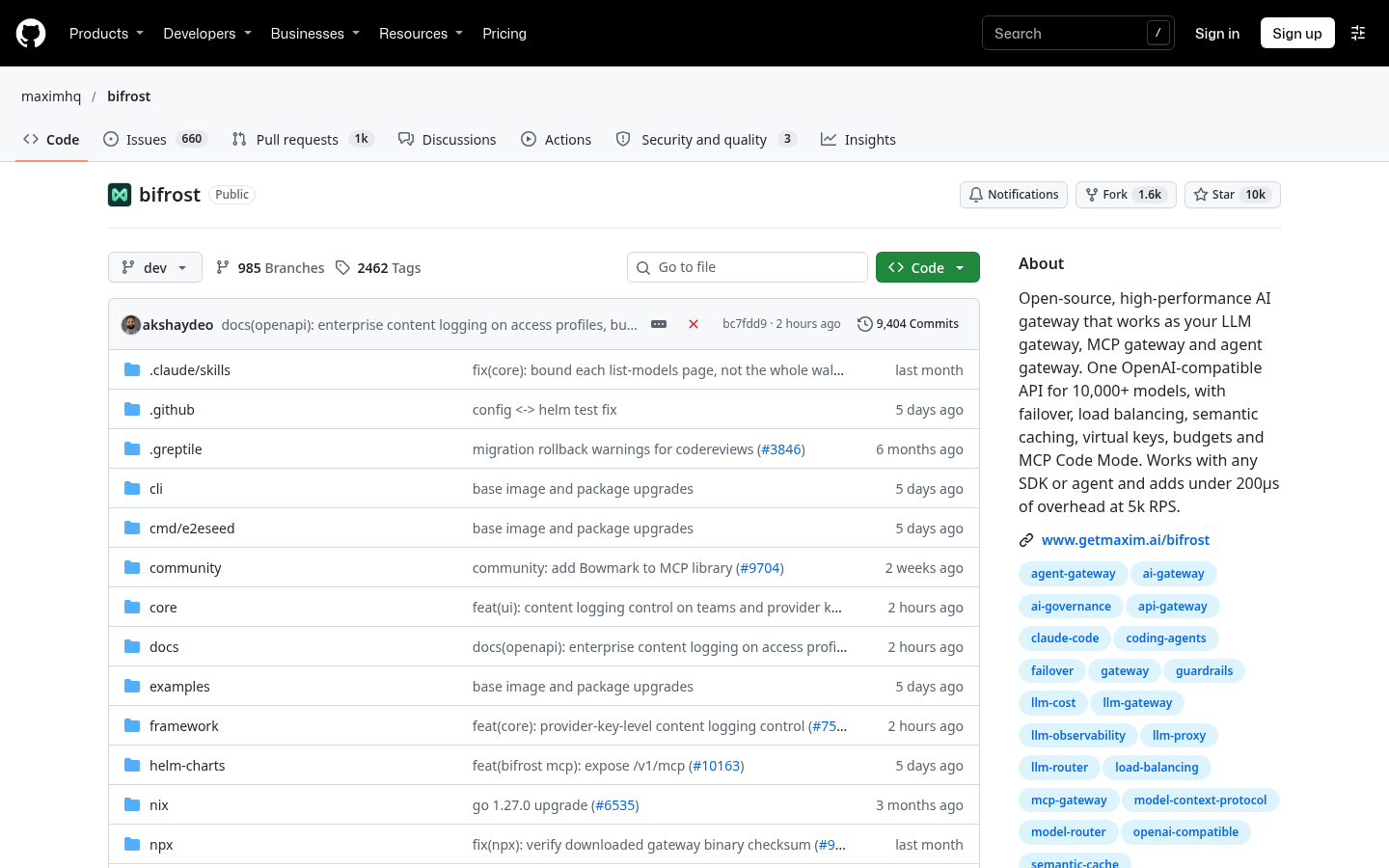
Bifrost is an open-source (Apache 2.0) AI gateway from Maxim AI, written in Go, that works as an LLM gateway, MCP gateway, and agent gateway.
It offers one OpenAI-compatible API across model providers with failover, load balancing, semantic caching, virtual keys, and budgets, plus an MCP Code Mode. The enterprise edition adds Virtual MCPs with access-profile grants, reusable access profiles that set MCP policy per user, team, or business unit, and LLM-as-judge guardrails on MCP inputs and outputs. Maxim states that Bifrost adds under 200 microseconds of overhead at 5,000 requests per second. Treat that as a vendor benchmark and measure on your own workload.
Deployment: self-hosted (Docker or Helm), with a paid enterprise edition. Best for: teams that want self-hosted model routing and MCP governance in one service. What to test: Run concurrent tool invocations with varying payload sizes and slow upstream responses. Measure CPU consumption, memory, error rates, and latency distributions. Separate gateway overhead from downstream execution time when interpreting performance results.
13. IBM ContextForge
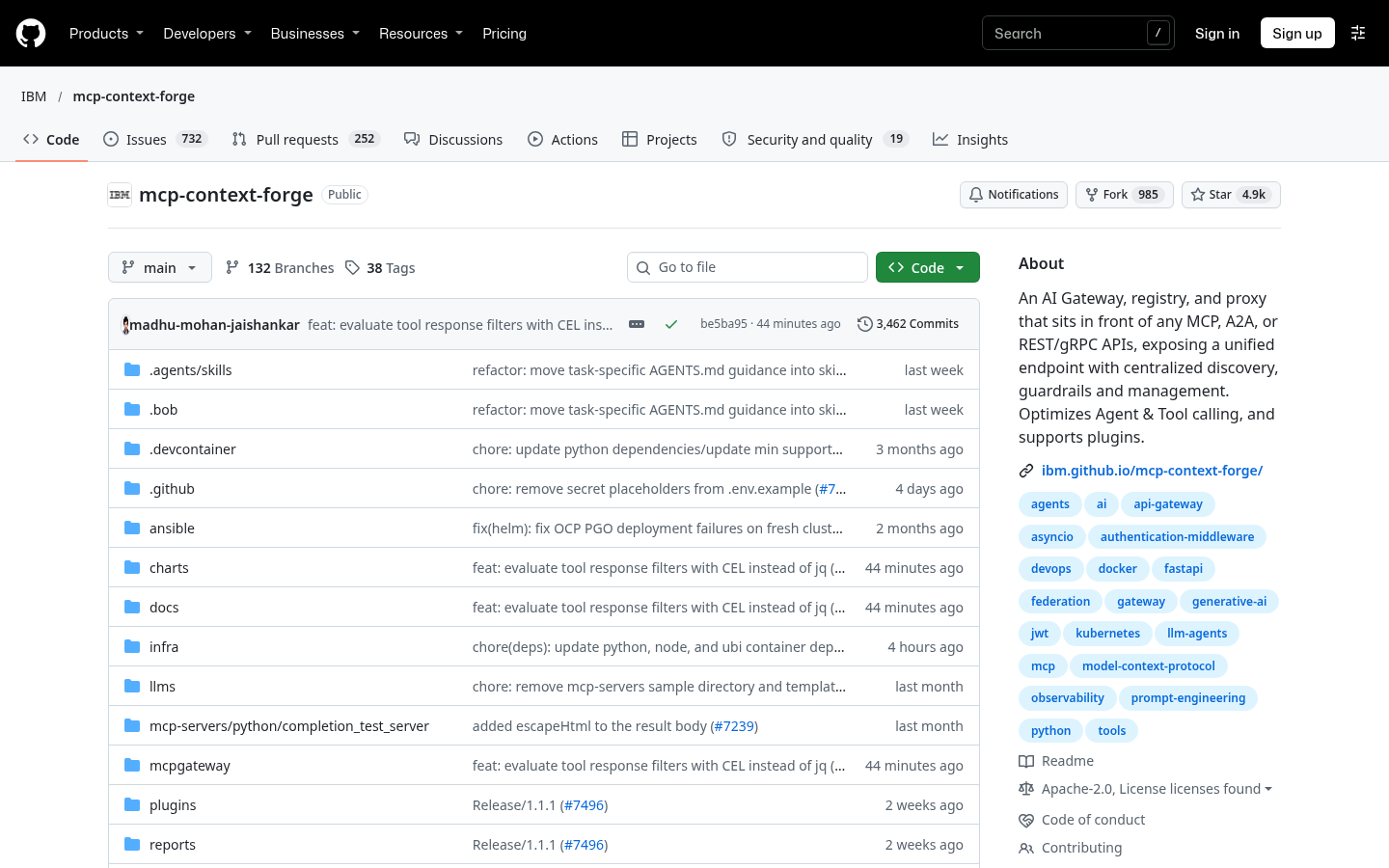
IBM ContextForge is an open-source (Apache 2.0) registry and proxy that federates MCP servers, A2A agents, and REST or gRPC APIs into one endpoint.
It translates REST and gRPC services into MCP tools, using reflection-based discovery for gRPC, and supports Streamable HTTP, SSE, WebSocket, and stdio transports. It ships an admin UI with air-gapped support, built-in auth, retries, and rate limiting with user-scoped OAuth tokens, more than 40 plugins, and OpenTelemetry tracing for Phoenix, Jaeger, Zipkin, and other OTLP backends. It scales across Kubernetes clusters with Redis-backed federation.
Deployment: self-hosted through PyPI or Docker, up to multi-cluster Kubernetes. Best for: teams that need to federate many MCP and legacy API services across environments. What to test: Deploy gateway instances across separate environments. Examine registry synchronization, duplicate tool names, unavailable regions, and incompatible service definitions. Verify authorization for tools exposed through protocol bridges.
14. Docker MCP Gateway
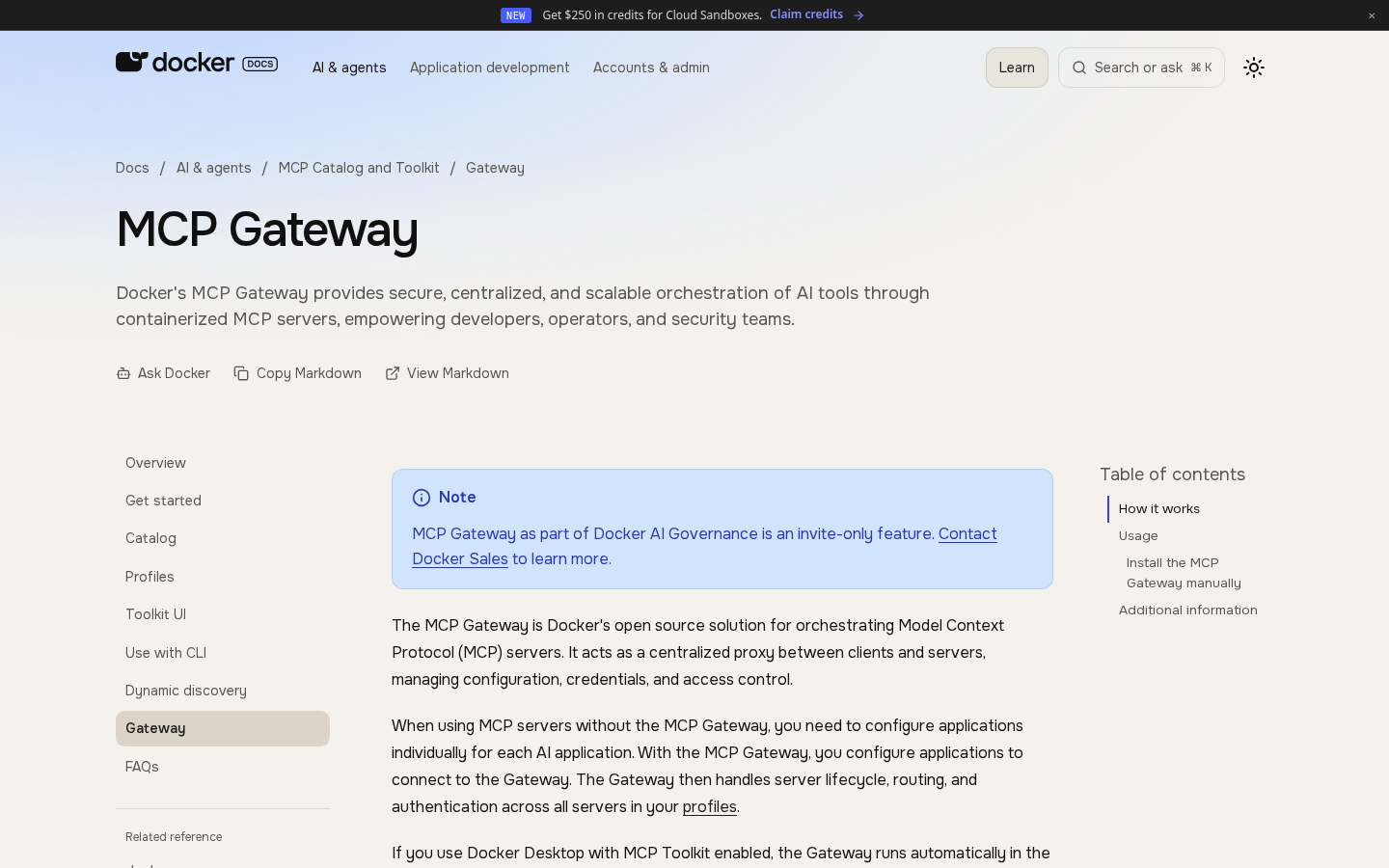
Docker MCP Gateway is Docker's open-source (MIT) gateway that runs each MCP server in its own isolated container and gives clients a single endpoint.
It starts servers on demand, injects credentials, restricts each container's privileges, network access, and resources, and logs and traces tool calls. It runs automatically with Docker Desktop's MCP Toolkit, uses profiles to choose which servers a client sees, and installs as the docker mcp CLI plugin on Docker Engine. A governed version under Docker AI Governance is invite-only.
Deployment: local or self-hosted with Docker. Best for: developers and small teams that want container isolation for MCP servers. What to test: Run a server that needs a secret, confirm the secret never appears in client config, and check which network destinations the container can reach.
15. Microsoft MCP Gateway
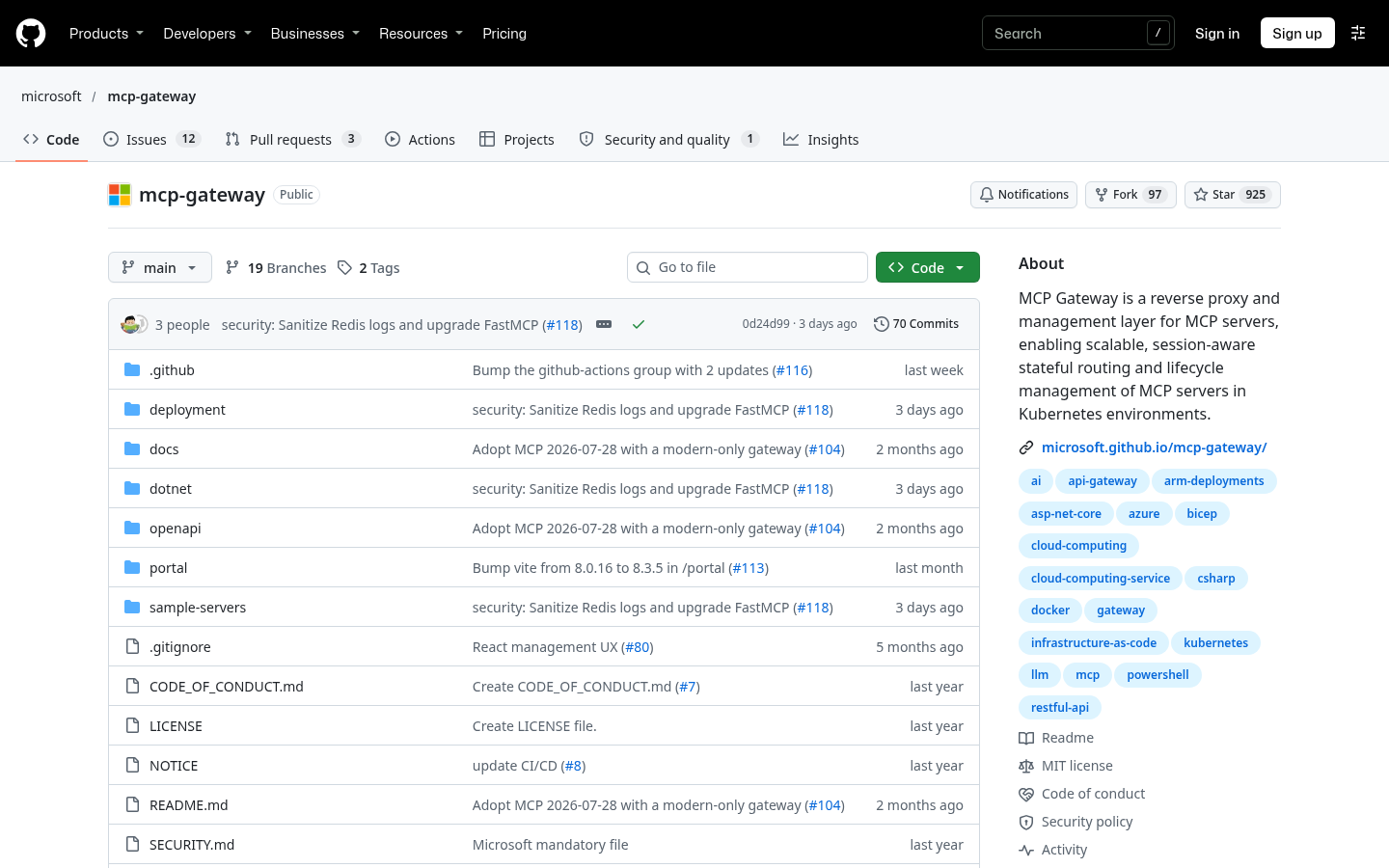
Microsoft MCP Gateway is an open-source (MIT) reverse proxy and management layer for running MCP servers on Kubernetes.
A data gateway routes each MCP request to a ready server instance, and a control plane deploys, updates, and deletes MCP servers. A tool gateway router sends tool calls to registered tool servers, and the project includes integration points for telemetry and access control plus a one-click deploy to Azure. The current version requires MCP 2026-07-28 clients and drops legacy session-based routing.
Deployment: self-hosted on Kubernetes, with an Azure deployment template. Best for: platform teams on Kubernetes or Azure that host and scale many MCP servers. What to test: Deploy two adapters, scale one under load, and confirm requests keep routing correctly during a rolling update.
A practical MCP gateway evaluation method
A controlled test helps determine whether a gateway meets organizational requirements. Use the same workflow across shortlisted platforms.
Step 1: Define a representative workflow
Select an agent that reads GitHub issues, retrieves documentation, and creates Jira tickets. Document required tools, identities, credentials, and permissions. Include at least one prohibited operation.
Step 2: Configure least-privilege access
Create a test principal and expose only approved tools. Separate human and autonomous-agent identities where supported. Configure downstream permissions independently.
Verify that unauthorized tools are hidden during discovery and rejected during execution.
Step 3: Test authentication failures
Run requests using valid, expired, and revoked credentials. Verify authorization errors and audit records. Test downstream token expiration separately from client authentication.
Step 4: Introduce security test cases
Use synthetic data to test prompt injection, unexpected tool arguments, unauthorized resources, sensitive responses, and newly discovered tools. Record whether each request is allowed, blocked, flagged, or requires approval.
Step 5: Measure operational behavior
Repeat the workflow under controlled concurrency. Measure gateway overhead, downstream execution time, end-to-end latency, throughput, and error rates.
Include upstream timeouts and rate limiting. Treat results as specific to the tested workload.
Step 6: Review audit and recovery controls
Confirm that audit records identify principals, tools, timestamps, outcomes, and policy decisions. Revoke an identity, disable a tool, and simulate upstream failure. Verify the expected denial or recovery behavior.
What a production decision should establish
An MCP gateway evaluation should establish who can access tools, which operations they can execute, how credentials are protected, and how activity can be investigated.
Retain test configurations, results, policy definitions, and recovery procedures. These records support future upgrades and help teams assess changes as additional MCP servers and autonomous agents enter production.
A gateway also shapes the developer experience for humans and AI agents: a small, well-described tool set is easier for people to approve and for agents to use correctly.
FAQ
An MCP gateway is a proxy between MCP clients, such as Claude, ChatGPT, Cursor, or a custom agent, and the MCP servers they call. It centralizes authentication, tool-level authorization, credential injection, and audit logging, so each agent does not need its own credentials and configuration for every server.
An API gateway routes and secures HTTP API calls from applications. An MCP gateway understands MCP's JSON-RPC messages, so it can filter the tool list each agent sees, authorize individual tool calls, and log tool arguments and results. Some API gateways, including Kong and Traefik Hub, now add MCP support on top of their API features.
Yes. Obot (MIT), Bifrost (Apache 2.0), IBM ContextForge (Apache 2.0), Docker MCP Gateway (MIT), and Microsoft MCP Gateway (MIT) are open source. Check each project's license, release activity, and enterprise features before production use.
Gateways can authenticate human users through enterprise identity providers and autonomous agents through machine-to-machine credentials. OAuth client credentials and workload identities are common options. Verify token expiration, identity propagation, and independent revocation before deployment. For a practitioner view on auth and agent readiness, listen to Hackmamba's podcast episode on [getting AI agents into production](https://hackmamba.io/eoc-podcast/how-to-get-ai-agents-into-production-auth-mcps-and-agent-readiness/).
Gateways observe traffic routed through their endpoints. Visibility into off-gateway activity may require endpoint instrumentation, agent hooks, or device management integrations. Coverage depends on the supported clients and monitoring configuration.
About author
Web Developer & Technical Writer