How to host a successful hackathon for your developer product
Learn how to host a hackathon that drives developer adoption, with nine practical steps covering event planning, starter kits, judging, and 90-day follow-up.

To host a hackathon that drives adoption of your developer product, you need to get developers past the initial setup, help them build working projects, and give them a reason to continue using the product after the event.
That means choosing a measurable goal, preparing documentation and starter projects before registration opens, setting challenges that require meaningful product usage, and tracking what participants do in the 90 days that follow.
We've applied this approach at Hackmamba while running university workshops and hackathons for Actian's VectorAI DB launch, where developers built projects using the database.
In this guide, we'll walk through the nine steps we follow to plan and run a hackathons for developer products. For a company-run online event, allow roughly eight weeks of preparation and 90 days of follow-up. We've also included a weighted judging rubric, sample timeline, and checklist you can use.
The process is divided into three phases: before, during, and after the hackathon.
- Pick one goal and the metric that proves it.
- Choose the format.
- Write tracks and problem statements.
- Build the starter kit before you announce.
- Set prizes, and decide whether to host or sponsor.
- Run the event so builders don't get stuck.
- Judge with a published rubric.
- Follow up for 90 days.
- Measure and report.
TL;DR
- Pick one adoption goal, such as activation or product feedback, and the metric that proves it.
- Ship a starter kit with a quickstart, credits, and one support channel before you announce.
- Publish a weighted judging rubric that scores how projects use your product.
- Follow up on days 1, 7, 30, and 90, and report the builders still active at day 90.
- Plan about eight weeks ahead for a company-run online hackathon.
Before the event
Five of the nine steps happen before anyone registers. This is where you decide what success looks like and remove the friction that would otherwise eat the first day.
1. Pick one goal and the metric that proves it
Choose one goal: activation, product use, retention, or product feedback. Then name the single number that proves it, so every later decision about format, tracks, and prizes can be tested against it.
| Goal | Metric that proves it | When to measure |
|---|---|---|
| Activation | Developers who reach a first successful API call or deploy | During the event |
| Product use | Submissions that use the product's core feature | At submission |
| Retention | Builders still active with the product | Day 30 and day 90 |
| Product feedback | Docs and SDK issues filed by participants | During and after |
Different teams inside a company want different outcomes from the same event. Major League Hacking's organizer guide notes that sponsors back hackathons to get product feedback, recruit, or raise awareness and it points organizers seeking product feedback to developer advocates. Pick the goal that matches the budget owner.
What Auth0 did: Auth0 ran its Authorized to Act hackathon from March 2 to April 6, 2026, requiring every submission to use Token Vault to qualify for prizes.
Judges first checked whether projects used the required SDK. They also scored submissions on "Insight Value," rewarding developers who identified gaps in the product.
One submission, AuthorizedOps, used Token Vault to manage an AI agent's access to GitHub, Google Calendar, and Slack. The developer demonstrated how the agent could securely connect to these services and perform actions on behalf of users.
The lesson: Require developers to use a specific product feature and include feedback in the judging criteria. This gives you working integrations to evaluate and identifies improvements your product team can act on.
2. Choose the format
Pick the format that fits your goal and your support capacity: a weekend sprint, a one-to-two-week build week, a multi-week online challenge, or a multi-city event. Shorter formats favor fast activation, and longer ones give builders time to use more than one feature and ship something deployed.
Repetition matters as much as the format. Devpost's 2026 platform data shows developers who join six or more hackathons ship AI projects to production at 2.2x the rate of first-timers, which makes the case for a recurring program over a one-off.
For in-person events, plan for empty seats. Our Everything Outside Code episode with Victoria Melnikova of Evil Martians covers attendance attrition of 20 to 30% at tech startup events in San Francisco. Plan for a gap of that size when you set registration targets.
What Anthropic did: For Built with Opus 4.6, held February 10 to 17, 2026, Anthropic partnered with Cerebral Valley to run a fully virtual, application-only event. It selected 500 participants and gave each $500 in Claude API credits to build for a week with Claude Code, with judges from the Claude team.
In Anthropic's write-up of the winners, four of the five were not professional developers.
The lesson: A small, selected cohort with credits in hand produces focused work when quality matters more than reach.
What Mistral AI did: The Mistral AI Worldwide Hackathon ran for 48 hours over February 28 and March 1, 2026, in Paris, London, New York, San Francisco, Tokyo, Singapore, and Sydney, plus online.
A Tokyo winner's write-up reports 7,000+ applicants worldwide and 1,753 developers submitting 564 projects, with city winners advancing to a global final streamed live.
The lesson: Local editions with venue and sponsor partners let you reach new regions without having to staff every city yourself. Once the format is fixed, the tracks tell builders what to make with that time.
3. Write tracks and problem statements
Keep the number of tracks small, and write each problem statement in one or two plain sentences. Major League Hacking recommends aiming for three tracks when you have no sponsor tracks, and warns that judging gets messy as categories multiply.
Each track should point builders to one part of the product you want adopted. A vague theme leaves teams to guess what you hope to see, and the guessing costs them the first hours of the event.
What Vercel did: For Zero to Agent, a 10-day global build week from April 24 to May 3, 2026, Vercel offered three tracks, each mapped to one product: Vercel Workflow, v0 with MCP servers, and ChatSDK.
The lesson: Each track should push a product you want developers to adopt. Tracks point builders at the product, and the starter kit is what gets them building on it in the first hour.
4. Build the starter kit before you announce
Have a working quickstart, starter projects, sandbox credits, office hours, and a dedicated support channel ready before registration opens. Test the setup instructions yourself so developers can spend their first few hours building.
Cost is another consideration. According to Devpost's 2026 data, 43% of developers cited API costs as a barrier when building with AI. Providing credits can help participants experiment without worrying about unexpected charges.
What we did for Actian: At Hackmamba, we helped organize the Actian VectorAI DB Build Challenge, a virtual hackathon held from April 13 to 18, 2026.
We prepared a straightforward setup process. Developers could start VectorAI DB using docker compose up and install its Python client with pip install actian-vectorai. The database supported macOS, including Apple Silicon, Linux, and Windows.
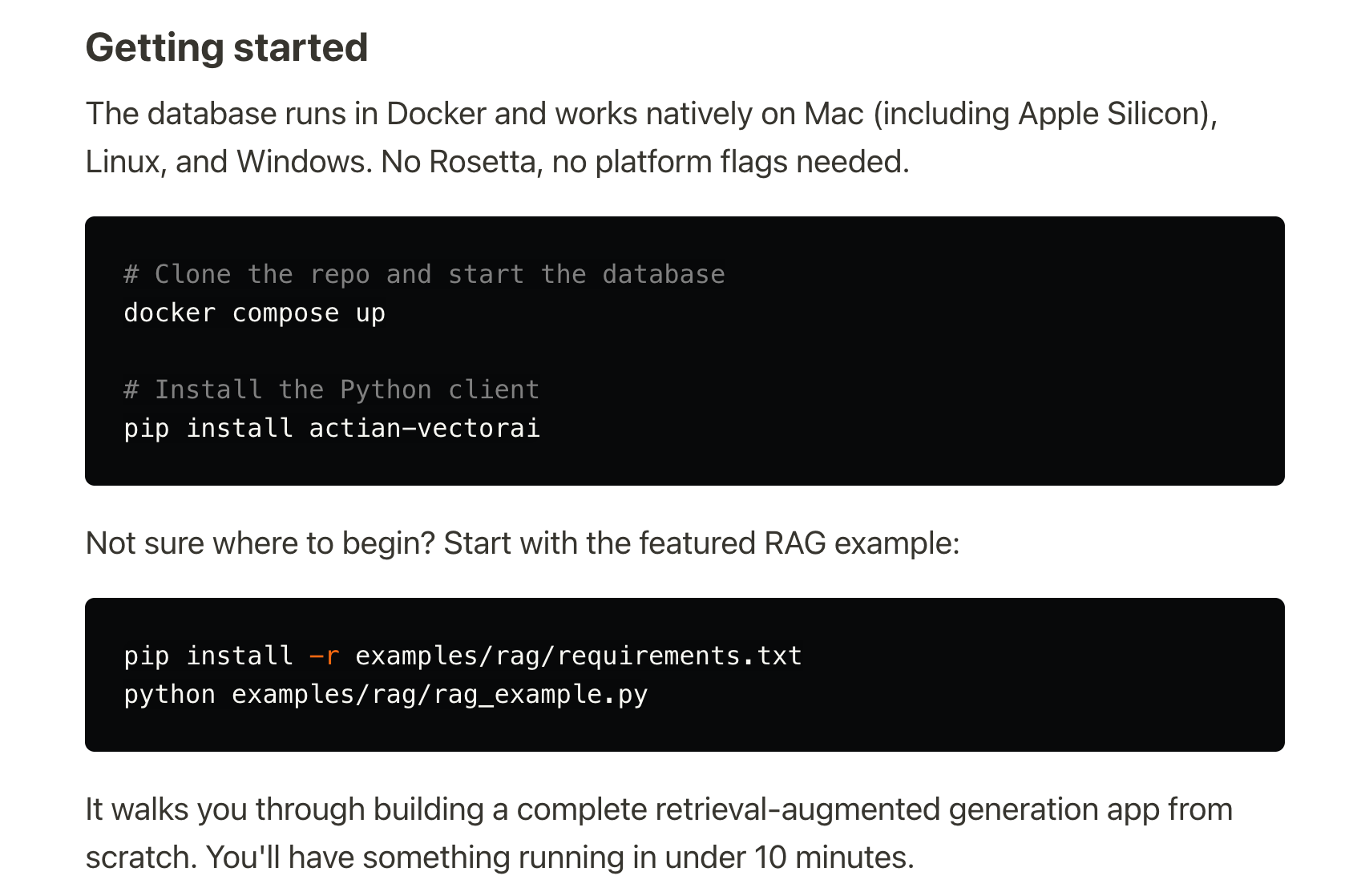
We also provided a RAG example that developers could run in under 10 minutes, along with a recommended embedding model. A dedicated Discord server handled technical questions, team formation, and progress updates.
Before the event, we published the challenge requirements, prizes, and registration details. Participants had to build an application using VectorAI DB and demonstrate at least one advanced feature, such as hybrid fusion, filtered search, or named vectors.
The hackathon also helped us identify where developers struggled with onboarding, documentation, and SDKs. We collected that feedback and shared it with Actian's product team to inform improvements. You can read more about this work in our Actian case study.
The lesson: Make the first working integration as easy as possible. Give developers tested setup instructions, a working example, and access to technical support. Use the questions they ask during the hackathon to identify and fix gaps in your documentation, SDKs, and onboarding.
What Mistral AI did: Three days before its worldwide hackathon, Mistral held an online briefing with partners to introduce the tools participants would use during the event.
The lesson: Give developers everything they need to complete their first working project before the hackathon begins. Test the instructions, provide a working example, and make technical support easy to access. Track where participants get stuck so your product team can address those issues after the event.
5. Set prizes, and decide whether to host or sponsor
Tie your main prizes to how projects use the product, then add smaller prizes for feedback and content. Prizes paid in product credits give winners a reason to keep building on your platform after the event ends.
Vercel's first prize was $3,000 in v0 credits, $200 a month in Vercel Platform credits, and Vercel Pro for six months. Auth0 paid cash for feedback prizes for actionable comments it could use to improve its SDKs or documentation, alongside prizes for blog posts about the build.
You also need to decide whether to host your own event or sponsor someone else's. Hosting gives you control of the format and the follow-up. Sponsoring a track at an established hackathon puts your product in front of developers who are already in the room.
What ElevenLabs did: ElevenLabs runs a sponsor program for community hackathons, giving participants access to its tools and prizes for winners.
It sponsors in-person events only, because online events make it hard to confirm credits go to the people who attend, and for most events it supplies a short Hacker Guide on getting started with its API. Organizers report back with photos and a link to the best project built with ElevenLabs.
The lesson: A clear sponsor program reaches developers at many events without hosting each one, and the report-back requirement keeps it measurable.
During the event
The live part of a hackathon covers building and judging. It works when builders get unstuck fast and trust how their work will be scored.
6. Run the event so builders don't get stuck
Put mentors on a rotation, check in with every team at set times, and run all communication through one channel. A team that stays stuck for an hour often gives up, and that team will not appear in your activation numbers.
Builders at our virtual hackathons joined from many time zones, so we ran mentors in rotating shifts and kept live support available around the clock. For the VectorAI DB Build Challenge, all of it ran through one Discord server, which also handled team formation and progress sharing.
What Reddit did: For its Mod Tools and Migrated Apps hackathon, held April 29 to May 27, 2026, Reddit offered live support and office hours on Discord and r/Devvit. It also paid community members to help one another, with six $500 Devvit Helper Awards for participants nominated by other builders.
The lesson: Reward the people who unblock others, and your support capacity grows with your participant count.
When building time ends, the event concludes with judging.
7. Judge with a published rubric
Publish the judging criteria before the event starts, and weight them toward your goal. Builders optimize for what you score, so a rubric that rewards product use produces projects that use the product.
For the VectorAI DB Build Challenge, we weighted use of VectorAI DB at 30%, real-world impact and technical execution at 25% each, and demo and presentation at 20%. The rubric below is the general version we start from for an adoption-focused hackathon. These weights are our recommendation; adjust them to your goal.
| Criterion | Weight | What judges look for |
|---|---|---|
| Product use and integration | 30 | Uses the product's core feature in a way that matters |
| Technical execution | 25 | Works, handles edge cases, sound architecture |
| Working demo | 20 | Live, deployed, demo runs end to end |
| Originality | 15 | New use case or approach |
| Completeness and docs | 10 | README, setup steps, clear write-up |
For in-person judging, Major League Hacking recommends science-fair style judging and stack ranking, where each judge reports their top three and points replace raw scores, because stack ranking normalizes scores across strict and generous judges. Start recruiting judges in the last two months before the event, and keep two or three extras on a buffer list.
What Reddit did: Reddit added a Moderator's Choice category, where a panel of moderator judges picked one winner from a shortlist of high-scoring projects.
Vercel took a similar approach, with the community and Vercel judges voting together on global winners. Every submission also needed a link to the deployed project, which kept judging tied to working products.
The lesson: Put the people your product serves on the judging panel. Reddit used moderators because moderators are the people who install and use mod tools.
After the event
Builders decide whether to keep using your product in the weeks after the event. These last two steps turn a weekend of activity into an adoption you can measure.
8. Follow up for 90 days
Plan the follow-up before the event, and run it on a fixed schedule. On day 1, publish the winners. On day 7, feature strong projects in your docs, blog, or newsletter. On day 30, hold office hours and extend credits. On day 90, check who is still building.
Send every bug report and doc gap to the product team as they arrive. For Actian, this loop turned university programs and hackathons into a continuous source of developer feedback for product and onboarding improvements.
Give builders a reason to keep going. Reddit told participants that successful apps could become eligible for its Developer Funds program, which rewards apps for reaching engagement milestones. For more ways to keep builders engaged, see our guide to growing a developer community.
What Auth0 did: The hackathon's winner announcement invited teams who wanted more time with enterprise features to send their project and Auth0 tenant details.
Ninety days of follow-up give you the numbers for the final step.
9. Measure and report
Go back to the metric you chose in step 1 and report the numbers behind it: activations during the event, submissions that used the product, builders still active at day 30 and day 90, and product fixes shipped based on participant feedback.
Report outcomes beyond registrations. Our Everything Outside Code episode with Scott McAllister, co-author of Developer Relations Activity Patterns, covers proving the bottom-line value of developer education to skeptical stakeholders without falling back on vanity metrics.
A simple report pairs each metric with where its number comes from:
| Metric | Where the number comes from |
|---|---|
| Activations during the event | First successful API calls or deploys from participant accounts in your product analytics |
| Submissions that used the product | Your review of each submission against the required feature |
| Builders active at day 30 and day 90 | Usage logs for the accounts that registered |
| Fixes shipped from feedback | Issues tagged with the event name in your tracker |
The timeline below puts all nine steps on a calendar, from goal-setting eight weeks out to the day-90 report.
A sample hackathon timeline
This is the timeline we use for a company-run online hackathon. Large in-person events need a much longer runway for venues, travel, and sponsors.
| When | What to do |
|---|---|
| 8 weeks out | Set the goal, metric, format, and budget |
| 6 weeks out | Write tracks and prizes, recruit judges, build the starter kit |
| 4 weeks out | Announce and open registration |
| 1 week out | Run a dry run and open office hours |
| Event | Run check-ins, mentor rotations, and judging |
| 1 day after | Publish winners |
| 7 days after | Feature strong projects |
| 30 days after | Hold office hours and extend credits |
| 90 days after | Check active builders and report |
Once the dates are set, use the checklist below to track each step as you go.
Hackathon checklist
Use this checklist before launching your hackathon:
- Define one adoption goal and a metric to measure it.
- Choose the event format and estimate registration and attendance.
- Create no more than three tracks, each tied to a product use case.
- Test the quickstart, starter templates, and sandbox credits.
- Schedule mentor office hours and set up a dedicated support channel.
- Set prizes that reward meaningful product usage.
- Publish the judging rubric and scoring weights.
- Recruit judges and identify two or three backups.
- Plan mentor rotations and team check-ins.
- Schedule follow-ups for days 1, 7, 30, and 90.
- Prepare a report that measures results against your original adoption goal.
A hackathon's success depends on what developers build during the event and whether they continue using your product afterward. Track completed integrations, working projects, and product activity over the following 90 days to understand the impact.
If you're looking for a DevRel agency to plan and run hackathons for your developer product, Hackmamba can help. We've organized developer workshops and hackathons for developer products like Actian's VectorAI DB, covering everything from event planning and developer onboarding to execution and post-event reporting. Book a call now.
FAQ
We plan about eight weeks for a company-run online hackathon, from setting the goal to opening registration. Large in-person events need a longer runway because venues, travel, and sponsors take time to arrange.
Good criteria cover product use, technical execution, a working demo, originality, and completeness, weighted toward your goal. Publish them before the event so builders know what you will score.
Pitch each sponsor on its own goal. Developer relations teams want product feedback, recruiters want hires, and marketing teams want awareness, so match your pitch to who controls the budget.
Sponsor tracks at established events to reach developers who are already building. Host your own when you need deep product use and control of the follow-up.
Count activations during the event, submissions that use your product, and builders still active 30 and 90 days later. Add the product fixes that came from participant feedback, since they are often the longest-lasting results.
About author
Asjad Khan is a Developer Advocate and Technical Writer passionate about building communities and making complex technologies simple and accessible. With experience in creating technical documentation, tutorials, and hands-on demos, he bridges the gap between engineering teams and developers by delivering clear, developer-first content. He has contributed to open-source projects, hosted workshops and hackathons, and actively engages with communities to drive adoption and learning. When not creating content or coding, Asjad can usually be found watching football and exploring new ideas in tech